A marble bathtub is a major structural fixture whose weight can reach several hundred kilograms depending on external dimensions, wall thickness and whether it is carved from a single block or assembled from fabricated stone sections. Custom length, width, depth and rim geometry are possible, but floor loading should be checked before installation. Natural stone performs well for soaking when properly fabricated and maintained; use neutral cleaners, rinse residues and avoid acidic bathroom chemicals.
Carved Stone Bathing
Marble Bathtub Small
Secure product inquiry
Buy now
Cash on delivery available. Product details are pre-filled below. Owner delivery adds AED 5,000.
Structural Planning & Custom Dimensions
Plan the Stone Bath Before Installation Begins
A 400 kg stone bath requires installation planning before delivery, including floor loading, access route, lifting method and final drain position. Custom fabrication can change length, depth, rim geometry and interior ergonomics, but these choices should be finalized before carving because later site modification is far less practical than with lightweight tubs.
Surface & Construction
Roman Travertine Bathtub Material and Finish
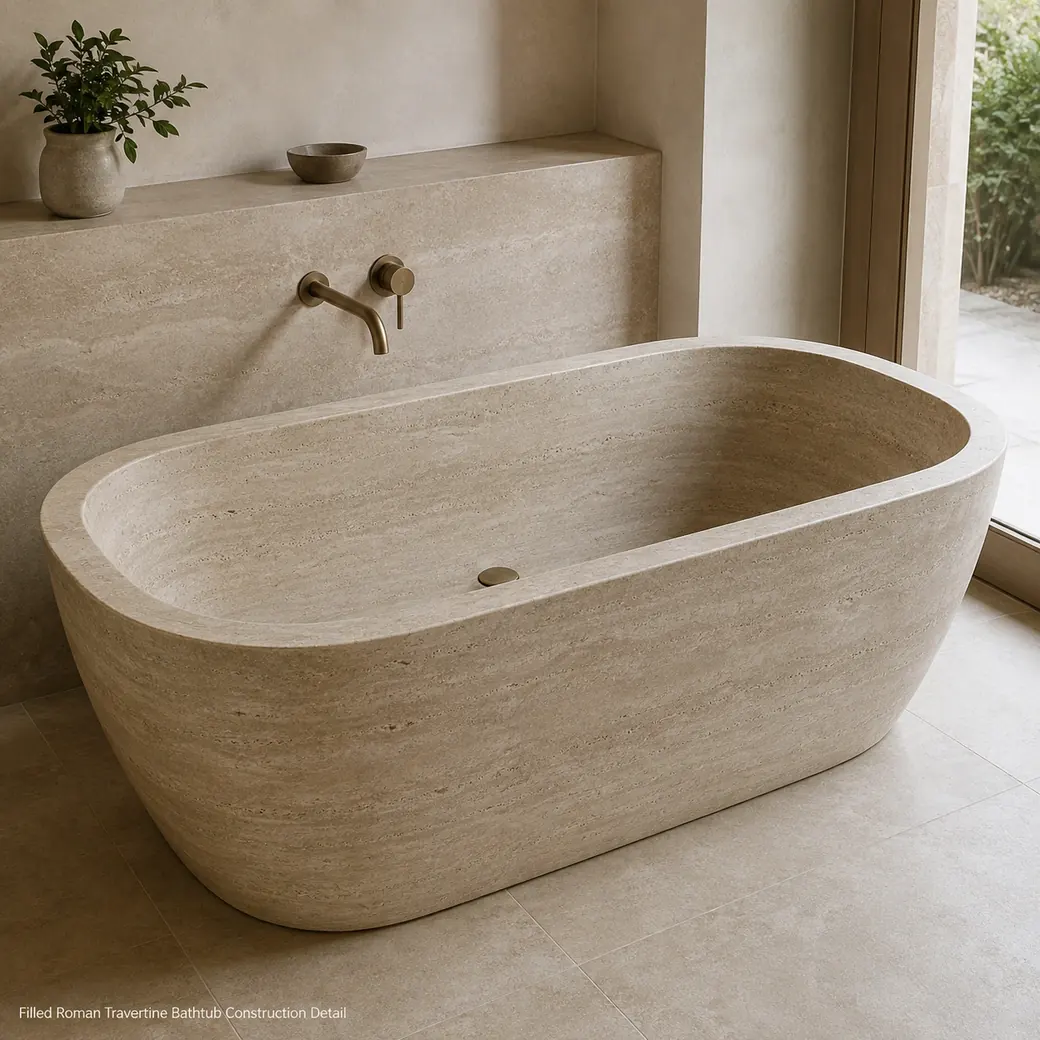
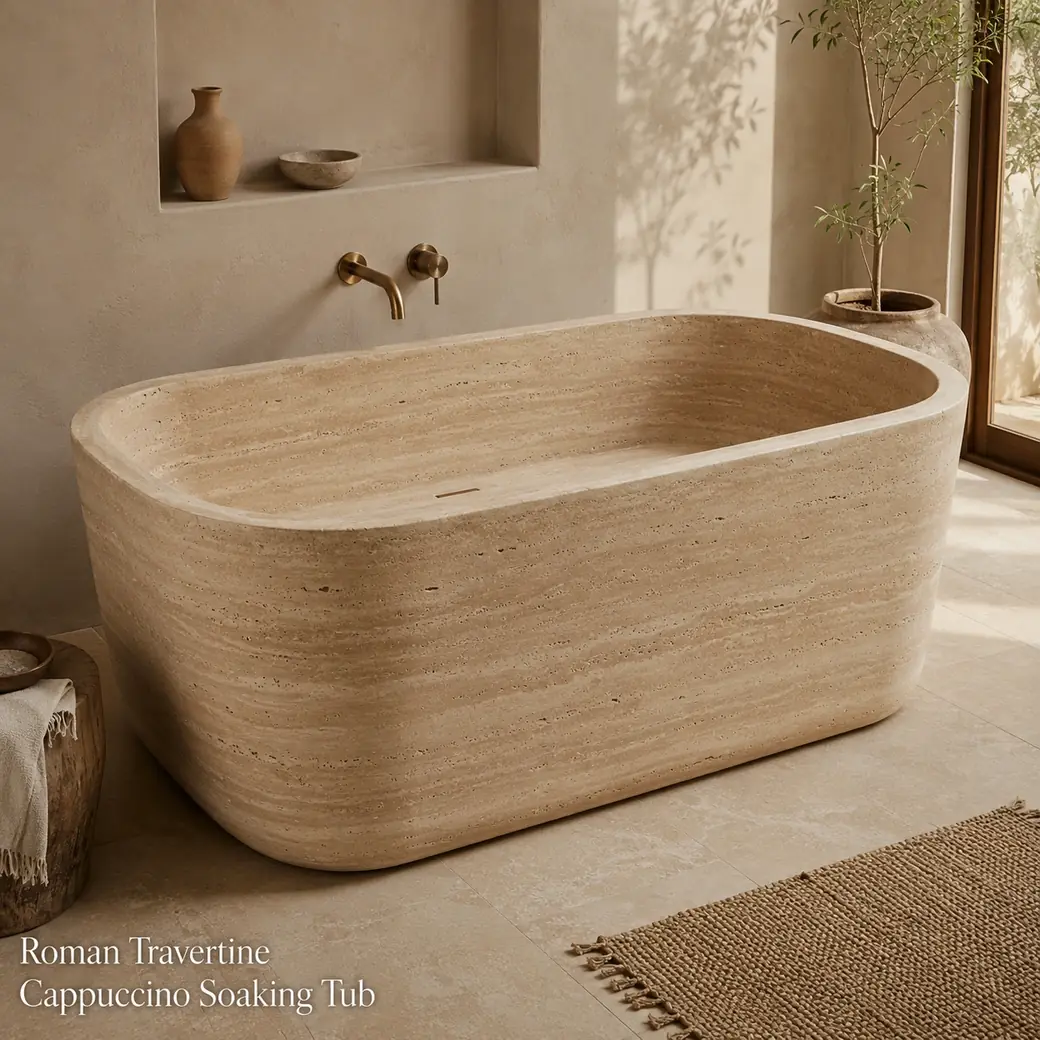
Roman Travertine gives this bathtub a naturally warm, architectural appearance through its Light Cappuccino Beige tone and subtle mineral movement. The Natural Travertine is finished with a Filled Satin-Honed surface, where open pores are filled before honing to create a smoother, softly reflective finish while retaining the stone’s characteristic texture. Depending on fabrication requirements, the bath can be carved from substantial stone sections or assembled from accurately fabricated travertine components, with the construction method coordinated around wall thickness, joints and the final bath geometry. This combination preserves the visual mass of natural stone while producing a refined bathing surface.
Sizing & Placement
Natural Stone Soaking Tub Size and Application
At 150 × 70 × 55 cm and about 400 kg before water or a user is added, this travertine tub requires structural floor capacity to be checked before installation. The 150 cm length creates a compact soaking format, while doorway access, turning space, lifting route and final bathroom positioning should all be confirmed before the finished stone tub reaches site.
Solid Block and Fabricated Stone Tubs
The 150 × 70 × 55 cm, 400 kg bath requires monolithic or carefully fabricated stone construction supported by a floor engineered for its full installed load.
Drain Overflow and Faucet Planning
Drain, overflow, filler location and service access must be resolved before positioning the 400 kg tub because later plumbing adjustment is highly restricted.
Heavy Stone Bath Structural Support
Position the 400 kg tub only after structural floor capacity, lifting access, drain alignment and service connections have all been confirmed.
Product Facts
Travertine Freestanding Bath Product Details
This Roman natural-travertine freestanding bathtub measures 150 × 70 × 55 cm and weighs approximately 400 kg, with a filled satin-honed light cappuccino-beige finish. Exact wall thickness, internal soaking depth, drain and overflow hardware and faucet arrangement are not stated; all plumbing, floor loading and structural support must therefore be resolved before fabrication and installation.
| Internal Soaking Depth | ≈42 cm internal soaking depth |
|---|---|
| Wall Thickness | ≈40 mm side/end wall thickness with an ≈50 mm heavier base zone around the waste. |
| Drain Outlet Diameter | Ø50 mm waste outlet connected to a removable bath waste assembly, with overflow provision coordinated before stone fabrication. |
| Overflow Type | Concealed integrated slot overflow connected to the bath waste assembly, positioned below the rim to preserve the continuous stone appearance. |
| Waste Location | Centered waste outlet positioned approximately 35 cm from one short end, allowing comfortable use while keeping the trap accessible below. |
| Faucet Deck Provision | Optional 120 mm-wide reinforced rear deck zone for a three-hole mixer, with all tap holes located at least 50 mm from stone edges and each other. |
| Service Access | Removable service panel of at least 400 × 300 mm aligned with the waste, overflow and faucet connections, using concealed corrosion-resistant fixings. |
| Base Bearing Area | Minimum continuous bearing area of approximately 120 × 55 cm beneath the tub base, fully supported by an engineered plinth without point-loaded gaps. |
| Filled-Water Load | Approximately 525 kg total service load when filled with about 350 L of water, excluding the bather; the structural floor must be verified for the concentrated load. |
| Lifting Point Provision | Four temporary certified lifting inserts positioned in reinforced upper structural zones and used with a spreader beam to prevent inward loading on the stone walls. |
Protection & Upkeep
Natural Stone Bathtub Care
Seal the Carrara bathtub only when absorption testing and the fabrication system require it, then wipe standing water and bath-product residue from the bowl after use. Clean with pH-neutral stone products and avoid acidic descalers. Its approximately 525 kg filled service load requires a verified structural floor and continuous bearing support, while delivery and positioning must use engineered lifting points, a spreader beam and specialist installers.
Designed for Use
Why Choose a Carved Stone Bathtub
A carved stone bathtub gives buyers a fully integrated bathing fixture with dimensions, rim profile and depth tailored to the room. Its substantial construction creates a stable soaking experience, while custom fabrication allows the bath to coordinate precisely with floor loading, plumbing and surrounding stone finishes.
- Custom Soaking Geometry
Custom length, width, depth and rim geometry let the Travertine bathtub fit the intended soaking posture and bathroom layout precisely.
- Natural Stone Character
The natural variation and layered beige movement of Roman Travertine give the bathtub an individually carved stone character that cannot be replicated by uniform manufactured surfaces.
- Freestanding Bath Design
The freestanding Roman Travertine form creates a self-contained soaking centerpiece that can be positioned independently from surrounding cabinetry or built-in bath structures.
- Made To Measure
Custom length, width, depth and rim geometry allow the Travertine bathtub to be fabricated around the exact bathroom layout and preferred soaking dimensions.
Custom Fabrication
Custom Travertine Bathtub Options
Roman Travertine bathtubs can be fabricated to custom length, width and soaking depth, with oval, round or rectangular forms and rim profiles shaped around the bathroom layout and user preference. Stone selection can be coordinated for colour and vein continuity before production, while the 400 kg-class fixture requires specialist handling, floor-load review and carefully planned installation; projects involving structural floor coordination may also benefit from understanding systems such as raised floor construction.

Specification Table
Stone Bathtub Technical Specifications
Use the technical specification table to confirm the Roman Travertine construction, filled satin-honed surface, light cappuccino-beige appearance, 150 × 70 × 55 cm dimensions and 400 kg weight together with wall thickness, internal soaking depth, waste position, overflow provision, plumbing access, floor-load requirement and installation method before finalizing the bathtub.
Product details
Specifications, care, delivery and FAQ
Everything is rendered from product JSON fields so the page remains SEO-ready even before JavaScript runs.
Cleaning: Rinse bath products after every use, wash with pH-neutral stone cleaner and a soft cloth, dry the Travertine and rim, clean the waste area regularly, remove mineral film with stone-safe products, avoid acidic descalers bleach and abrasives
Daily Care: Rinse bath products after every use, wipe the Travertine dry, avoid acidic descalers and abrasive scrubbers, keep waste and perimeter seals clean, prevent heavy impacts on the rim, monitor floor drainage and sealing
- Installing without checking the 400 kg dry load plus water and occupants
- using acidic bathroom descalers
- allowing water beneath failed perimeter seals
- dropping heavy objects onto the Travertine
- moving the tub after plumbing without specialist handling
Maintenance: Rinse bath products after every use, dry the Travertine and rim, use neutral bathroom cleaner, keep waste and perimeter seals maintained, monitor floor drainage, test absorption before applying more sealer
Handling: Move the 400 kg Travertine bathtub only with a specialist rigging team, verify floor and access capacity, use engineered lifting points and wide padded slings, keep the tub level, never lift by the rim, lower it onto continuous prepared support
Can a residential floor safely support a 400 kg natural-stone bathtub once the weight of water and the person using it are added?
A 400 kg stone bathtub can create a total operating load of approximately 650–850 kg after adding 200–300 litres of water and one or two users. Whether the floor is safe depends on joist or slab capacity, load distribution, span, bathtub footprint and location relative to supports—not simply the room’s stated area loading. Do not install it without structural verification. A structural engineer should check the actual building drawings and site conditions and, where required, specify a spreader frame, reinforced slab zone or supports transferring the load directly to structural elements.
What drain position, waste size and overflow rough-in must be completed before placing this 400 kg Roman Travertine bathtub so the plumbing remains accessible and accurately aligned?
Finalise the drain centre, trap orientation, waste-pipe diameter and overflow connection from the actual bathtub shop drawing before the 400 kg unit arrives. Provide an accessible trap or service panel, accurately level structural support and enough tolerance for final flexible connections. Waste sizes are commonly around 40–50 mm, but the selected drain assembly and UAE plumbing requirements control the specification. Dry-fit or template all rough-ins first because moving or drilling the Roman Travertine bathtub after placement creates substantial breakage and handling risk.
What doorway, corridor, lift and turning clearances—and which lifting equipment—are required to deliver and position this 400 kg Roman Travertine bathtub safely?
Measure the bathtub’s packed dimensions plus handling frame and add clearance for lifting equipment and workers, not merely the finished 150 × 70 cm size. Survey every doorway, turn, corridor, lift opening and capacity, and prepare a scaled route drawing. A 400 kg bath normally requires professional stone handlers using rated lifting straps, dollies, gantry or crane equipment. Verify floor loading, remove obstacles and complete plumbing rough-ins before delivery because repositioning it after placement is difficult and hazardous.
What internal bathing length, width and water depth should this 150 × 70 cm Travertine bathtub provide for comfortable soaking without making entry and exit difficult?
Within a 150 × 70 cm exterior envelope, a practical internal bathing area is approximately 115–125 cm long, 50–55 cm wide and 40–45 cm deep, depending on wall and rim thickness. That supports seated soaking while keeping the step-over height near the 55 cm external height. A deeper bowl improves immersion but increases water load and exit difficulty. Use a gently sloped backrest, broad stable rim and optional grab support, then verify comfort with a full-size ergonomic template before carving.
What waterproofing upturns, drainage provisions and flexible perimeter sealing are required beneath and around this 400 kg freestanding Travertine bathtub?
Install a continuous wet-area membrane beneath the tub and turn it up adjoining walls and penetrations according to the approved bathroom system, while keeping the floor structure capable of supporting the filled tub and occupants. Provide a controlled floor fall to an accessible drain, waterproof all waste and supply penetrations, and use a flexible sanitary seal at the tub perimeter without blocking inspection, ventilation or maintenance access required by the installation design.
Reviews
Reviews and new review submission
0.0 average rating from 0 reviews. New reviews are saved as pending until approved.
No approved reviews yet for this product. The review form is ready for buyer submissions.