Marble countertops are attractive work surfaces but the right stone should be selected for actual kitchen exposure because calcitic marble can etch from citrus, vinegar and wine, while quartz-rich stones generally tolerate kitchen acids better. Sealing should be based on the stone's absorption and sealer guidance rather than an automatic fixed calendar. Straight, eased, bevelled, bullnose and built-up edges can be fabricated, and stain protection never eliminates the need for immediate spill cleanup.
Premium Kitchen Surfaces
Marble Countertops Small
Secure product inquiry
Buy now
Cash on delivery available. Product details are pre-filled below. Owner delivery adds AED 5,000.
Edges, Cutouts & Bookmatched Seams
Plan Every Seam, Opening and Finished Edge
Fabrication planning should map sink openings, cooktop cutouts, seams and edge build-ups onto the selected slab before cutting. Where the vein pattern is prominent, bookmatched or carefully aligned seams can make adjoining sections feel intentional, while a mitered edge can create a substantial thick appearance without requiring a full solid block.
Stone Character
Taj Mahal Countertop Material and Finish
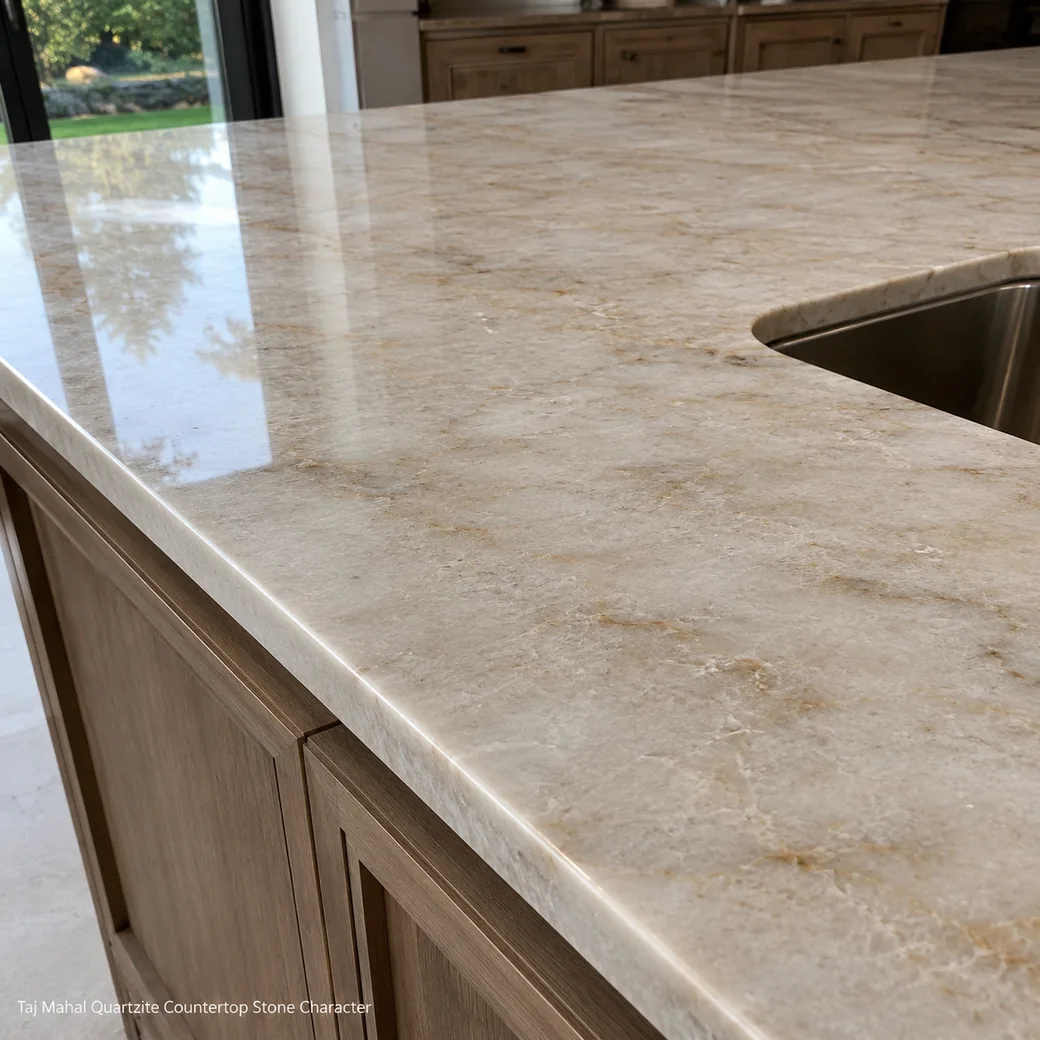
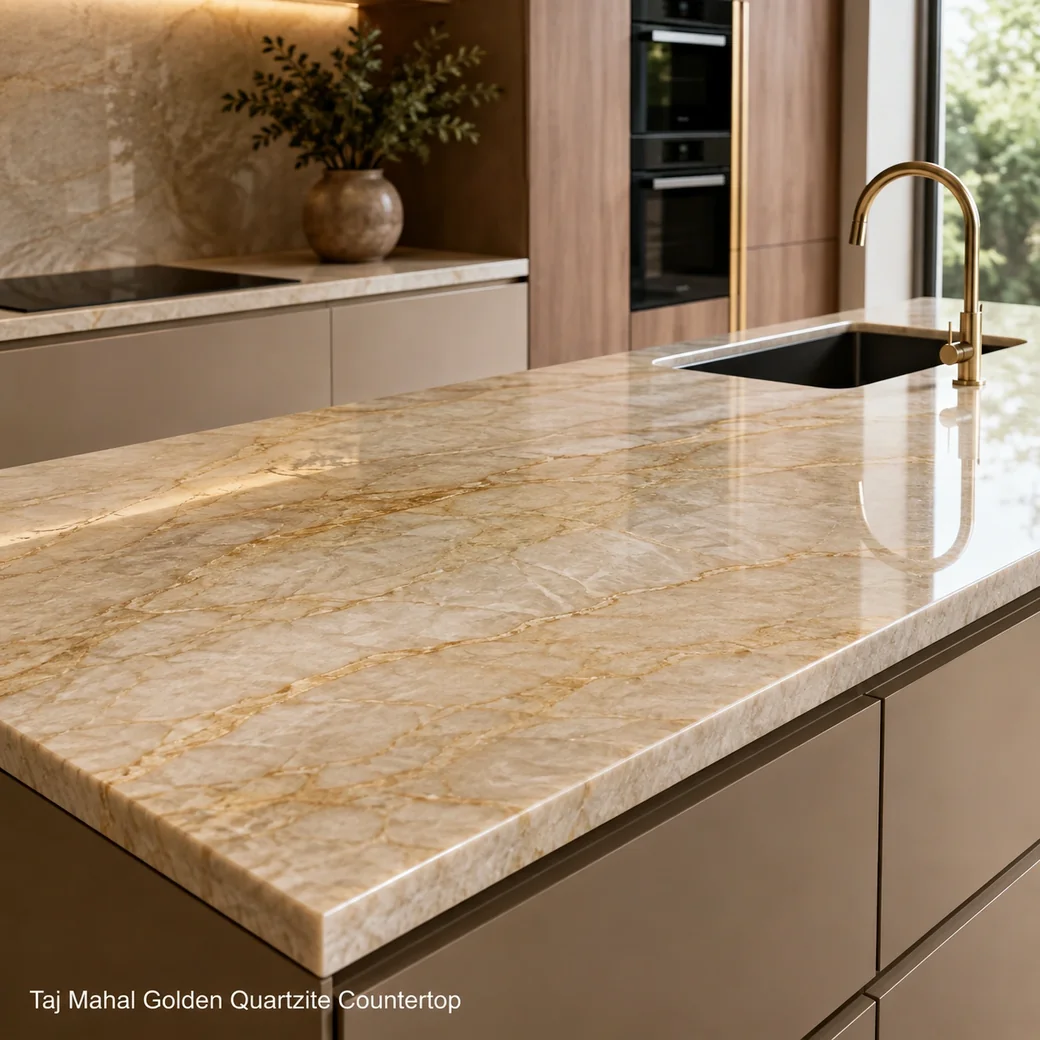
Taj Mahal is a metamorphic quartzite with a light beige background and warm golden movement created by its natural mineral structure. The High-Lustre Polished Finish increases clarity and depth across this movement, giving the beige field a reflective surface while making warmer gold-toned veins more distinct. Unlike calcitic marble, whose calcium-carbonate composition is particularly susceptible to etching from common kitchen acids, quartzite is predominantly quartz-rich and generally offers stronger resistance to acid-related surface attack. This material distinction makes Taj Mahal quartzite visually marble-like while providing performance characteristics more closely associated with a harder quartz-rich natural stone.
Scale & Configuration
Natural Stone Worktop Size and Application
At 120 × 60 × 2 cm and 38.2 kg, this Taj Mahal quartzite piece corresponds well to a compact countertop or vanity section with a conventional 600 mm working depth. The same 20 mm stone can be fabricated for kitchen runs, islands, vanity tops or matching upstands and backsplashes, with support and cutouts adjusted to each application.
Stone Counter Edge Profiles
A 20 mm quartzite countertop can use eased, bevelled or built-up edges, with the profile selected around durability, visual thickness and cabinet design.
Sink and Cooktop Fabrication
Sink, tap and appliance cutouts should be templated before fabrication with adequate stone left around openings to avoid weak narrow sections.
Slab Vein and Seam Planning
Taj Mahal quartzite is particularly suitable where a light natural-stone look is wanted with greater resistance to kitchen acids than typical calcitic marble.
Product Overview
Quartzite Worktop Product Details
This Taj Mahal metamorphic-quartzite worktop measures 120 × 60 × 2 cm, weighs 38.2 kg and has a high-lustre polished light-beige surface with warm golden movement. The confirmed thickness is 20 mm, while edge profile, sink or appliance cutouts, backsplash, structural support and installation details remain project-specific; sealing should be determined from actual slab absorption and exposure.
| Sink Cutout Reinforcement | Epoxy-set stainless-steel reinforcement rods at front and rear of sink cutout |
|---|---|
| Cooktop Cutout Clearance | Minimum 50 mm stone bridge from the cooktop cutout to an unsupported edge; final cutout clearance per appliance template. |
| Joint Location | Position the principal field joint over a fully supported cabinet division, at least 150 mm from sink or hob cutout corners and away from unsupported spans. |
| Support Span | Maximum 600 mm clear support spacing beneath the 20 mm marble, with continuous support around sink, hob and other fabricated openings. |
| Backsplash Interface | Leave a 3 mm flexible joint between the countertop and backsplash, sealed with colour-matched neutral-cure sanitary silicone rather than rigid grout. |
| Overhang Limit | Maximum 150 mm unsupported overhang for the 20 mm marble; deeper projections require concealed steel brackets or continuous engineered reinforcement. |
| Seam Adhesive Type | Two-part colour-matched low-yellowing knife-grade epoxy specifically formulated for natural-stone seams, with the joint clamped flush during curing. |
| Corner Radius | R10 external corner radius as the standard safe profile, with R20 available for exposed circulation corners requiring a softer transition. |
| Fabrication Tolerance | Finished dimensions within ±1.5 mm, cutout positions within ±1 mm and seam levels within 0.5 mm after installation. |
| Installation Joint Sealant | Non-staining neutral-cure natural-stone silicone over closed-cell backing rod at wall and movement joints; use colour-matched stone epoxy only for rigid fabricated seams. |
Maintenance & Use
Polished Worktop Care and Performance
Determine whether the polished Calacatta Oro needs sealing through absorption testing, then use an appropriate impregnating treatment rather than assuming all marble requires the same schedule. Blot oil, wine, coffee and coloured spills promptly, and prevent lemon, vinegar and acidic cleaners from contacting the surface because they can etch even sealed stone. Use trivets beneath hot cookware, boards for cutting and pH-neutral cleaner for daily maintenance.
Why It Works
Why Choose a Quartzite Kitchen Counter
A quartzite kitchen counter is a practical choice for buyers who want the appearance of natural stone with stronger resistance to demanding kitchen use than many calcitic marbles. It works particularly well for islands and preparation areas where durability, distinctive veining and long-term visual value all matter.
- Precision Cut Openings
Sink, hob and fixture openings can be accurately fabricated into Taj Mahal quartzite to suit the final kitchen layout and hardware.
- Custom Edge Profiles
Taj Mahal quartzite can be fabricated with straight, eased, bevelled, bullnose or built-up edge profiles to suit the kitchen design.
- Heat Aware Surface
Taj Mahal quartzite tolerates normal kitchen warmth well, but trivets should still isolate very hot cookware to reduce thermal stress and protect the finished surface.
- Professional Installation Ready
Fabricated sink openings, edge details, joints and support requirements can be prepared around site dimensions for professional countertop installation.
Bespoke Options
Custom Stone Countertop Fabrication
Taj Mahal quartzite countertops can be fabricated with eased, bullnose, curved, mitred or built-up edges after exact slabs are selected for colour, movement and possible bookmatching. Sink and cooktop openings can be CNC-cut to appliance templates before delivery, with joints, supports and final installation coordinated from site measurements; accurate planning starts with practical references such as kitchen countertops size.

Specification Guide
Countertop Technical Specifications
The countertop table consolidates Taj Mahal metamorphic quartzite, high-lustre polished finish, light beige colouring with warm golden movement, 120 × 60 × 2 cm dimensions and 38.2 kg weight with slab selection, edge profile, seam locations, sink and cooktop cut-outs, backsplash allowance, support requirements and site-template information.
Product details
Specifications, care, delivery and FAQ
Everything is rendered from product JSON fields so the page remains SEO-ready even before JavaScript runs.
Cleaning: Wipe cooking spills immediately, clean daily with mild soap or pH-neutral stone cleaner, degrease only with quartzite-safe products, rinse and dry, use cutting boards and trivets, avoid abrasive powders harsh chemicals and unnecessary resealing
Daily Care: Use cutting boards and trivets, wipe oil wine citrus and sauces immediately, clean daily with mild neutral products, avoid abrasive powders, inspect cut-outs and seams, reseal only when water absorption returns
- Cutting directly on the polished quartzite
- placing hot cookware without trivets
- ignoring spills because the surface is sealed
- using abrasive powders or harsh chemicals
- leaving narrow sink or cooktop bridges unsupported
Maintenance: Use cutting boards and trivets, wipe citrus wine oil and sauces immediately, clean daily with mild neutral products, dry around sink and cooktop cut-outs, inspect seams and reinforcement, reseal according to absorption
Handling: Transport the 20 mm Taj Mahal countertop vertically on an A-frame, use stone-rated clamps or vacuum lifters, support sink and cooktop bridges, never carry it by a cut-out, protect polished edges, lower it uniformly onto continuous cabinetry support
How much better does quartzite resist lemon, vinegar and wine etching than calcitic marble in a frequently used kitchen countertop?
Genuine quartzite is substantially more resistant to lemon, vinegar and wine etching than calcitic marble because it is primarily quartz rather than calcium carbonate. However, some slabs sold under quartzite trade names contain calcite or are actually marble, so performance should be verified rather than assumed. Test an offcut of the selected Taj Mahal slab with the fabricator before purchase. Sealing can reduce absorption and staining from wine or oil but cannot make calcite acid-proof; spills should still be blotted quickly and cleaned with a neutral stone product.
Which edge profile gives a 20 mm Taj Mahal quartzite countertop adequate chip resistance without making the slim slab look visually too heavy?
A small eased edge or approximately 2–3 mm pencil round gives a 20 mm Taj Mahal quartzite countertop good everyday chip resistance while preserving its slim appearance. A narrow bevel creates a sharper architectural look but may reveal small impacts more readily. Avoid elaborate ogee or full bullnose profiles because the slab is too thin to show them naturally unless a laminated edge is added. Reinforce sink and hob cut-outs separately, as the edge profile alone cannot protect narrow stone bridges from cracking.
Where should seams be positioned in this 20 mm Taj Mahal quartzite countertop relative to sink cut-outs, cooktops, cabinet supports and visible vein direction?
Position seams over cabinet divisions or other full support, never across unsupported spans. Keep them away from narrow sink and cooktop corners where possible; if a joint must intersect a cut-out, place it where each piece retains broad support rather than creating a fragile stone bridge. Avoid highly visible central areas unless vein continuity justifies them. Digitally map the Taj Mahal pattern, dry-lay pieces and coordinate seams with mitres, appliances and backsplash joints before cutting.
What concealed reinforcement is required around sink and cooktop cut-outs in this 20 mm Taj Mahal quartzite countertop to protect narrow stone bridges and corners?
Reinforce narrow bridges with factory-cut stainless-steel or composite rods set into underside channels, or support the complete cut-out zone with a rigid cabinet frame or substrate. Round every internal corner, keep seams away from weak corners where possible and ensure sink rails or cooktop framing carry appliance loads independently of the stone. Reinforcement must be designed around the actual slab, vein direction and cut-out geometry; it supplements full cabinet support but cannot rescue an excessively narrow or unsupported bridge.
Should this polished Taj Mahal quartzite countertop be sealed before installation, and how can a water-absorption test determine when it genuinely needs resealing?
Seal the Taj Mahal quartzite before or immediately after installation only if a clean, dry sample darkens readily during an absorption test; dense material may need little or no treatment. Place water on several representative areas, observe whether it darkens the stone within the sealer manufacturer’s test period, and reseal only when absorption returns, using a penetrating product tested for colour and gloss compatibility.
Reviews
Reviews and new review submission
0.0 average rating from 0 reviews. New reviews are saved as pending until approved.
No approved reviews yet for this product. The review form is ready for buyer submissions.