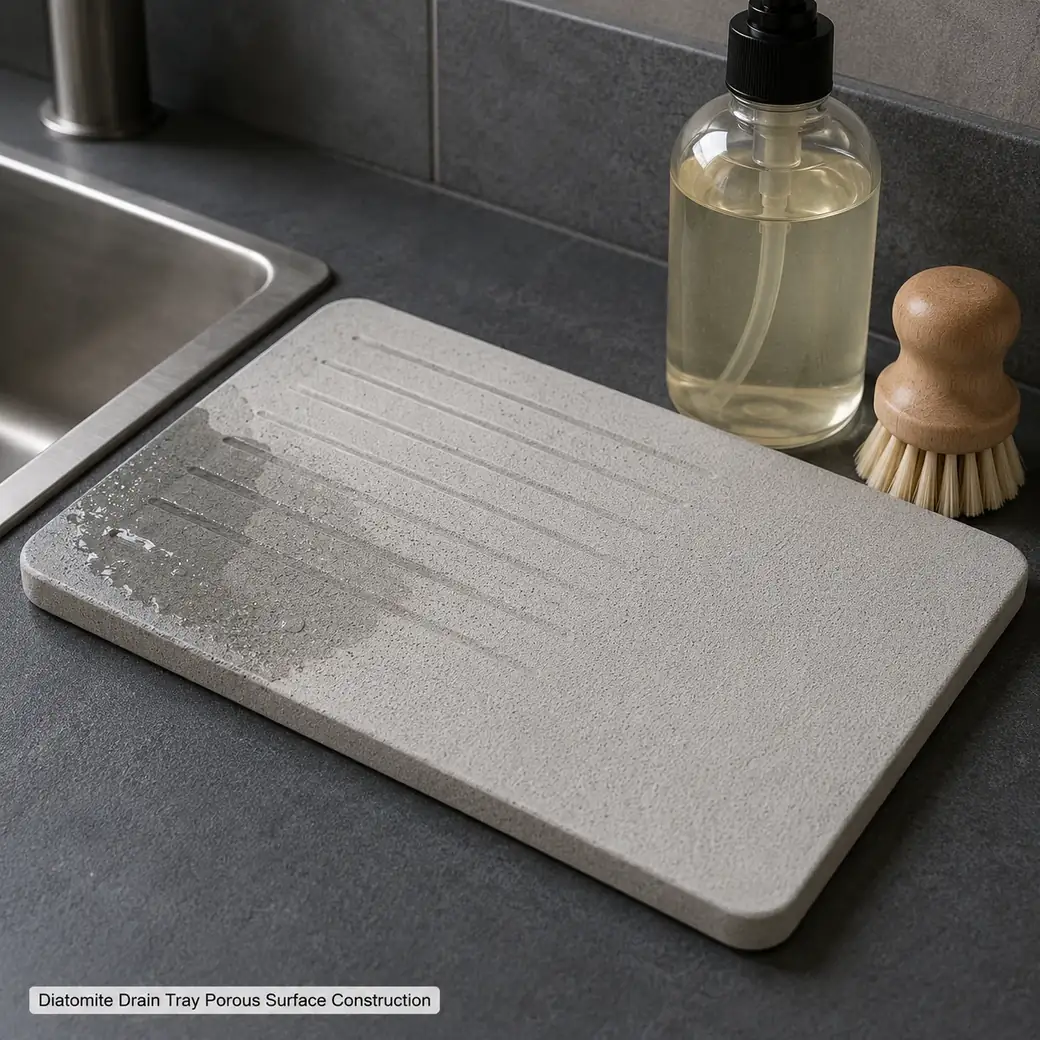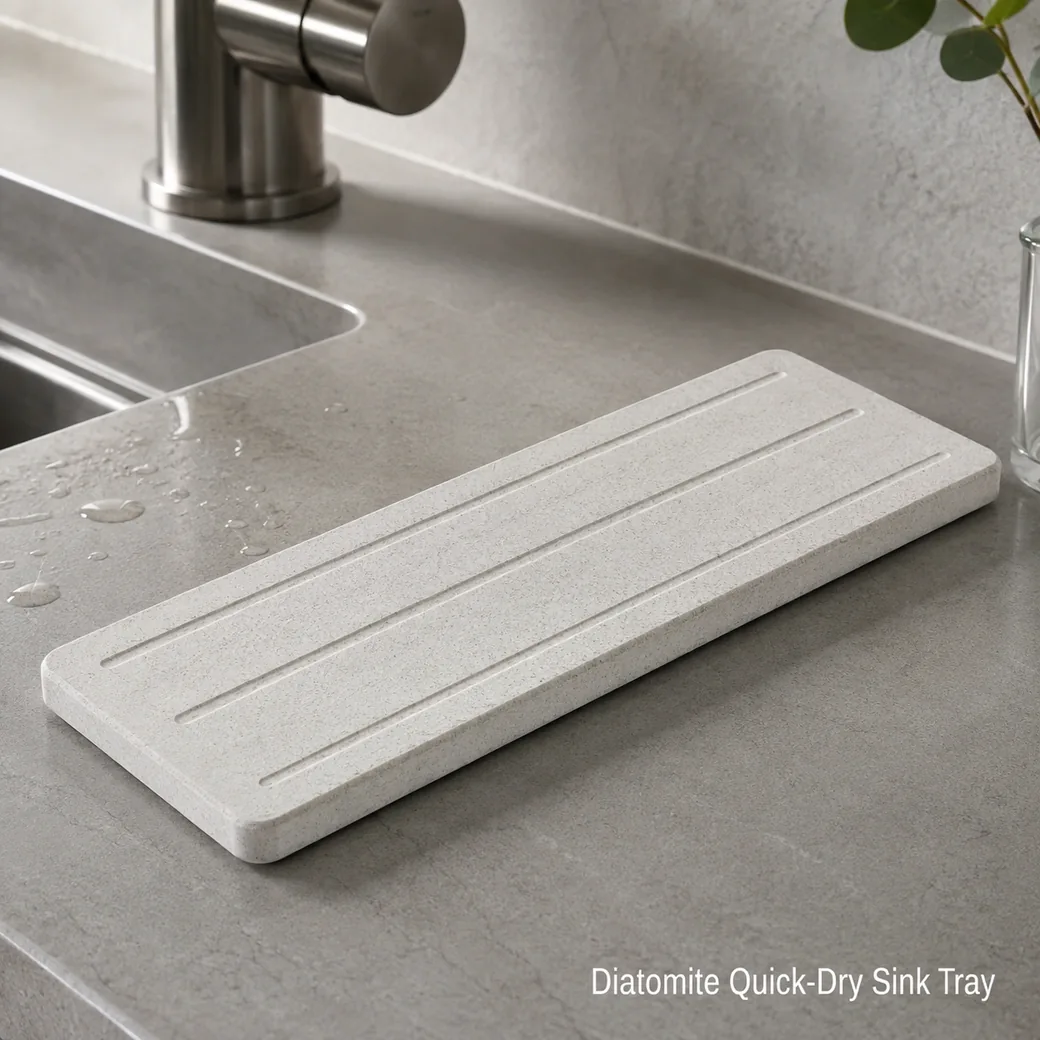
A drain tray beside a sink holds soap, brushes or washed accessories while keeping residual water away from the surrounding countertop. Diatomite is particularly absorbent because its porous structure draws in moisture, so it does not necessarily need deep drainage grooves to function; grooves can still improve runoff and airflow. Choose a footprint that fits beside the basin without obstructing taps, rinse residue away and allow the tray to dry fully between uses.
Sink-Side Drain Solutions
Marble Drain Tray Small
Secure product inquiry
Buy now
Cash on delivery available. Product details are pre-filled below. Owner delivery adds AED 5,000.
Quick-Dry Countertop Protection
Keep Sink-Side Surfaces Drier and More Organized
Diatomite behaves differently from marble because its porous structure actively absorbs residual moisture. A long narrow format beside the faucet can therefore dry soap, brushes or small accessories without deep standing water, while grooves, raised feet and airflow beneath the tray can improve drying performance further.
Surface & Construction
Diatomite Drain Tray Material and Finish
Diatomaceous Earth is formed from highly porous Diatomite, giving this drain tray the ability to absorb residual surface moisture through its microscopic pore structure rather than functioning only through conventional drainage channels. The Fine-Sanded Matte Finish keeps the Light Stone Grey surface smooth enough for countertop use while maintaining a dry, non-reflective appearance. Its pale grey tone emphasizes the mineral character of the material, while the exceptionally porous structure allows moisture to disperse through a much larger internal surface area than dense natural stone.
Sizing & Placement
Stone Sink Drying Tray Size and Use
The 30 × 10 × 1.2 cm diatomite format weighs only 0.65 kg and is deliberately narrow for placement beside a sink. Its long footprint can hold soap, a sponge and a brush in one line, while the absorbent material and open placement help manage residual water without consuming a large section of the countertop.
Quick-Dry Stone Surface Performance
Diatomite absorbs residual moisture through its porous structure, allowing the 30 × 10 cm tray to dry wet accessories without relying solely on drainage grooves.
Grooves and Airflow Design
Diatomite naturally absorbs residual moisture, while shallow grooves can improve airflow and runoff so the surface dries more evenly between uses.
Kitchen and Bathroom Sink Use
Place the 30 × 10 cm diatomite tray beside the basin where wet soap or brushes can drain without obstructing faucets or working space.
Product Facts
Stone Drain Organizer Product Details
This diatomite drain organizer measures 30 × 10 × 1.2 cm, weighs 0.65 kg and uses a fine-sanded matte light-stone-grey surface. Its porous material is naturally absorbent, while exact groove pattern and feet are not specified; it is intended for sink-side soap or accessory storage and should be allowed to dry fully between wet uses.
| Water Absorption Rate | ≈60% water absorption by weight |
|---|---|
| Drying Time | Approximately 5–10 minutes to fully surface-dry under normal indoor humidity. |
| Groove Spacing | Six parallel drainage grooves at approximately 15 mm centres, each about 5 mm wide × 3 mm deep and falling toward one short edge. |
| Groove Depth | Drainage grooves approximately 3 mm deep at the high end, increasing to about 5 mm at the outlet end to promote positive drainage. |
| Feet Material | Four 3 mm-thick moulded silicone feet with drainage notches, keeping the tray stable while allowing air and water movement underneath. |
| Anti-Slip Rating | Minimum wet pendulum target of P4 or equivalent high wet-slip resistance for the textured contact surface and silicone-footed base. |
| Water Retention Capacity | Approximately 120 mL temporary water-retention capacity below the raised contact ribs; the tray should be emptied before reaching the rim. |
| Airflow Clearance | Minimum 3 mm airflow gap beneath the tray created by notched silicone feet, allowing evaporation and drainage under the 12 mm stone body. |
| Sink-Edge Clearance | Maintain at least 20 mm clearance from the sink edge so water can be wiped around the tray without obstructing the basin seal or overhanging the counter. |
| Replacement Cycle Guidance | Replace only if the stone cracks, drainage grooves become damaged or pads detach irreparably; otherwise reseal and replace silicone feet approximately every 2–3 years as needed. |
Protection & Upkeep
Diatomite Drying Tray Care
Rinse the diatomite tray to clear soap or mineral residue, use a soft brush on stained areas and allow it to dry completely in moving air. Do not leave it permanently submerged or saturated because continuous moisture can reduce drying performance and encourage odour. Keep the underside clearance open and avoid bleach, acidic descalers or surface coatings that block its pores.
Designed for Use
Why Choose a Quick-Dry Stone Tray
A quick-dry stone tray made from diatomite helps draw residual moisture away from soap, brushes and washed accessories while keeping the surrounding counter drier. Its slim footprint fits beside a basin, and the naturally absorbent material can reduce dependence on deep drainage channels or bulky plastic drip trays.
- Fast Moisture Absorption
Porous diatomite absorbs residual sink-side moisture quickly, helping soap and washed accessories dry while reducing countertop wetness.
- Compact Sink Placement
The slim 30 × 10 cm format fits beside the basin to absorb residual moisture without obstructing taps or consuming excessive counter space.
- Soap Sponge Organization
The narrow diatomite surface keeps soap, sponges and small brushes grouped beside the basin while managing residual sink-side moisture.
- Quick Dry Surface
Porous diatomite draws residual moisture away from soap, brushes or washed accessories, helping the surface dry faster between sink-side uses.
Custom Fabrication
Custom Sink Drying Tray Options
Diatomite drying trays can be fabricated to custom length and width so they sit beside the basin without obstructing taps or working space. Surface grooves can be added to improve runoff and airflow, while raised feet can create extra drying clearance and layouts can be shaped around soap, brushes or bottles; broader stone coordination may include materials such as a beige marble slab on adjoining surfaces.

Specification Table
Drain Tray Technical Specifications
Check the technical specifications for Diatomite, fine-sanded matte finish, light stone-grey colouring, 30 × 10 × 1.2 cm dimensions and 0.65 kg weight alongside absorbent surface area, drainage grooves, drying rate considerations, raised-foot option, sink-side clearance and recommended drying procedure between uses.
Product details
Specifications, care, delivery and FAQ
Everything is rendered from product JSON fields so the page remains SEO-ready even before JavaScript runs.
Cleaning: Rinse soap residue regularly, scrub gently with a soft brush and clean water, blot rather than saturate the diatomite, stand it upright to air-dry completely, lightly sand persistent surface marks if manufacturer-approved, avoid bleach acids and sealing
Daily Care: Rinse soap residue regularly, allow the diatomite to dry fully between uses, rotate or stand it upright for airflow, avoid sealing its absorbent surface, keep oils and coloured liquids away, lightly sand only when manufacturer-approved
- Sealing the absorbent diatomite
- leaving it continuously saturated
- cleaning with bleach or acids
- storing it flat while wet without airflow
- allowing oily coloured liquids to penetrate its pores
Maintenance: Rinse soap residue frequently, stand the diatomite upright for airflow, allow complete drying between uses, rotate the working face if permitted, lightly sand marks only when approved, never seal the absorbent surface
Handling: Support the thin diatomite tray along its full 30 cm length, never lift it from one end when saturated, remove accessories first, handle it with dry hands, avoid knocks against the sink, allow it to dry fully before storage
How quickly should a diatomite drain tray absorb sink-side water, and what indicates that its absorbency has started to decline?
A functional diatomite tray should absorb a light splash within seconds and show visible darkening that begins to fade as moisture evaporates. Declining performance is indicated by water remaining beaded on the surface, slow drying, persistent dark patches, odour or a polished film of soap and mineral residue. Rinse the tray, allow it to dry completely and gently refresh the surface with fine abrasive paper only if the manufacturer permits it. Replace it if cracking, warping or permanent saturation develops.
Do drainage grooves improve this diatomite tray’s sink-side performance, or will a flat absorbent surface dry water faster and remain easier to clean?
A flat diatomite surface normally absorbs water more uniformly and is easier to sand or clean, while shallow grooves can channel larger drips and keep bottles above moisture. Deep grooves reduce the active contact area and may trap soap residue. For a sink-side tray, use a mostly flat absorbent field with a few broad, gently sloped channels rather than a heavily ribbed design. Performance depends more on clean open pores, full drying and absence of soap film than on decorative drainage grooves.
How can the absorbency of this diatomite drain tray be restored when soap residue or mineral deposits cause water to remain on the surface and drying becomes slower?
Rinse the diatomite tray thoroughly with clean water, scrub gently using a soft brush and allow it to air-dry completely. If the manufacturer permits, lightly sand the dry surface with fine abrasive paper to remove soap film and mineral residue blocking its pores, then rinse away all dust. Avoid oil, wax and harsh chemical cleaners. Replace the tray if it remains slow, develops persistent dark patches, warps or cracks after cleaning and full drying.
How should this absorbent diatomite drain tray be cleaned and dried to prevent mildew, bacterial odour and persistent dark patches from developing in its pores?
Rinse soap and residue frequently using clean water and a soft brush, then stand the tray upright in a ventilated area until both sides are completely dry. Rotate or alternate its use so it does not remain continuously saturated. If absorbency declines, lightly sand the dry surface only when the manufacturer permits, then rinse away dust. Avoid oils, bleach and coatings; replace the tray if odour, dark patches, warping or cracking persist after thorough cleaning and drying.
Is the 10 cm width of this diatomite drain tray sufficient beside the intended sink without blocking the tap handles, spout movement or frequently used counter space?
A 10 cm width is appropriate for many narrow sink ledges, provided a site measurement confirms clearance from the faucet base, handle sweep and spout controls. Leave a small cleaning gap around the tray and ensure its 30 cm length does not occupy the principal preparation area; where clearance is tighter, a narrower custom version is preferable to obstructing the taps.
Reviews
Reviews and new review submission
0.0 average rating from 0 reviews. New reviews are saved as pending until approved.
No approved reviews yet for this product. The review form is ready for buyer submissions.