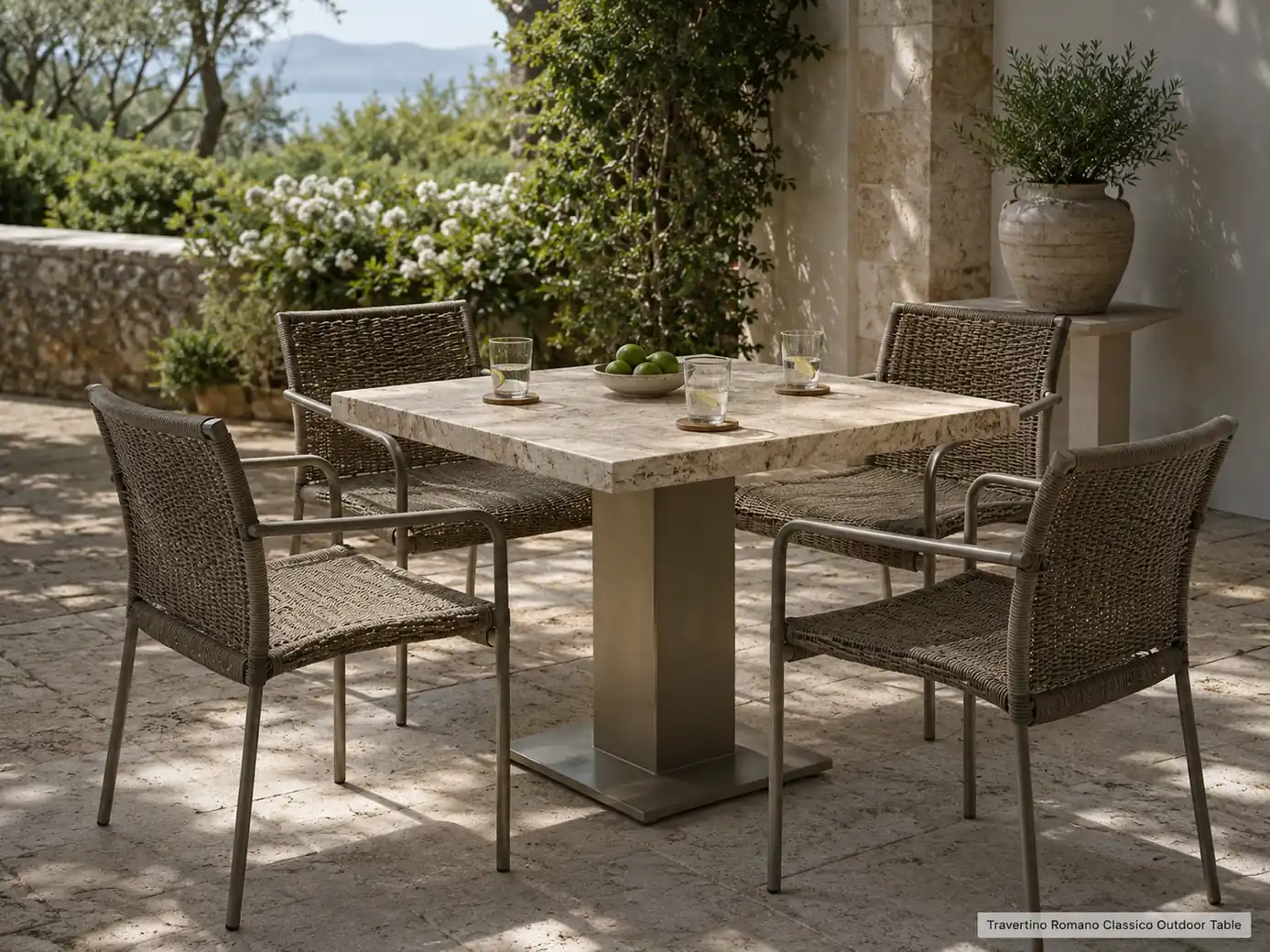
Outdoor stone tables are possible, but not every marble performs equally well outside; the Natural Stone Institute notes that weathering and acid rain can affect exterior marble. A corrosion-resistant metal or properly engineered stone base works best, while drainage, shade and suitable sealing help reduce maintenance. Clean dirt with mild neutral products and avoid acidic cleaners; custom dimensions should also account for wind exposure and overall table weight.
Weather-Ready Stone Outdoor Dining
Marble Outdoor Table Small
Secure product inquiry
Buy now
Cash on delivery available. Product details are pre-filled below. Owner delivery adds AED 5,000.
Sun, Humidity & Base Choice
Weather Exposure, Sealing and Outdoor Base Materials
Outdoor stone tables perform best when exposure is considered during specification rather than after installation. Covered or semi-covered placement reduces prolonged sun and weathering, while teak and powder-coated or enamelled metal frames are common because they tolerate outdoor conditions better than untreated interior materials. This 85 kg travertine table has useful physical stability, but sealing, prompt spill removal and mild soap-and-water cleaning remain important around humidity, rain and poolside use.
Exterior Stone Dining
Roman Travertine Patio Dining Table
The Roman Travertine Patio Dining Table is a substantial 90 × 90 × 72 cm outdoor piece made for locations where stability and natural-stone character are priorities. Its brushed Roman travertine surface presents a champagne-beige tone with cream veining that fits naturally into villa patios, balconies, landscaped gardens and hospitality terraces. At 85 kg, it has significantly more mass than typical lightweight outdoor furniture, giving it a grounded presence that works particularly well in permanent or semi-permanent exterior dining arrangements.
Outdoor Specification
How to Plan a Natural Stone Garden Table
Position the 90 × 90 × 72 cm travertine garden table where its 85 kg mass can sit on a stable, well-drained surface without obstructing the main patio route. Shade can reduce direct weathering and heat exposure, while drainage around and beneath the table helps prevent persistent moisture; seating should still have enough surrounding clearance to pull chairs out comfortably without pushing users into planting, walls or circulation paths.
Choose a Weather-Ready Patio Table Base
Engineered stone bases maximize visual continuity, teak introduces a warmer lighter structure, and corrosion-resistant powder-coated metal provides durable outdoor support with less bulk.
Place a Travertine Terrace Table Under Suitable Cover
Covered placement gives the travertine the most protection, while semi-covered exposure requires greater attention to direct sun, humidity, wind-driven rain and drying after weather events.
Protect an Exterior Stone Dining Surface
An appropriate impregnator can reduce exterior staining, but the travertine should still be checked periodically for resealing and spills cleaned promptly.
Product Data
Travertine Patio Table Product Details
This small patio table uses brushed Travertino Romano Classico in exterior Roman Travertine, coloured champagne beige with cream veining. At 90 × 90 × 72 cm and 85 kg, it is a substantial outdoor format; the source allows corrosion-resistant metal or engineered stone support but does not identify the actual base supplied.
| Base Fastener Grade | A4-70 / 316 stainless-steel base fasteners |
|---|---|
| Levelling Foot Material | A4/316 stainless threaded levelling feet with UV-stable nylon or EPDM pads |
| Drainage Gap Under Top | Continuous 8 mm drainage and ventilation gap between the stone top and support frame |
| Expansion Joint Provision | 8 mm movement joint around rigid stone-to-frame interfaces using UV-resistant neutral-cure silicone |
| Umbrella Hole Option | Optional Ø50 mm central umbrella hole with removable sleeve and matching stone plug; parasol must use an independent weighted base |
| Wind Anchor Point | Two concealed M10 stainless-steel wind-anchor points integrated into the base frame |
| Floor Contact Pad | 5 mm-thick UV- and weather-resistant EPDM floor-contact pads |
| Top-to-Base Isolator | 5 mm-thick UV-resistant EPDM isolator between the stone top and metal base |
| Cover Compatibility | Compatible with a fitted UV-resistant, breathable and water-repellent cover with secured hem |
| Freeze-Thaw Exposure Rating | Natural stone verified for 48 freeze–thaw cycles under EN 12371 before exterior cold-climate use |
Outdoor Customization
Custom Stone Garden Dining Options
Custom stone garden-dining tables can be enlarged for four to six seats and produced in round, square, oval or rectangular shapes. Stone or corrosion-resistant metal bases and bespoke hospitality formats can be developed, with drainage, wind exposure and exterior material suitability resolved before fabrication.
Built for Outdoor Living
Why Choose a Travertine Terrace Table
A travertine terrace table combines the mass and stability needed for outdoor dining with a surface that can be fabricated around the proportions of the terrace. Exterior Roman travertine works particularly well on covered patios and villa seating areas when paired with suitable supports, drainage and maintenance, creating a permanent dining surface rather than lightweight movable furniture.
- Heavy Wind Stability
The 85 kg stone construction gives the terrace table substantial resistance to unwanted movement in exposed settings.
- Brushed Natural Texture
The brushed travertine finish preserves natural stone texture while providing a softer, less reflective outdoor surface.
- Custom Patio Sizing
The 90 × 90 cm format can be customized around patio dimensions, seating count and required circulation space.
- Exterior Base Options
The travertine top can be paired with corrosion-resistant metal or engineered stone bases designed for exterior exposure and weight.
Weather Care
Maintaining a Stone Balcony Dining Table
Wash the brushed Roman travertine with water, mild soap or a pH-neutral stone cleaner and avoid acidic products that can attack the surface. Provide drainage around the table, use shade where practical and reassess sealing periodically according to exposure and absorption; these lifecycle considerations matter independently of questions such as is quartzite more expensive than granite.

Technical Specification
Outdoor Dining Table Specifications
Review the specification table for seating, support-base construction and exposure guidance before placing this table on a balcony, terrace or garden setting. The environmental and care fields help you determine whether your intended location provides suitable drainage, shade and maintenance conditions for the selected stone.
Product details
Specifications, care, delivery and FAQ
Everything is rendered from product JSON fields so the page remains SEO-ready even before JavaScript runs.
Cleaning: Rinse UAE dust away before wiping, wash brushed Roman travertine with a soft nylon brush and pH-neutral stone cleaner, flush away residue and dry evenly, remove bird droppings promptly, avoid acids wire brushes dry abrasive wiping and aggressive pressure washing
Daily Care: Rinse UAE dust before wiping, remove bird droppings and food spills promptly, use placemats and outdoor trivets, wash brushed travertine with pH-neutral stone cleaner, keep drainage clear, avoid acids dry abrasive wiping and uncovered long-term exposure
- Avoid wiping UAE desert dust away dry
- avoid acidic cleaners and bird-dropping residue
- avoid trapping moisture beneath covers
- avoid close-range pressure washing
- avoid placing the table on an unstable or poorly drained surface
Maintenance: Rinse UAE dust before wiping, remove food and bird residue promptly, clean brushed travertine with pH-neutral stone cleaner, keep drainage clear, inspect base corrosion and stability, use a breathable cover only when the table is dry
Handling: Remove accessories and rinse away abrasive dust first, use professional handling for the 85 kg table, lift from structural base points, keep travertine edges padded, use exterior-rated dollies on firm ground, never drag across paving
Can this brushed Roman travertine outdoor table remain uncovered through a UAE summer without excessive fading, surface damage or extra maintenance from heat and dust?
Brushed Roman travertine can remain outdoors in the UAE, but leaving it uncovered will increase dust staining, thermal cycling and maintenance even if its natural colour does not dramatically fade. Use an exterior-suitable impregnating sealer, shaded placement where possible, breathable cover during long idle periods and corrosion-resistant supports; clean dust regularly and avoid trapping moisture beneath an impermeable cover.
How will repeated exposure to pool salt or chlorinated splash affect this natural stone’s finish, sealer and metal fixings in an outdoor UAE setting?
Repeated salt or chlorinated splash can leave deposits, degrade unsuitable sealers and accelerate corrosion of unprotected metal fixings. Rinse the table with fresh water, dry it regularly and use exterior-rated penetrating treatment and marine-grade or similarly corrosion-resistant hardware; avoid acidic deposit removers, which can damage calcareous natural stone.
How should this 85 kg outdoor stone table be levelled safely on uneven paving without concentrating weight on fragile paver edges?
Level the table using broad, load-rated, non-staining adjustable glides positioned over sound central areas of the pavers—not near unsupported edges. Avoid thin wedges that concentrate the 85 kg load; where paving is significantly uneven, install a level structural pad or redistribute support through larger base plates.
Can abrasive UAE desert dust scratch or dull the brushed Roman travertine finish if it is wiped away dry rather than rinsed or lifted with a soft cloth?
Yes, UAE desert dust contains fine mineral particles that can act like an abrasive if rubbed dry across brushed travertine, gradually dulling high points and lodging in its texture. Remove loose dust with gentle vacuuming or soft brushing, then rinse or wipe with ample clean water and a soft microfiber cloth; never use a dry gritty cloth or pressure that grinds particles into the stone.
How might brushed Roman travertine change in colour after prolonged UAE outdoor exposure, and which changes indicate normal weathering rather than staining, sealer failure or stone deterioration?
Long UAE exposure may gradually soften colour contrast, lighten surface treatments and produce a more weathered, dusty appearance; natural mineral variation itself should remain recognizable. Uniform slow patination is normal, while isolated dark patches, white crusts, flaking filler, persistent rings or blotchy wet-looking zones indicate moisture, salts, staining or sealer failure requiring assessment.
Reviews
Reviews and new review submission
0.0 average rating from 0 reviews. New reviews are saved as pending until approved.
No approved reviews yet for this product. The review form is ready for buyer submissions.