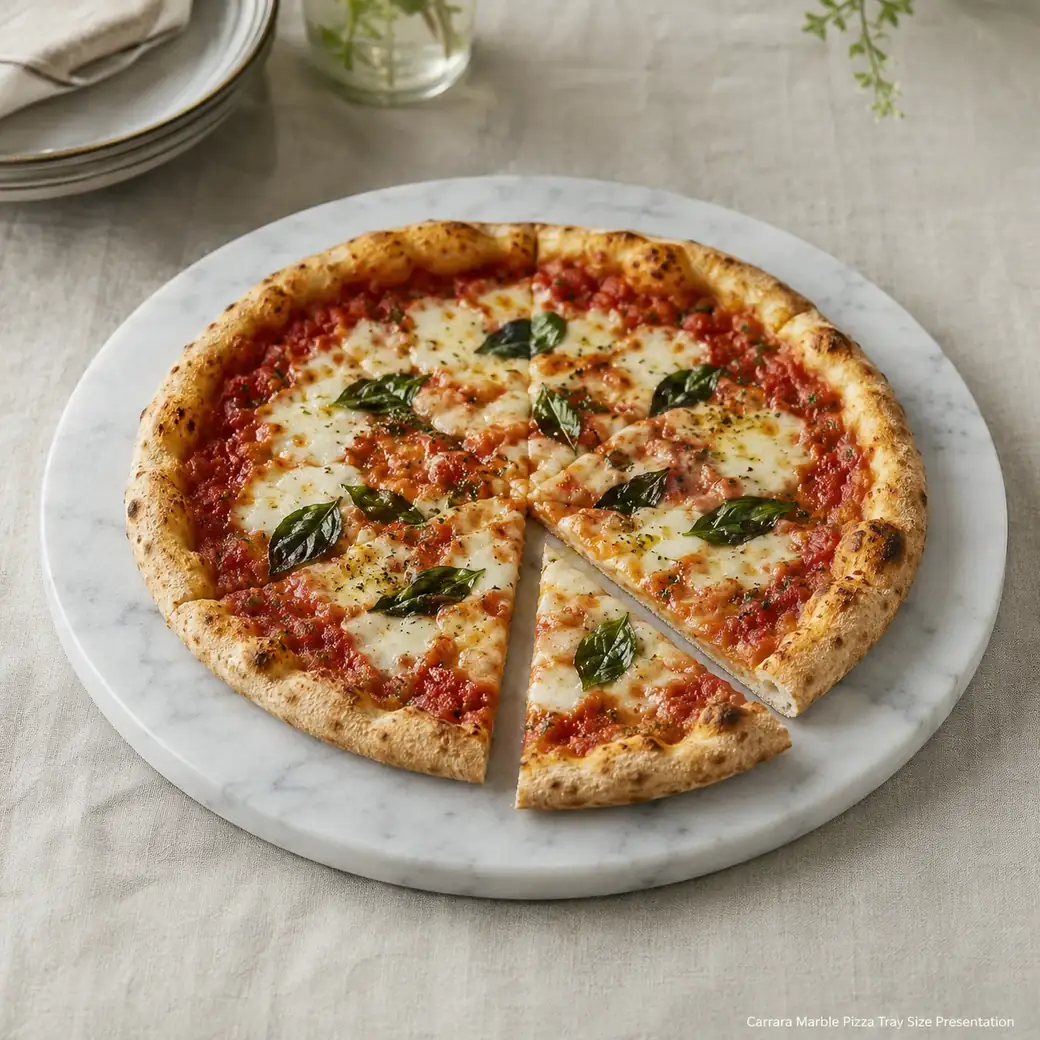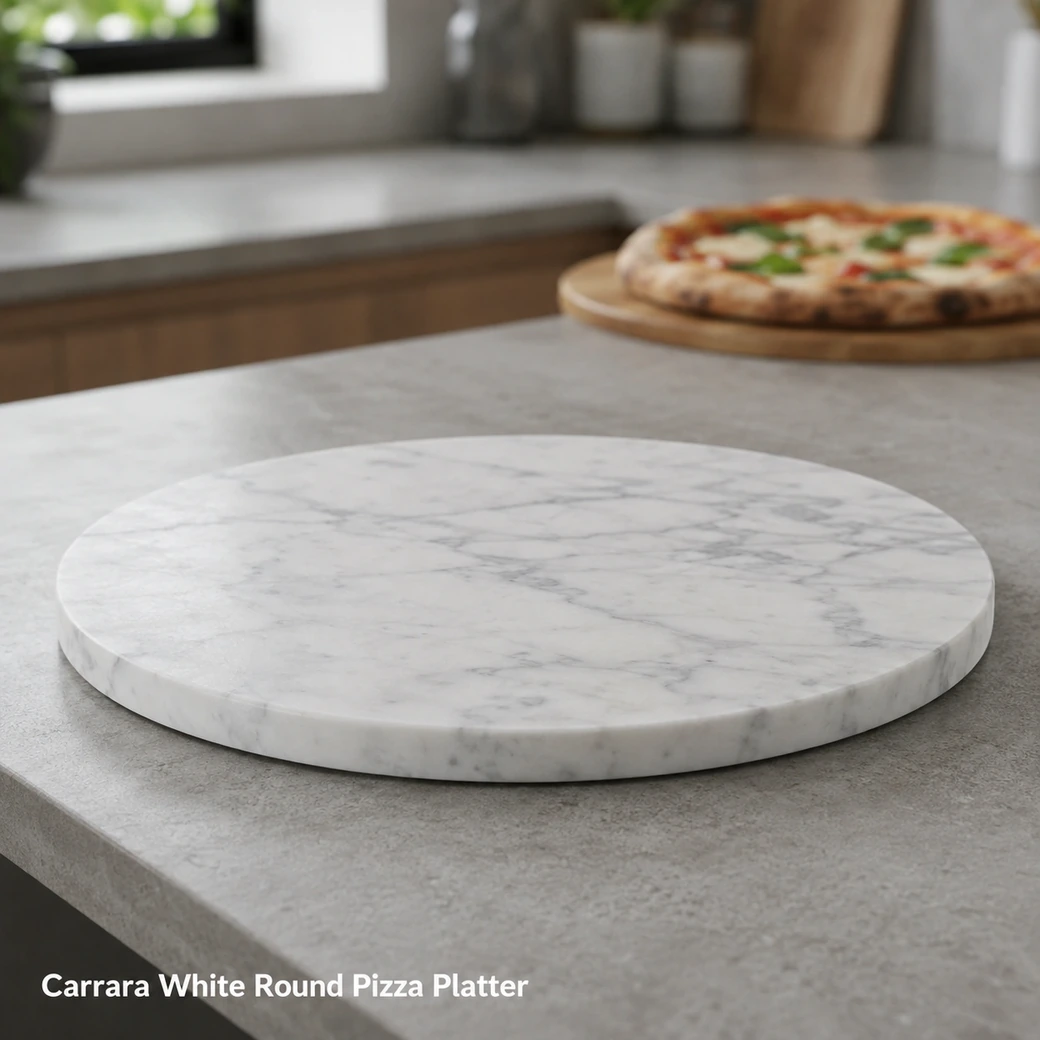
A pizza tray in natural stone works very well as a serving platter because the cool surface creates a premium presentation, although it will not keep pizza hot like an insulated server. Food use is appropriate on a properly finished, clean surface, with diameter selected slightly larger than the pizza. Avoid repeated knife cutting directly on stone because hard surfaces dull blades quickly; transfer slices with a pizza wheel or cut on a knife-friendly board, then hand-clean the tray.
Pizza Serving & Care
Marble Pizza Serving Tray Small
Secure product inquiry
Buy now
Cash on delivery available. Product details are pre-filled below. Owner delivery adds AED 5,000.
Stone Board Versatility
Serve Pizza on a Solid Natural Stone Platform
A solid stone pizza board works particularly well as a presentation and transfer surface rather than a cutting surface. The same round slab can also serve cheese, charcuterie, fruit or desserts, while direct repetitive knife cutting is better avoided because dense stone can dull blades quickly.
Pizza Size & Presentation
Choosing a Carrara Pizza Platter for the Right Pie
The Ø30 cm Carrara stone platter is best matched with a pizza slightly smaller than its full diameter so the crust remains supported while leaving a visible stone margin for handling and presentation. A pizza approaching the full 30 cm diameter would leave little clearance around the edge, whereas a modestly smaller pie creates a cleaner serving border and makes individual slices easier to lift. The circular format also presents portions evenly around the centre. Natural Carrara stone stays relatively cool and provides a premium serving surface, but it does not insulate or retain heat like a dedicated heated pizza server, so it should be chosen for presentation rather than for keeping the pizza hot.
Serving Beyond Pizza
How a Natural Stone Pizza Board Works at the Table
The Ø30 cm Carrara board can move easily between pizza, cheese, charcuterie and appetizer service because all four uses benefit from a broad, flat presentation surface. For pizza it suits a pie smaller than the full diameter, while for cheese or charcuterie the same space can be divided into several ingredients with enough exposed stone for serving utensils and visual separation.
Food-Safe Use of a Marble Pizza Board
Direct pizza contact is appropriate only when the honed marble surface and any sealer or treatment are confirmed food-contact safe.
Should You Slice Pizza on a Stone Platter?
Use the marble primarily for presentation and transfer pizza to a knife-friendly board for repeated cutting, since hard stone dulls blades faster.
Matching Pizza Size to a Round Marble Server
A pizza should sit slightly inside the Ø30 cm perimeter so a useful marble border remains for lifting, presentation and slice removal.
Product at a Glance
Carrara Pizza Serving Board Product Details
This pizza serving board is made from Veined White Marble in a milky white colour with soft grey veins, finished to a 220-grit honed surface. It measures Ø30 × 2 cm and weighs 3.8 kg, providing a compact natural-stone platter intended primarily for pizza presentation and serving rather than repeated knife cutting directly on the marble.
| Usable Serving Diameter | ů28 cm usable serving diameter |
|---|---|
| Edge Radius | R3 mm continuous eased perimeter edge. |
| Food-Safe Treatment | Sealed with a certified food-contact-safe penetrating stone sealer that does not form a surface film; acidic toppings should not remain on the marble after service. |
| Underside Protection | Four 2 mm food-grade silicone pads evenly spaced beneath the Ø30 cm tray to protect tables and create a slight lifting gap. |
| Anti-Slip Feet | Five evenly spaced Ø12 × 2 mm food-grade silicone feet beneath the Ø30 cm tray, including one central support pad. |
| Pizza Board Clearance | Suitable for pizzas up to Ø28 cm, leaving approximately 10 mm handling clearance around the complete Ø30 cm board edge. |
| Heat Exposure Limit | Do not place pizza directly from an oven above approximately 80°C onto the marble; allow brief cooling and use a food-safe liner to reduce thermal shock. |
| Handle Option | Two opposed shallow finger scallops, each approximately 70 × 18 mm, formed in the underside edge without cutting through the Ø30 cm board. |
| Juice/Groove Option | Optional circular juice groove approximately 8 mm wide × 3 mm deep, positioned 15 mm inside the Ø30 cm perimeter. |
| Packaging Protection | Wrapped in a food-safe non-woven sleeve, protected by circular foam sheets and packed flat in a rigid double-wall pizza-board carton. |
Carry & Table Use
Serving With a Solid Marble Pizza Platter
This Ø30 cm solid Carrara pizza platter is substantially heavier than a wooden board, so support it with both hands or specify shallow handles for safer transfer. Set it on a stable, level table before loading and use it to carry or present pizza rather than attempting to toss dough on the stone. Keep the pizza within the usable diameter so weight remains centered during movement.
Made for Food Presentation
Why Choose a Natural Stone Pizza Server
A natural stone pizza server provides a stable platter sized slightly beyond the pizza for easier lifting; its cool surface gives clean serving presentation; the solid weight helps it stay steady during table service; and the same platter can be reused for bread, cheese or other dry foods between pizza occasions.
- 30 cm Serving Surface
The 30 cm Carrara surface provides a stable platter for pizzas up to the matching serving size with room for table presentation.
- Cool Stone Presentation
The naturally cool Carrara surface gives pizza a clean stone presentation while functioning as a stable serving platter rather than a heat-retaining server.
- Charcuterie Crossover Use
The 30 cm Carrara platter can serve pizza and later function as a charcuterie surface for cheeses, breads and other suitable dry foods.
- Stable 3.8 kg Weight
The 3.8 kg Carrara body stays firmly positioned while pizza slices are lifted and served from the platter.
After the Meal
Cleaning a Honed Marble Pizza Board
A honed Carrara pizza board should be hand washed rather than left soaking, with oil, cheese and sauce residue removed promptly before it can mark the stone. Use a pH-neutral cleaner with a soft sponge or cloth, rinse away cleaner residue and dry the board thoroughly before storage; the same non-acidic care principles apply to many calcareous stones, including classic beige.

Technical Overview
Marble Pizza Tray Specifications
The specification table should help you verify the Ø30 cm serving diameter, 2 cm thickness and 3.8 kg weight together with the Carrara White veined marble, 220-grit honed finish, milky white and soft-grey appearance, food-contact status, optional handle provision and hand-cleaning requirements before ordering.
Product details
Specifications, care, delivery and FAQ
Everything is rendered from product JSON fields so the page remains SEO-ready even before JavaScript runs.
Cleaning: Let the tray cool before washing, remove cheese with a soft plastic scraper, blot grease and sauce, hand-wash with mild soap, rinse and dry promptly, avoid dishwashers vinegar citrus cleaner metal cutters and abrasive pads
Daily Care: Use as a serving platter rather than a cutting board, remove cheese oil and tomato sauce promptly, hand-wash after cooling, dry thoroughly, avoid sudden heat changes, never use vinegar or citrus cleaner
- Cutting pizza directly on Carrara
- leaving tomato sauce or cheese oil on the honed surface
- putting a hot tray into cold water
- washing in a dishwasher
- cleaning with vinegar or abrasive pads
Maintenance: Let the tray cool before washing, lift cheese with a soft plastic scraper, blot grease and tomato sauce, hand-wash with mild soap, dry promptly, cut pizza on a separate knife-friendly board
Handling: Use both hands beneath the 3.8 kg Carrara platter, keep the pizza centred, place it on a non-slip pad, never carry it by the 2 cm edge, avoid cutting forcefully on the stone, let very hot pizza pans cool before contact
What marble platter diameter is best for serving 10-inch and 12-inch pizzas while leaving enough edge clearance for lifting slices?
Allow roughly 2.5–5 cm of platter beyond the pizza on every side. A 10-inch pizza, approximately 25.4 cm, works best on a Ø30–32 cm platter; a 12-inch pizza, approximately 30.5 cm, needs around Ø35–38 cm. The Ø30 cm Carrara platter is ideal for a 10-inch pizza but too tight for a true 12-inch pizza. Use a peel or broad server for transfer, provide hand clearance beneath the edge, and avoid cutting directly on marble because it quickly dulls pizza wheels and knives.
Is this Ø30 cm honed Carrara marble platter suitable for direct pizza contact, and what food-safe treatment is needed before serving hot or oily slices?
The honed Carrara platter can contact pizza when the stone, filler and penetrating sealer are approved for food-contact use and fully cured. Because hot pizza contains oil, tomato and possible acidic toppings, parchment or a food-safe serving liner is still the safest option for preventing stains and etching. The Ø30 cm platter suits approximately a 10-inch pizza, not a full 12-inch pizza with lifting clearance. Avoid direct knife cutting, hand-wash with mild soap and dry immediately.
Why does cutting pizza directly on this honed Carrara marble platter dull knives and pizza wheels, and which separate cutting surface should be used instead?
Carrara marble is much harder than the sharpened edge of most kitchen knives, so repeated cutting rolls or abrades the fine steel edge and quickly reduces sharpness. Hard contact can also mark the stone or damage a pizza wheel. Cut pizza on a wood, rubber or food-grade polymer board, then transfer the slices to the marble platter using a peel or broad server. Avoid cutting directly on the serving tray even when its surface is food-safe.
Does this Carrara marble pizza tray retain useful heat after serving, or will its cool stone surface cause pizza to lose temperature faster than an insulated server?
Marble absorbs heat from the pizza initially and then releases it slowly, so an unheated Carrara tray will normally cool the base faster than an insulated or preheated server. It provides excellent presentation but is not a heat-retention product. Do not place the tray in an oven or expose it to sudden high heat unless specifically rated. Serve immediately, use an insulated cover where appropriate and avoid cutting directly on the stone.
How should melted cheese oil, tomato sauce and baked residue be removed from this 220-grit honed Carrara pizza tray without etching or darkening the marble?
Remove loose food after the tray cools, blot oil rather than spreading it, and wash with warm water, mild dish soap or pH-neutral stone cleaner using a soft pad. A persistent grease mark may need a stone poultice, whereas tomato-induced dullness is acid etching and requires re-honing; never use vinegar, citrus cleaner, metal scrapers or abrasive powder.
Reviews
Reviews and new review submission
0.0 average rating from 0 reviews. New reviews are saved as pending until approved.
No approved reviews yet for this product. The review form is ready for buyer submissions.