A marble sink is practical for bathrooms when the bowl, waste opening and countertop junction are fabricated correctly and protected from standing water. Vessel basins are offered in many proportions, so the ideal size should be selected from the available counter depth and faucet reach rather than one fixed standard. Custom carving is possible, while regular care requires prompt rinsing, a soft cloth and non-acidic cleaner; an impregnating treatment may be advisable depending on stone absorption.
Sculpted Natural Stone Basin
Marble Sink Small
Secure product inquiry
Buy now
Cash on delivery available. Product details are pre-filled below. Owner delivery adds AED 5,000.
Shapes, Drainage & Custom Carving
Configure the Basin Around Your Vanity Layout
Basin geometry should be coordinated with faucet reach, drain position and usable vanity depth before carving begins. Round vessels suit compact counters, while rectangular or fluted forms create more architectural presence; custom fabrication can also move the waste opening or adjust wall thickness to accommodate a specific installation.
Natural Material
Roman Travertine Vessel Sink Material and Finish
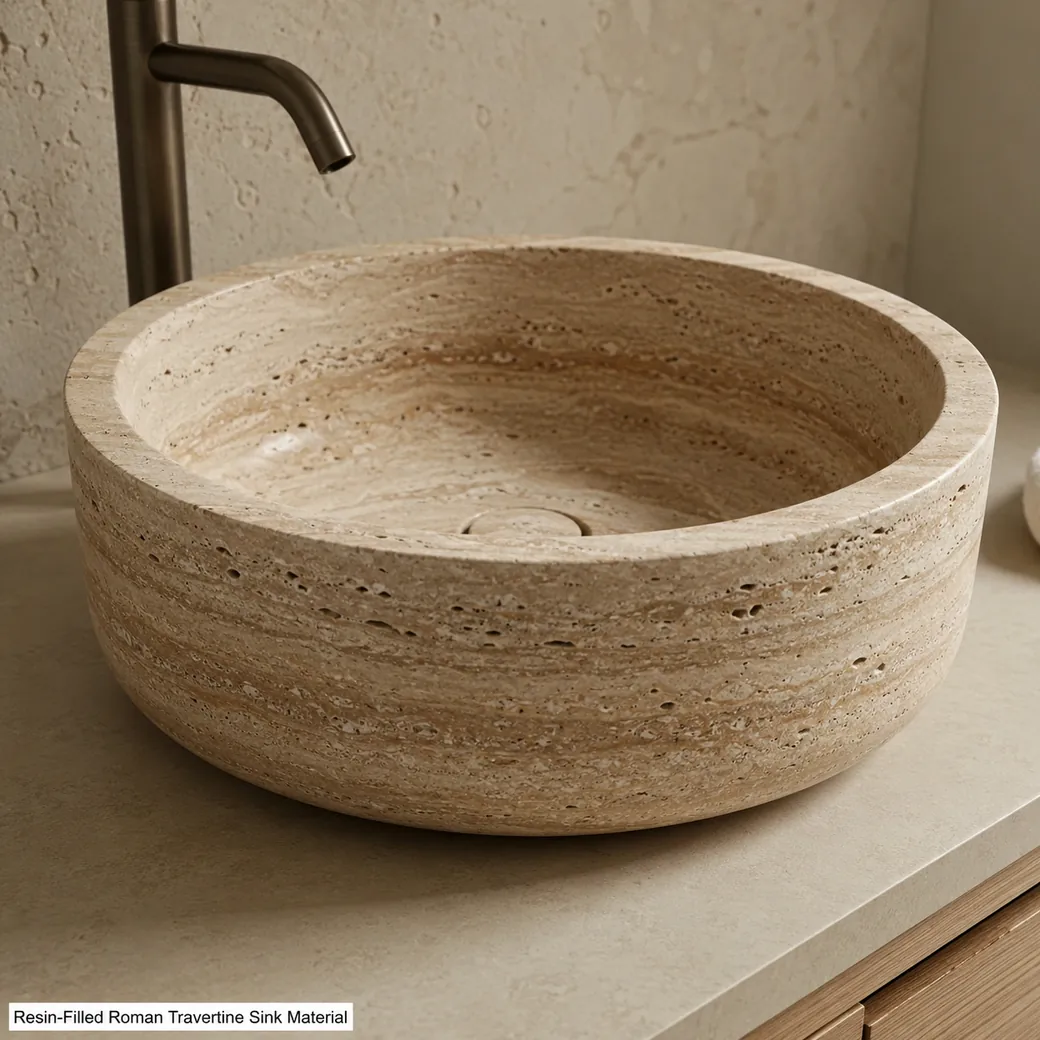
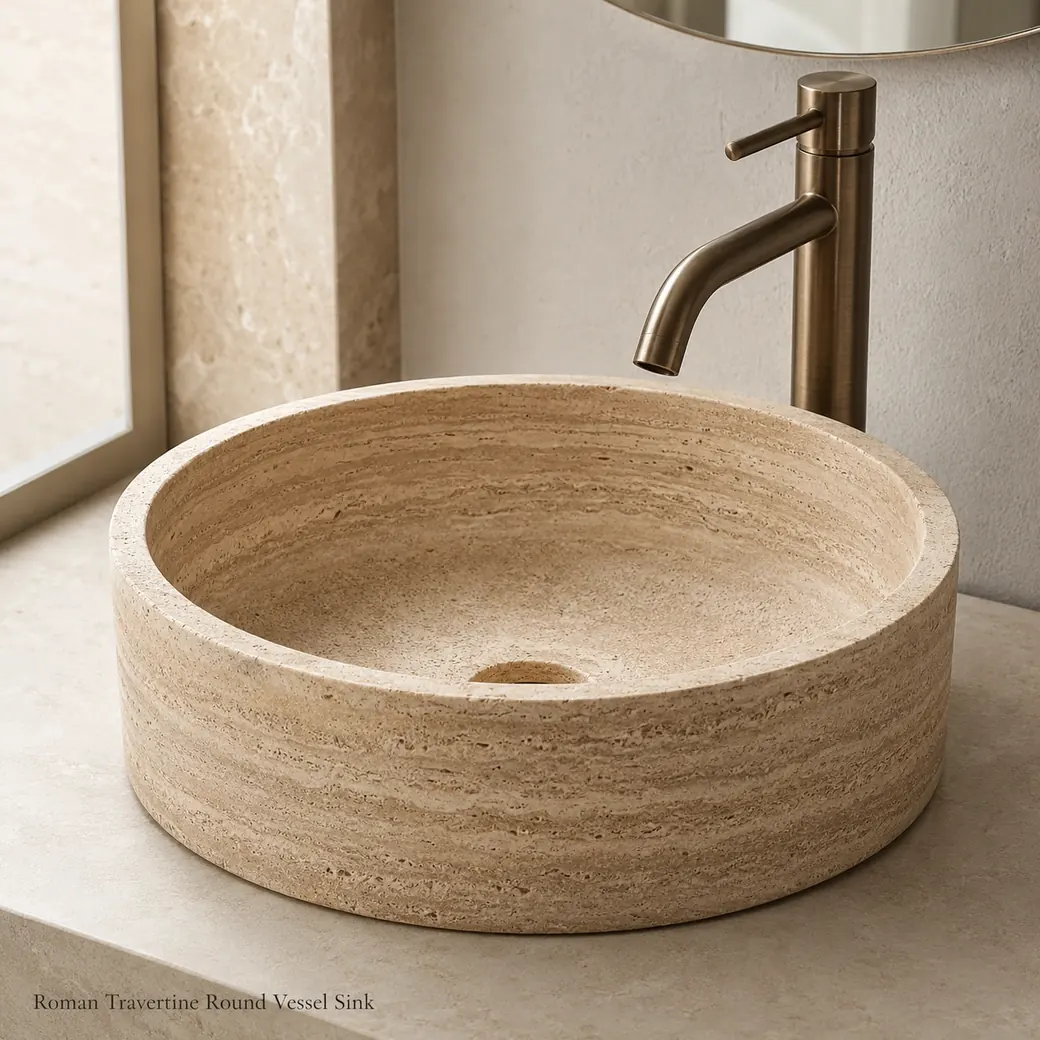
Roman Travertine brings a warm beige colour to this vessel sink, with subtle brown veining and mineral movement giving the carved form greater visual depth than a uniform manufactured basin. The Resin-Filled Honed Finish fills the stone’s more open natural pores and cavities before the surface is honed smooth, producing a more practical basin finish while retaining the characteristic travertine structure. Brown vein intensity, beige tone and small mineral features can vary across the rim, bowl and exterior walls, so each sink preserves visible evidence of the original stone block from which it was fabricated.
Form & Application
Natural Stone Basin Size and Bathroom Use
At Ø40 cm × H14 cm and 16 kg, this travertine vessel basin needs enough vanity depth to contain its full footprint while leaving practical space around the bowl. Faucet reach should place the water stream well inside the basin rather than on the rim, and the final counter position should preserve comfortable hand clearance without pushing the bowl too close to the wall or front edge.
Round Stone Vessel Basin Proportions
The Ø40 × 14 cm bowl gives a compact vessel-basin form with enough diameter for hand washing while limiting projection across the vanity.
Waste Opening and Drain Setup
The waste opening should be fabricated to the selected drain fitting and positioned at the bowl’s low point so water clears completely.
Countertop Stone Basin Mounting
Install the Ø40 cm vessel basin on a level supported vanity with its drain aligned before final fixing and its faucet positioned to clear the raised rim.
Detailed Breakdown
Travertine Bathroom Basin Product Details
This Roman travertine basin measures Ø40 × H14 cm, weighs 16 kg and uses a resin-filled honed warm-beige surface with subtle brown movement. The exact drain-opening diameter, rim thickness and mounting interface are not stated; faucet compatibility must be coordinated with the 14 cm vessel height, while sealing should follow the absorption characteristics of the finished stone.
| Drain Opening Diameter | Ø45 mm / 1.75 in standard drain opening |
|---|---|
| Overflow Provision | No overflow; use an unslotted/free-flow waste compatible with the Ø45 mm / 1.75 in drain opening. |
| Rim Thickness | 18 mm nominal finished rim thickness, with no section below 15 mm after profiling and polishing around the Ø40 cm basin opening. |
| Internal Bowl Depth | Approximately 115 mm usable internal bowl depth, leaving sufficient stone thickness beneath the waste outlet within the 140 mm overall basin height. |
| Base Contact Area | Approximately Ø18 cm continuous flat contact ring beneath the Ø40 cm vessel basin, isolated from the countertop with a thin neutral-cure silicone gasket. |
| Waste Fitting Type | Standard 1¼-inch unslotted basin waste with removable strainer, compatible with a vessel basin without an integral overflow. |
| Trap Clearance | Minimum 120 mm clear vertical space beneath the waste outlet for the trap and connection, excluding additional cabinet plumbing clearance. |
| Faucet Splash Zone | Allow at least 100 mm of sealed countertop behind the basin as the principal faucet splash zone, with wall protection extending approximately 150 mm above the rim. |
| Mounting Sealant Type | Non-staining neutral-cure sanitary silicone formulated for natural stone, applied as a continuous isolation and watertight seal beneath the basin base. |
| Technical Drawing Availability | Dimensioned fabrication drawing available showing external diameter, bowl depth, rim thickness, base-contact ring, waste opening and recommended countertop positioning. |
Everyday Care
Natural Stone Sink Care and Performance
Rinse soap and toothpaste from the polished Carrara basin after use, then wipe the bowl and rim dry so mineral deposits and standing-water marks do not build up. Use only pH-neutral bathroom cleaner because acidic descalers can etch the marble. Apply an impregnating sealer when absorption testing indicates it and keep the waste area clear so water does not remain around the bowl’s lowest point.
Practical Benefits
Why Choose a Travertine Vessel Basin
A Travertine vessel basin gives buyers a visible carved-stone feature rather than a sink that disappears into the vanity. It works particularly well in bathrooms where the basin is intended to contribute to the material palette and can be proportioned around the exact vanity and faucet arrangement.
- Custom Basin Geometry
The Travertine basin can be custom carved around vanity depth, faucet reach and waste position for a more exact bathroom fit.
- Wet Area Suitable
Properly fabricated and maintained Travertine performs effectively in bathroom wet areas when standing water is controlled and suitable sealing is used.
- Drainage Planned Design
Bowl geometry, waste position and internal slope can be fabricated together so water moves efficiently toward the drain instead of collecting within the basin.
- Stone Safe Maintenance
Routine rinsing, prompt drying and non-acidic cleaners help preserve the resin-filled Travertine surface without attacking the natural stone.
Customization
Custom Stone Sink Options
Custom Travertine sinks can be carved in round, square or rectangular forms with dimensions matched to the vanity depth, faucet reach and available counter space. Waste openings can be positioned to suit the plumbing, while fluted exteriors, smooth forms and honed or polished finishes can be specified before each basin is protectively crated for delivery; planning the surrounding vanity also benefits from understanding kitchen countertop dimensions.

Technical Data
Stone Basin Technical Specifications
The technical specification table combines Roman Travertine, resin-filled honed finish, warm beige colouring with subtle brown veining, Ø40 × H14 cm dimensions and 16 kg weight with waste-hole diameter, overflow provision, faucet relationship, countertop opening, mounting method, trap clearance and sealing requirements so your plumber can check compatibility before installation.
Product details
Specifications, care, delivery and FAQ
Everything is rendered from product JSON fields so the page remains SEO-ready even before JavaScript runs.
Cleaning: Rinse soap and toothpaste after each use, wipe with a soft cloth and pH-neutral cleaner, dry the bowl and waste area, clean filled pores gently, remove mineral residue with stone-safe products only, avoid acidic bathroom cleaners and abrasives
Daily Care: Rinse soap and toothpaste after use, wipe standing water daily, use only pH-neutral cleaner, avoid dropping hard toiletries into the bowl, keep the waste and countertop joint dry, monitor the surface for renewed absorption
- Leaving standing water or soap residue in Travertine
- using acidic toilet or bathroom cleaner
- supporting the 16 kg basin only through plumbing
- dropping hard objects into the bowl
- ignoring leakage at the waste or countertop junction
Maintenance: Rinse soap and toothpaste daily, dry standing water, use pH-neutral cleaner, clean around the waste with a soft brush, inspect the countertop seal and plumbing, reseal only when water begins absorbing
Handling: Use two people to lift the 16 kg Travertine basin from underneath, never grip the waste opening or thin rim, protect the resin-filled surface with clean foam, keep it upright, set it onto continuous padded support, tighten plumbing without stressing the stone
What vessel-basin diameter works best for my vanity depth while still leaving enough countertop space and correct faucet reach?
A vessel basin should leave approximately 8–12 cm of countertop in front, sufficient rear space for the faucet and splash control, and useful landing space on at least one side. A Ø40 cm Roman Travertine basin normally fits best on a vanity about 50–60 cm deep. For a deck-mounted faucet, allow roughly 8–12 cm behind the bowl plus the clearance required by the chosen tap body and handle; for a wall-mounted faucet, verify that the spout reaches near the basin’s drain without causing splash-back.
What faucet spout height and reach should be selected for this Ø40 × H14 cm Roman Travertine vessel sink so the water lands near the drain without excessive splashing?
For a Ø40 cm vessel sink with a 14 cm bowl height, choose a faucet whose outlet sits roughly 10–15 cm above the rim and reaches far enough for the stream to land near the drain—often around 14–18 cm from the faucet centreline. Excessive height increases splash, while insufficient reach sends water against the rear bowl wall. Use the actual faucet drawing and a plan-view template before drilling because mounting position, spout angle and water pressure materially affect performance.
What waste-hole diameter should be fabricated in this Roman Travertine vessel basin to fit a standard unslotted or slotted basin waste without unsafe site enlargement?
Many vessel basins use a nominal 45 mm waste opening for a standard 1¼-inch basin waste, but actual flange and body dimensions vary. Select the slotted or unslotted waste first—usually unslotted when the basin has no overflow—then fabricate the hole from its technical drawing. Maintain adequate stone around the opening and use diamond tooling at the workshop. Never enlarge the Roman Travertine hole on site without the fabricator’s approval.
Does this resin-filled Roman Travertine sink require penetrating sealer before bathroom use, and how should future resealing be determined from actual water absorption?
Resin filling does not eliminate natural Travertine absorption, so test the clean dry bowl before use. If water darkens the surface within several minutes, apply a bathroom-compatible penetrating sealer and allow full curing; if it remains beaded, do not add unnecessary coats. Repeat the water test periodically in the bowl and rim rather than sealing annually by habit. Sealer reduces staining but cannot replace prompt drying or protect against acidic cleaners.
What countertop reinforcement, cut-out dimensions and under-basin plumbing clearance are required to support this 16 kg Roman Travertine vessel sink safely?
The 16 kg basin requires a rigid, moisture-resistant vanity top that supports its full base or engineered bearing ring rather than relying on plumbing or a thin cut-out edge. Template the actual basin and waste before cutting, reinforce narrow countertop sections where necessary, and leave accessible clearance below for the waste fitting, trap, supply lines and future maintenance while confirming that the faucet reaches comfortably into the Ø40 cm bowl.
Reviews
Reviews and new review submission
0.0 average rating from 0 reviews. New reviews are saved as pending until approved.
No approved reviews yet for this product. The review form is ready for buyer submissions.