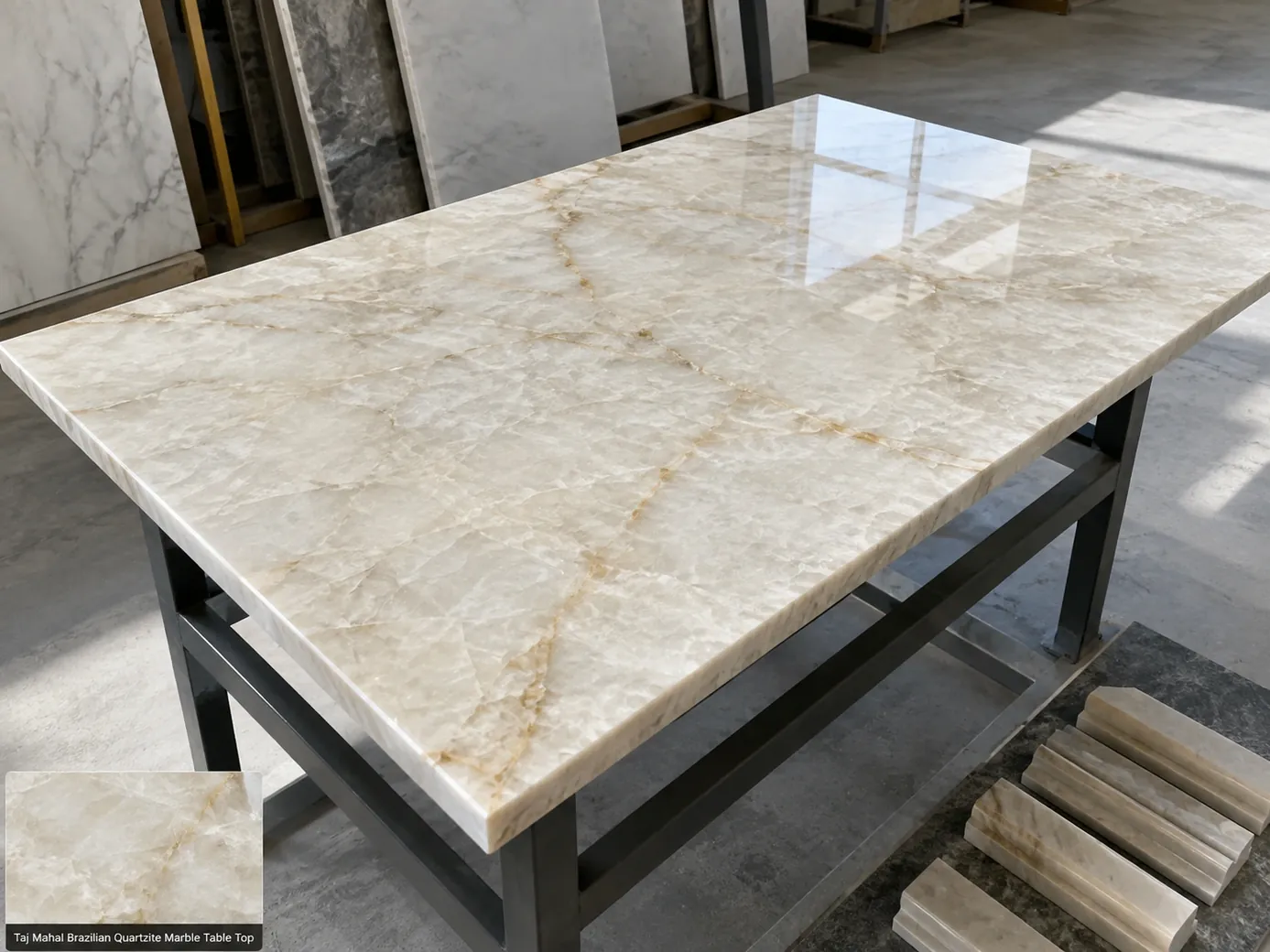
Table-top thickness should be engineered around slab strength, span, edge profile and the support frame instead of chosen from one universal dimension. Tops can be cut to custom shapes and finished with straight, beveled, bullnose or other fabricated edges. Some natural stones benefit from impregnating sealer, while trivets remain recommended for hot objects; exterior use requires checking the specific stone’s weathering suitability.
Custom-Cut Stone Surface Options
Marble Table Top Small
Secure product inquiry
Buy now
Cash on delivery available. Product details are pre-filled below. Owner delivery adds AED 5,000.
Thickness, Edges & Replacement Fit
Selecting Thickness, Edge Profile and Base Support
Tabletop performance depends on thickness, edge treatment and how the slab is supported. Natural-stone tops are commonly made in 20, 30 and 40 mm thicknesses with eased, bevelled, bullnose, ogee or chamfered edges, while fixing plates may be added for particular bases. This Taj Mahal quartzite top is 90 × 60 × 2 cm, so the supporting frame should distribute its 29.2 kg weight evenly rather than relying on a few narrow contact points.
Cut-to-Size Stone
Taj Mahal Quartzite Replacement Tabletop
The Taj Mahal Quartzite Replacement Tabletop is a 90 × 60 × 2 cm polished natural-stone surface intended for either replacing an existing top or becoming the finished surface of a newly fabricated table. Its soft white-beige background and flowing golden movement give furniture a warmer, more refined appearance while retaining the individuality of Brazilian quartzite. Weighing 29.2 kg, the top requires a suitably engineered base or frame, making it especially appropriate for custom furniture projects where support, proportions and edge detailing can be designed specifically around the stone.
Fabrication Planning
How to Specify a Custom Stone Table Surface
This 90 × 60 × 2 cm Taj Mahal quartzite top should be specified together with its supporting base, because the 20 mm section, unsupported span and support-point spacing determine how the surface performs. A broad frame or closely spaced supports can carry a thinner top more effectively, while a more open pedestal arrangement may require additional reinforcement or a different thickness; final dimensions and edge fabrication should therefore follow the actual base drawing.
Select 20 mm, 30 mm or Thicker Table Slabs
Increasing quartzite thickness adds visual substance and weight but also raises the demands on the base, span support and handling compared with a thinner engineered top.
Finish a Quartzite Tabletop with the Right Edge
Eased edges give a subtle softened profile, bevels and chamfers create crisp facets, bullnose rounds the perimeter and ogee adds a more decorative moulded edge.
Secure a Replacement Stone Top Correctly
Fixing plates should create broad frame contact beneath the quartzite so the 29.2 kg top is evenly supported without long unsupported spans.
Product Data
Quartzite Tabletop Product Details
This small tabletop is cut from polished Taj Mahal Brazilian Quartzite with a soft white-beige field and golden movement. Measuring 90 × 60 × 2 cm and weighing 29.2 kg, the 20 mm top needs an edge profile and support frame selected to avoid excessive unsupported span; the exact edge profile is not stated.
| Mounting Insert Type | M6 A4 stainless threaded inserts epoxy-bonded into reinforced underside pads |
|---|---|
| Support Span Requirement | Maximum recommended unsupported span: 600 mm before additional framing/support |
| Underside Reinforcement | Two recessed 40 × 20 × 2 mm steel stiffener rails bonded beneath the long span |
| Flatness Tolerance | Maximum 1.5 mm deviation under a 1.2 m straightedge |
| Fabrication Tolerance | Finished length and width tolerance of ±2 mm, thickness tolerance of ±1 mm and diagonal difference not exceeding 3 mm |
| Corner Radius | R20 mm corner radius on all four plan-view corners |
| Seam Position | Main seam centred directly above a structural base support rather than across an unsupported span |
| Base Contact Pad | 3 mm-thick high-density neoprene isolation pad between the stone top and supporting base |
| Vein Orientation | Primary vein direction aligned with the longest tabletop dimension |
| Cutout Provision | Cutouts fabricated from approved templates with minimum R10 internal corners and at least 80 mm stone remaining from any edge |
Made to Measure
Custom-Cut Marble Top Options
Custom-cut stone tops can be fabricated in round, square, rectangular or fully bespoke shapes using marble, quartzite, travertine or other suitable materials. Drilled fixing points, cable holes and equipment cutouts should follow approved templates, with made-to-order production preserving safe stone margins around every opening.
Fabricated for Fit
Why Choose a Custom Stone Replacement Top
A custom stone replacement top allows an existing dining, console or table base to be upgraded without replacing the complete piece. Taj Mahal quartzite can be cut to the required shape, span, thickness and edge profile, allowing the fabricator to match the support structure accurately and produce a finished top that fits the furniture rather than relying on a standard off-the-shelf size.
- Cut to Exact Size
The quartzite top can be fabricated to exact furniture dimensions, including custom shape, openings and edge profiles.
- Multiple Edge Profiles
Straight, beveled, bullnose and other edge profiles can be fabricated to suit the table base and design intent.
- Polished Quartzite Finish
Polishing brings out the Taj Mahal quartzite’s soft beige tone and golden movement while creating a smooth reflective surface.
- Base Fixing Options
The quartzite top can be mechanically fixed, bonded or supported within a properly engineered base according to the furniture design.
Use & Protection
Maintaining a Natural Stone Table Surface
Use trivets beneath hot objects, clean the polished Taj Mahal quartzite with a pH-neutral stone product and consider impregnation only where the slab's absorption and exposure make it beneficial. Exterior placement should be confirmed specifically for the selected quartzite and climate, while the 29.2 kg top must be carefully supported and fixed during installation; similar material-performance questions often arise when comparing formica vs granite.

Technical Specification
Replacement Tabletop Specifications
Use the replacement-top specifications to verify the finished shape, edge treatment, fixing method and fabrication options before ordering for an existing base. These details are essential for confirming that the new top can be mounted correctly rather than assuming that matching overall dimensions alone will guarantee compatibility.
Product details
Specifications, care, delivery and FAQ
Everything is rendered from product JSON fields so the page remains SEO-ready even before JavaScript runs.
Cleaning: Lift grit with microfiber, wipe polished Taj Mahal quartzite using diluted pH-neutral stone cleaner, blot oil wine and colored spills promptly, rinse with minimal clean water and dry, use trivets and coasters, avoid harsh alkalis abrasives wax buildup and thermal shock
Daily Care: Dust with microfiber, use coasters trivets and felt pads, blot oils wine and colored spills immediately, wipe polished Taj Mahal quartzite with pH-neutral stone cleaner, dry without streaks, avoid harsh chemicals abrasives and unsupported heavy loads
- Avoid excessive unsupported spans
- avoid point loads near cutouts or edges
- avoid direct hot cookware
- avoid harsh chemicals or abrasives
- avoid lifting the 29.2 kg top without full edge support
Maintenance: Support the top evenly, use coasters trivets and padded accessories, blot stains promptly, clean polished quartzite with pH-neutral stone cleaner, inspect edges and supports for movement, reseal only when the specific stone’s absorption requires it
Handling: Carry the 29.2 kg quartzite top vertically in a padded A-frame where practical, use at least two trained handlers, support the full edge, avoid lifting through cutouts, protect corners, lower evenly onto correctly spaced base supports
How should I template my existing table base so this custom Taj Mahal quartzite top is fabricated with the correct footprint, fixing points, overhang and support positions?
Create a rigid full-size template of the installed base, marking its exact perimeter, centre lines, front orientation, leg and rail positions, fixing holes, obstructions and every supported versus unsupported area. Record the desired overhang from confirmed reference points, photograph and dimension the base diagonally, and have the stone fabricator verify the template on site before drilling or cutting the quartzite.
How much unsupported overhang can this 20 mm stone tabletop safely have beyond the base before steel reinforcement or additional support is required?
A 20 mm natural-stone top should have conservative overhangs, commonly around 20–30 cm only when the stone, edge condition and base support are suitable. Larger spans, narrow support points, cutouts or seating overhangs may require a steel subframe or concealed brackets; the fabricator must approve the final support layout for the specific slab.
Should this 29.2 kg quartzite tabletop be bonded to its frame, mechanically secured with inserts or installed using both methods?
Use both methods: flexible stone-compatible adhesive distributes load and prevents vibration, while engineered mechanical clips or threaded inserts provide positive restraint. Avoid drilling improvised fixings into the quartzite; all inserts and frame supports should be planned during fabrication and allow minor differential movement.
How closely spaced must the base supports be beneath this 20 mm Taj Mahal quartzite top to limit flexing and reduce cracking risk across unsupported spans?
For a 20 mm Taj Mahal quartzite top, provide continuous perimeter support plus cross-supports so unsupported areas generally remain no greater than about 40–50 cm, subject to slab quality and base design. Keep supports closer around edges, fixings and cutouts, limit overhang and have the fabricator approve the exact frame because natural fissures and concentrated loads can require near-continuous backing.
How should the gold vein direction be oriented across this custom Taj Mahal quartzite tabletop in relation to the base, room layout and primary viewing position?
Orient the primary gold movement along the table’s longest visual axis or toward the main room viewpoint, while centring dramatic features rather than allowing them to terminate awkwardly at edges. Overlay the exact 90 × 60 cm template on the slab image, coordinate vein direction with the base and seating orientation and avoid placing natural fissures over unsupported spans or fixing points.
Reviews
Reviews and new review submission
0.0 average rating from 0 reviews. New reviews are saved as pending until approved.
No approved reviews yet for this product. The review form is ready for buyer submissions.