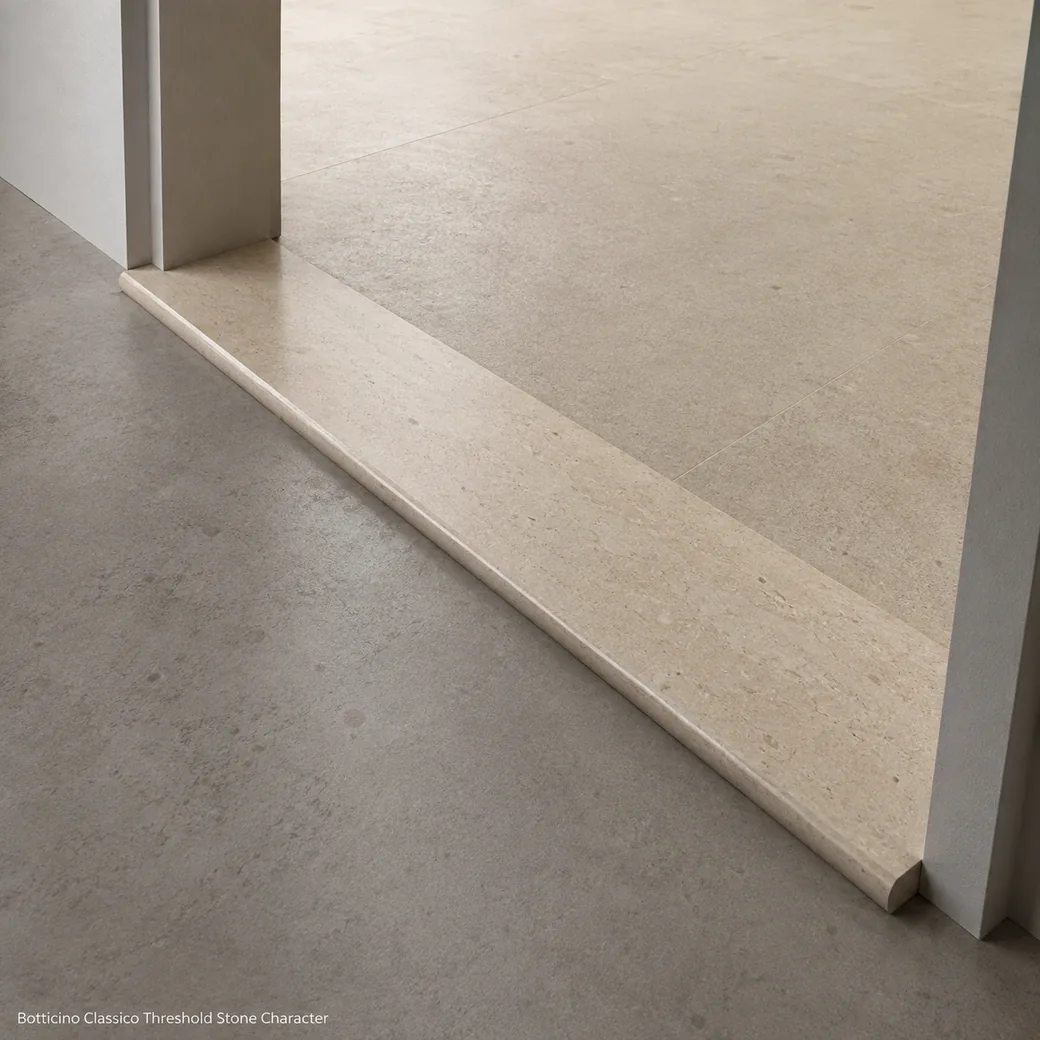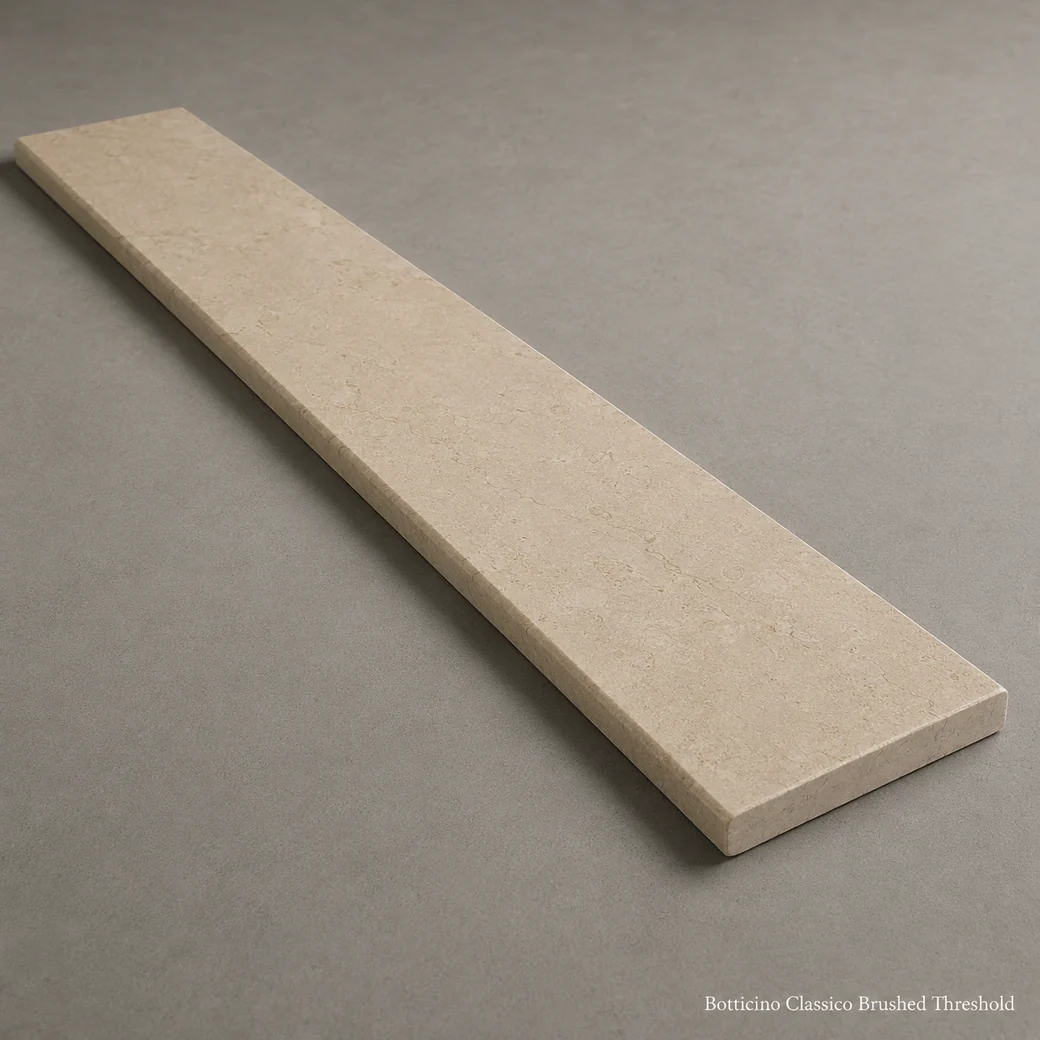
Threshold marble is the stone strip installed across a doorway or floor transition, while “marble saddle” is commonly used for the same type of raised transition piece. Width, length and thickness can be cut to the actual opening; a textured, brushed or honed walking surface is usually more practical than a highly polished wet threshold. Installation requires a flat, well-supported substrate and suitable stone adhesive, with custom cutting allowing exact door-jamb and floor-level coordination.
Precision Stone Transitions
Marble Threshold Small
Secure product inquiry
Buy now
Cash on delivery available. Product details are pre-filled below. Owner delivery adds AED 5,000.
Profiles, Edges & Custom Cuts
Match Every Transition to the Exact Opening
A threshold should be measured to the actual jamb width, finished floor levels and intended transition rather than selected only by standard length. Flat, bevelled and Hollywood-style profiles solve different level changes, while brushed or honed walking surfaces are generally more appropriate where the strip sits near bathrooms or other wet areas.
Stone Character
Botticino Stone Threshold Material and Finish
Botticino Classico is a compact limestone with a warm beige-ivory body defined by fine brown veining and delicate mineral movement rather than bold contrasting patterns. The Brushed Finish gives the threshold a lightly textured, less reflective surface that visually softens the beige stone while making the narrow brown veins and tonal variations easier to read at floor level. Its dense limestone structure provides a visually substantial transition piece, while differences in vein placement and beige concentration retain the natural character of Botticino across each cut section.
Scale & Configuration
Natural Stone Door Saddle Size and Application
The 91.4 × 10.2 × 1.6 cm format is sized for a typical doorway-width transition and weighs about 4 kg, making it suitable as a stone saddle between adjoining floor finishes. It can also be adapted for bathroom entries, shower curbs or sill details where width, finished floor levels and jamb dimensions are checked before cutting.
Flat and Hollywood Threshold Profiles
The 91.4 × 10.2 × 1.6 cm profile forms a slim doorway transition that can bridge adjoining floor finishes without excessive projection.
Brushed Stone Door Transition
The brushed walking surface offers more practical traction than high polish at wet or frequently crossed doorway transitions.
Custom-Cut Doorway Saddle
Bed the 91.4 cm threshold fully on a flat supported substrate and coordinate its finished height precisely with both adjoining floor surfaces.
Product Overview
Stone Door Threshold Product Details
This Botticino Classico compact-limestone threshold measures 91.4 × 10.2 × 1.6 cm, weighs 4 kg and uses a brushed warm beige-ivory surface with fine brown veining. The exact exposed edge profile is not stated, while installation requires a flat, fully supported substrate and compatible stone adhesive coordinated with the adjoining floor levels and doorway opening.
| Edge Bevel Detail | 3 mm × 45° eased bevel on exposed longitudinal edges |
|---|---|
| End-Cut Tolerance | ±1.0 mm finished length with ≤1.0 mm out-of-square across the 102 mm width. |
| Transition Height Difference | Suitable for bridging a maximum 12 mm finished-floor height difference using a gradual beveled transition; greater differences require substrate build-up or a purpose-cut ramp profile. |
| Door-Clearance Requirement | Provide at least 6 mm clearance between the door leaf and the highest finished threshold point, including allowance for normal hinge movement and minor floor variation. |
| Movement-Joint Allowance | Maintain a 5 mm perimeter movement gap at door jambs and adjoining rigid finishes, filled with colour-matched neutral-cure flexible sealant rather than grout. |
| Moisture Barrier Interface | Turn the adjoining waterproofing membrane up beneath the threshold and bond it continuously to the substrate, maintaining sealed continuity at both door jambs. |
| Bond-Bed Thickness | 6–10 mm finished white flexible stone-adhesive bed over a flat, fully supported substrate, with no spot bonding or unsupported voids. |
| Slip-Resistance Classification | Target wet pendulum classification P4 or DIN 51130 R11 equivalent for the brushed walking surface, subject to batch-specific slip testing. |
| Cut-to-Jamb Tolerance | Cut finished ends to within ±1 mm of the verified jamb-to-jamb site dimension, allowing a 3–5 mm flexible perimeter joint at each end. |
| Expansion Gap | Maintain 5 mm expansion clearance at both jambs, filled over backing material with colour-matched neutral-cure flexible sealant rather than grout. |
Maintenance & Use
Doorway Stone Transition Care and Performance
The brushed Botticino threshold provides better wet-foot practicality than a polished strip, but soap, dust and standing water should still be removed to preserve traction. Install it over a flat, continuously supported substrate using compatible stone adhesive, with waterproofing or moisture-control detailing maintained beneath and at adjoining wet-area finishes. Clean with a pH-neutral product and inspect perimeter sealant rather than allowing moisture to enter open jamb joints.
Why It Works
Why Choose a Natural Stone Saddle
A natural stone saddle gives buyers a durable, purpose-cut transition between adjoining floor finishes while protecting the doorway edge from repeated foot traffic. It is particularly useful where exact floor levels, door-jamb dimensions and a visually finished transition matter.
- Exact Opening Fit
Custom cutting matches the saddle precisely to doorway width, jamb position and adjoining floor levels for a cleaner transition.
- Durable Floor Transition
The solid Botticino transition protects and finishes the doorway junction while handling regular foot traffic between adjoining floors.
- Multiple Edge Profiles
Straight, eased, bevelled or other fabricated edge treatments can be selected to coordinate the Botticino threshold with adjoining floors and doorway details.
- Wet Area Options
Brushed or honed Botticino surfaces can be specified for suitable wet transitions when combined with correct drainage, waterproofing and installation detailing.
Bespoke Options
Custom Threshold and Sill Options
Botticino thresholds and sills can be cut to the exact doorway length, width and thickness, with square, bevelled or eased edges selected around adjoining finishes. Accessibility-conscious profiles can be fabricated to reduce abrupt level changes, while final dimensions should coordinate precisely with door jambs and finished floor heights; this type of site-specific stone supply is also associated with a zenith modern stackstone supplier vancouver.

Specification Guide
Door Threshold Technical Specifications
Check the table for Botticino Classico compact limestone, brushed finish, warm beige-ivory colouring with fine brown veining, 91.4 × 10.2 × 1.6 cm dimensions and 4 kg weight, plus edge profile, finished opening size, floor-level difference, adhesive requirement, joint allowance and substrate condition needed for installation.
Product details
Specifications, care, delivery and FAQ
Everything is rendered from product JSON fields so the page remains SEO-ready even before JavaScript runs.
Cleaning: Sweep away abrasive grit, wipe with diluted pH-neutral cleaner, scrub the brushed texture gently with a soft nylon brush, rinse thoroughly, dry wet edges, avoid acidic bathroom descalers bleach and wire brushes
Daily Care: Sweep away grit frequently, dry water tracked from the bathroom, clean with pH-neutral stone cleaner, keep adjoining joints sealed, avoid acidic descalers and metal brushes, inspect for looseness or raised edges
- Using highly acidic bathroom descaler
- allowing wet grit to accumulate on the brushed finish
- installing over hollow or unsupported areas
- leaving raised edges that create a trip hazard
- polishing the wet walking surface to a slippery gloss
Maintenance: Sweep away abrasive grit daily, dry bathroom water promptly, clean brushed texture with a soft nylon brush, keep perimeter joints sealed, use pH-neutral products, inspect regularly for looseness or raised trip edges
Handling: Carry the long 1.6 cm Botticino threshold vertically with support near both ends, never lift it from the centre alone, protect the thin edges with foam, keep it fully supported during transport, dry-fit before applying adhesive
How wide should a marble threshold be so it fully bridges the doorway opening and aligns correctly with both floor finishes?
The threshold should extend from finished jamb to finished jamb and cover the entire transition between the two flooring materials, including any exposed substrate or waterproofing termination. Its finished width is therefore determined on site rather than selected from the nominal door width; typical internal thresholds are about 100–150 mm wide, but thicker walls or offset floor junctions may require more. The 102 mm-wide Botticino piece is suitable only if it fully spans the measured transition, sits beneath the closed door where required and finishes flush—or with safely bevelled edges—with both adjoining floors.
Is a flat or bevelled Botticino marble threshold safer and more practical when joining two floor finishes with slightly different finished heights?
Use a flat threshold when both finished floors are level because it provides the easiest passage and lowest trip risk. Choose a bevelled or ramped profile when there is a small height difference, with a gentle transition rather than an abrupt raised edge. The 16 mm Botticino threshold must have full support beneath it and should not bridge an unsupported step. Confirm accessibility limits, door clearance and both finished floor levels before cutting; a bevel cannot safely compensate for a substantial change in elevation.
How should this Botticino marble threshold be installed over concrete, screed, tile or timber substrates so it remains fully supported and does not crack at the floor transition?
Install the threshold on a flat, rigid and fully supported bed using a white stone-compatible adhesive. Concrete or screed should be clean and stable; existing tile may require abrasion and an approved primer; timber needs a reinforced tile backer or uncoupling system to control movement. Do not bridge different flexible substrates without a movement detail. Confirm finished heights, waterproofing termination and door clearance before setting the Botticino piece, then protect its edges until curing is complete.
What Botticino marble threshold thickness and edge profile should be specified when adjoining floors finish at different heights without creating a trip hazard?
The 16 mm Botticino piece can bridge small level differences when fully supported, but threshold thickness should be selected from the higher finished floor, substrate build-up and required edge strength. Use a flat profile when floors are level and a gently bevelled or ramped edge where one side is higher; avoid abrupt vertical lips. The transition should comply with applicable accessibility limits, and larger differences should be corrected in the substrate rather than disguised by a steep marble bevel.
Is the brushed Botticino Classico finish safer and more practical than a polished finish for this 91.4 cm bathroom threshold when it will regularly be walked on with wet feet?
The brushed Botticino Classico finish is generally more practical than a polished surface at a wet bathroom entrance because its texture offers better barefoot traction and disguises water marks more effectively. Texture alone does not guarantee safety, so request documented wet-slip test performance for the finished threshold and install it with proper support, drainage control and bevelled transitions that do not create a trip edge.
Reviews
Reviews and new review submission
0.0 average rating from 0 reviews. New reviews are saved as pending until approved.
No approved reviews yet for this product. The review form is ready for buyer submissions.