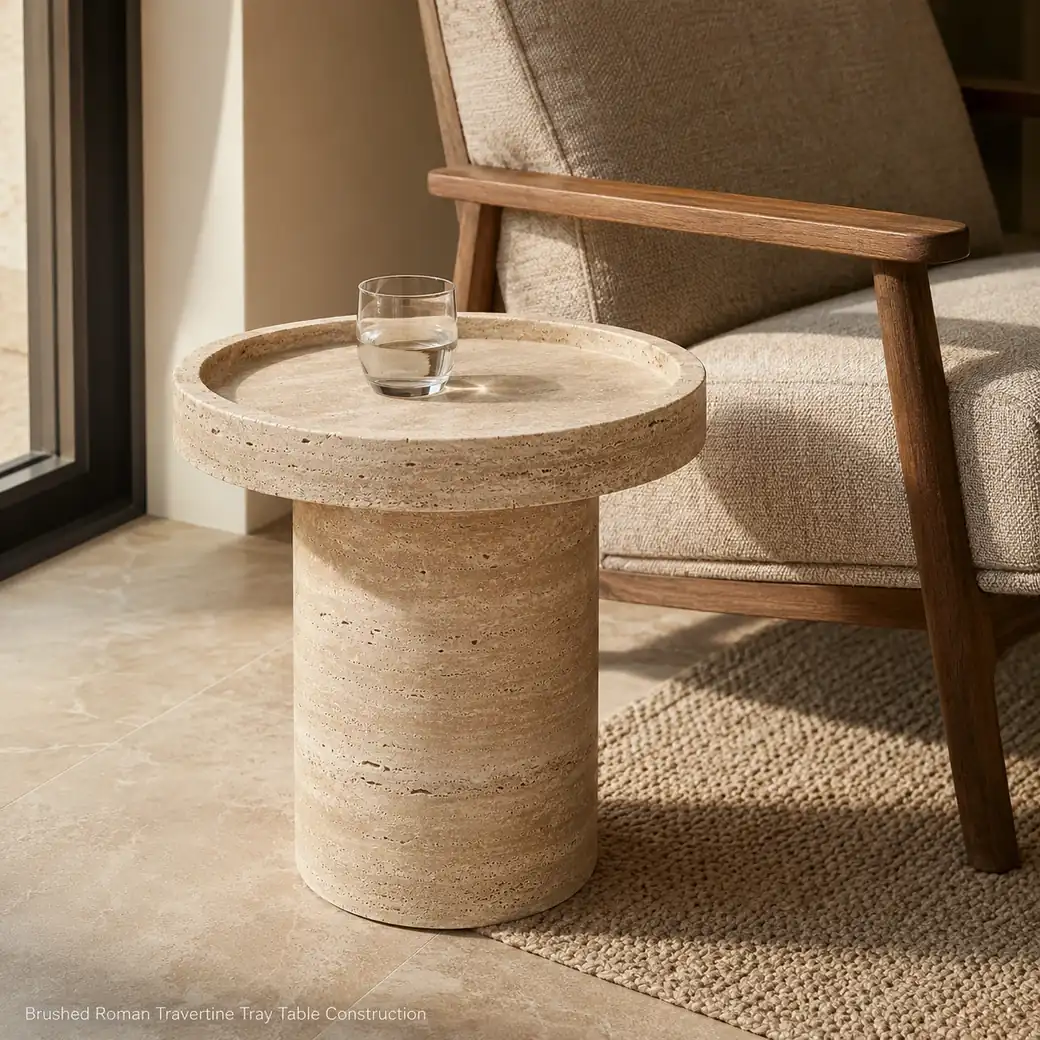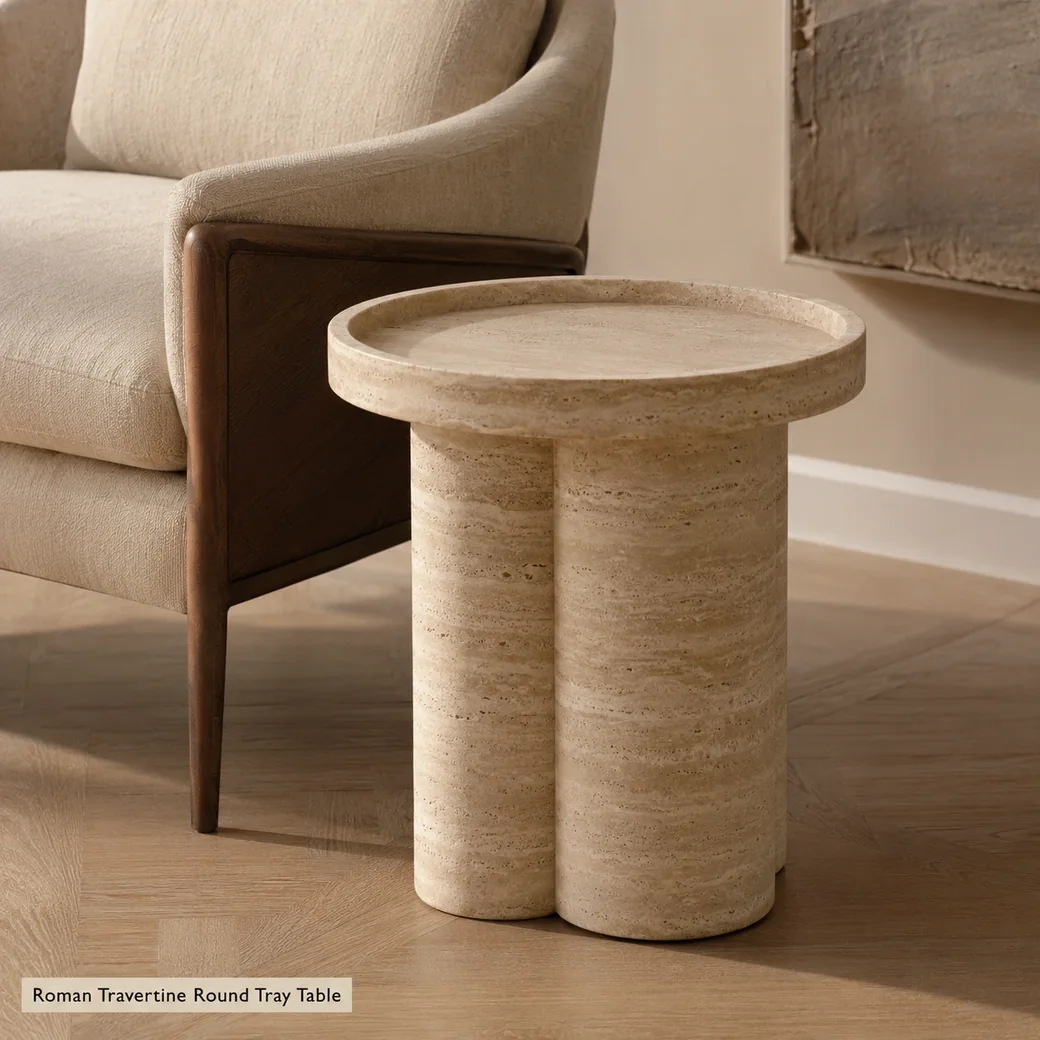
A tray table combines the accessible surface of a serving tray with the height and stability of a side table, making it useful beside sofas, lounge chairs or beds. Whether its upper tray is removable depends on the construction, so that feature should be specified rather than assumed. Overall height should relate to adjoining furniture, while stone makes the piece naturally substantial; custom dimensions, edge height and base geometry can be fabricated for the intended room.
Compact Pedestal Function
Marble Tray Table Small
Secure product inquiry
Buy now
Cash on delivery available. Product details are pre-filled below. Owner delivery adds AED 5,000.
Removable Tops & Mixed-Material Bases
Combine Portable Serving with Side-Table Function
A tray table can be designed so the stone top lifts away for serving, or fixed permanently when stability is more important. Mixed bases in brass, bronze or other metals reduce visual weight and can introduce X-frames or stretchers that would be difficult to achieve economically as solid stone.
Surface & Construction
Roman Travertine Tray Table Material and Finish
Roman Travertine brings a Classic Warm Beige palette to this tray table, with subtle bands, pores and mineral movement resulting from its Sedimentary Travertine formation. The Brushed-Honed Finish combines light surface texture with a refined honed feel, avoiding strong gloss while allowing natural directional markings to remain visible. Beige tone, banding and pore distribution can change across the top and supporting elements, so each finished table develops an individual stone composition. This natural variation prevents the warm beige surface from appearing flat or mechanically uniform.
Sizing & Placement
Natural Stone Tray Side Table Size and Use
The Ø40 × H50 cm proportions place the 22 kg tray surface at a practical side-table height for lounge chairs, sofas and many beds. The 40 cm top gives enough room for a drink, book, lamp or small serving arrangement, while the pedestal footprint should remain stable without extending excessively into surrounding circulation.
Removable Stone Tray Top Options
The Ø40 cm tray-style top gives a contained side-table surface, with the raised edge kept shallow enough for easy access to drinks or accessories.
Pedestal and Metal Tray Table Bases
The 22 kg tray table needs a broad, centred base beneath its Ø40 cm top so loading near the raised edge does not destabilize it.
Side Table and Serving Crossover
At 50 cm high, the Ø40 cm tray table functions as a compact chairside surface for drinks, books or accessories with shallow edge containment.
Product Facts
Stone Tray Furniture Product Details
This Roman sedimentary-travertine tray table has an Ø40 cm top, 50 cm overall height, 22 kg weight and a brushed-honed warm-beige finish. Tray depth, removable-top status, handles, base geometry and assembly are not specified for this configuration, so these should be confirmed if portability or detachable serving use is required.
| Tray Depth | ≈2.5 cm tray depth |
|---|---|
| Base Footprint | ≈Ø28 cm centered base footprint beneath the Ø40 cm tray top. |
| Top-to-Base Fixing | Concealed M8 stainless-steel threaded insert centered beneath the tray and bolted through the stand’s steel head plate, with a 2 mm neoprene isolation washer. |
| Maximum Distributed Load | 10 kg maximum evenly distributed load on the Ø40 cm tray top, with the load centered over the pedestal and no sitting or leaning permitted. |
| Center-of-Gravity Stability | Stable with a centered 10 kg load when the combined centre of gravity remains inside the central Ø15 cm zone of the base; edge loading is not permitted. |
| Floor Contact Pads | Full-face 3 mm cork-neoprene composite pad beneath the pedestal base, recessed slightly from the edge to protect flooring without remaining visible. |
| Top Overhang | Approximately 5 cm radial top overhang beyond the Ø30 cm pedestal or supporting head plate beneath the Ø40 cm tray top. |
| Leveling Adjustment | Three concealed M6 leveling glides beneath the pedestal, providing approximately 6 mm adjustment and preventing rocking on uneven flooring. |
| Assembly Requirement | Two-part assembly: align the pedestal beneath the Ø40 cm tray, insert the concealed M8 bolt through the base plate and tighten against the neoprene isolation washer. |
| Fabrication Tolerance | Top diameter ±2 mm, overall height ±3 mm, pedestal centring within 1.5 mm and top-level deviation no greater than 1 mm. |
Protection & Upkeep
Brushed Stone Tray Table Care
Lift the brushed Calacatta Viola table by its pedestal or reinforced frame rather than by the projecting tray rim. Use coasters and blot drink spills promptly, especially citrus, wine and alcohol that may mark the stone. Keep non-marking floor pads clean, distribute objects centrally and maintain the textured surface using a soft cloth or brush with pH-neutral cleaner.
Designed for Use
Why Choose a Travertine Tray Side Table
A Travertine tray side table combines the reach of a side table with a raised edge that helps keep small items contained. It is useful beside sofas, beds or lounge chairs where drinks, books and accessories need to stay within easy reach, while custom height and tray depth can be matched to the adjoining furniture.
- Chairside Serving Surface
The elevated Travertine surface keeps drinks, books or accessories within comfortable reach beside a sofa, chair or bed.
- Stable Stone Weight
The substantial 22 kg Travertine construction keeps the tray table securely positioned beside sofas, beds or lounge chairs during everyday use.
- Tray Table Crossover
The 50 cm-high Travertine design combines the containment of a tray with the accessible height of a side table beside sofas, chairs or beds.
- Custom Base Options
Pedestal, column or other engineered base geometries can be customized around the tray diameter, desired height and adjoining furniture.
Custom Fabrication
Custom Stone Tray Table Options
Custom Travertine tray tables can be produced with removable or fixed tops, integrated handles, tailored overall height and diameters selected around sofa, bedside or lounge use. Brass, bronze or other engineered bases can be paired with the stone top to create a lighter or more decorative structure, with fabrication precision comparable to the component coordination expected from raised access floor manufacturers.

Specification Table
Tray Table Technical Specifications
Check the technical table for Roman Travertine, brushed-honed finish, classic warm-beige appearance, Ø40 × H50 cm dimensions and 22 kg weight together with usable top diameter, removable or fixed tray construction, rim height, base geometry, floor protection, assembly status and recommended furniture-height relationship.
Product details
Specifications, care, delivery and FAQ
Everything is rendered from product JSON fields so the page remains SEO-ready even before JavaScript runs.
Cleaning: Dust the top and base with microfiber, blot drinks immediately, clean using pH-neutral stone cleaner, wipe beneath a removable tray, dry joints and locating points, avoid acids abrasives excess water and lifting while wet
Daily Care: Use coasters, keep loads centred, wipe spills immediately, lift a removable tray only by supported handles, avoid dragging the 22 kg table, check base stability and floor pads regularly
- Carrying the full table by a removable tray edge
- loading objects near the Ø40 cm perimeter
- dragging the 22 kg base
- leaving drink spills on brushed Travertine
- assuming the top is removable without confirming its construction
Maintenance: Use coasters, keep loads near the centre, clean the top and base with pH-neutral products, wipe beneath a removable tray, check locating hardware, move the 22 kg table only when empty
Handling: Remove all objects before moving the 22 kg tray table, lift from the reinforced base or frame rather than the Ø40 cm rim, use two handlers, keep it upright, avoid side loading, never drag it, confirm that any removable top is seated securely
Is a removable stone tray top more practical than a fixed top for serving, cleaning and everyday use beside a sofa or bed?
A removable stone tray is useful when serving items can be carried separately and the tray can be cleaned away from the base, but it must lock into a recessed frame or have a nonslip interface because a loose heavy stone top can slide or tip. A fixed top is safer for everyday use beside a sofa or bed and is preferable where children, pets or frequent contact are expected. For a 22 kg Roman Travertine table, a fixed or mechanically retained top is usually more practical than a fully removable solid-stone component.
Is the 50 cm height of this Roman Travertine tray table better suited to a sofa arm or bedside use, and how closely should it align with the adjacent furniture height?
At 50 cm high, this Travertine tray table is suited to a low or standard sofa whose arm is approximately 45–55 cm high and to a low bed with a mattress top around the same range. For comfortable use, keep the tabletop level with the sofa arm or mattress, or no more than about 5 cm above or below it. Measure the actual furniture before purchase and ensure the Ø40 cm top and 22 kg base do not obstruct circulation or damage the flooring.
What verified load can this 22 kg Roman Travertine tray table safely carry at its centre and near its edge without tipping or overstressing the tabletop connection?
A safe load cannot be inferred from the table’s 22 kg weight or Ø40 cm top. It depends on stone thickness, support connection, base footprint, reinforcement and whether the load is centred or placed near the edge. The fabricator should issue separate centred and edge-load ratings after structural and overturning tests. Until verified, use it only for light drinks, books and décor, avoid sitting or leaning on it, and keep heavy objects near the centre.
Which pedestal footprint, weighted base or reinforced frame will keep this 22 kg Roman Travertine tray table stable when objects are placed near the Ø40 cm top’s edge?
For a Ø40 cm top at 50 cm height, a pedestal or weighted base around Ø25–30 cm is a reasonable starting proportion, but final stability depends on mass distribution and connection strength. A concealed steel frame running from a broad mounting plate into a low weighted base provides better edge-load resistance than a narrow solid stem. The completed table should undergo an overturning and concentrated-load test, because its 22 kg total weight alone does not guarantee stability near the tabletop edge.
Is this 22 kg Roman Travertine tray table more practical as a permanent side table or occasional serving table when portability, stability and its potentially removable top are considered?
At 22 kg, this Travertine piece is better treated as a permanent side table than a frequently carried serving table, particularly when loaded with drinks or décor. It can provide occasional serving access if the top is intentionally removable, positively located and equipped with safe grips, but it should not be lifted by an unsupported rim or moved across soft flooring while loaded.
Reviews
Reviews and new review submission
0.0 average rating from 0 reviews. New reviews are saved as pending until approved.
No approved reviews yet for this product. The review form is ready for buyer submissions.