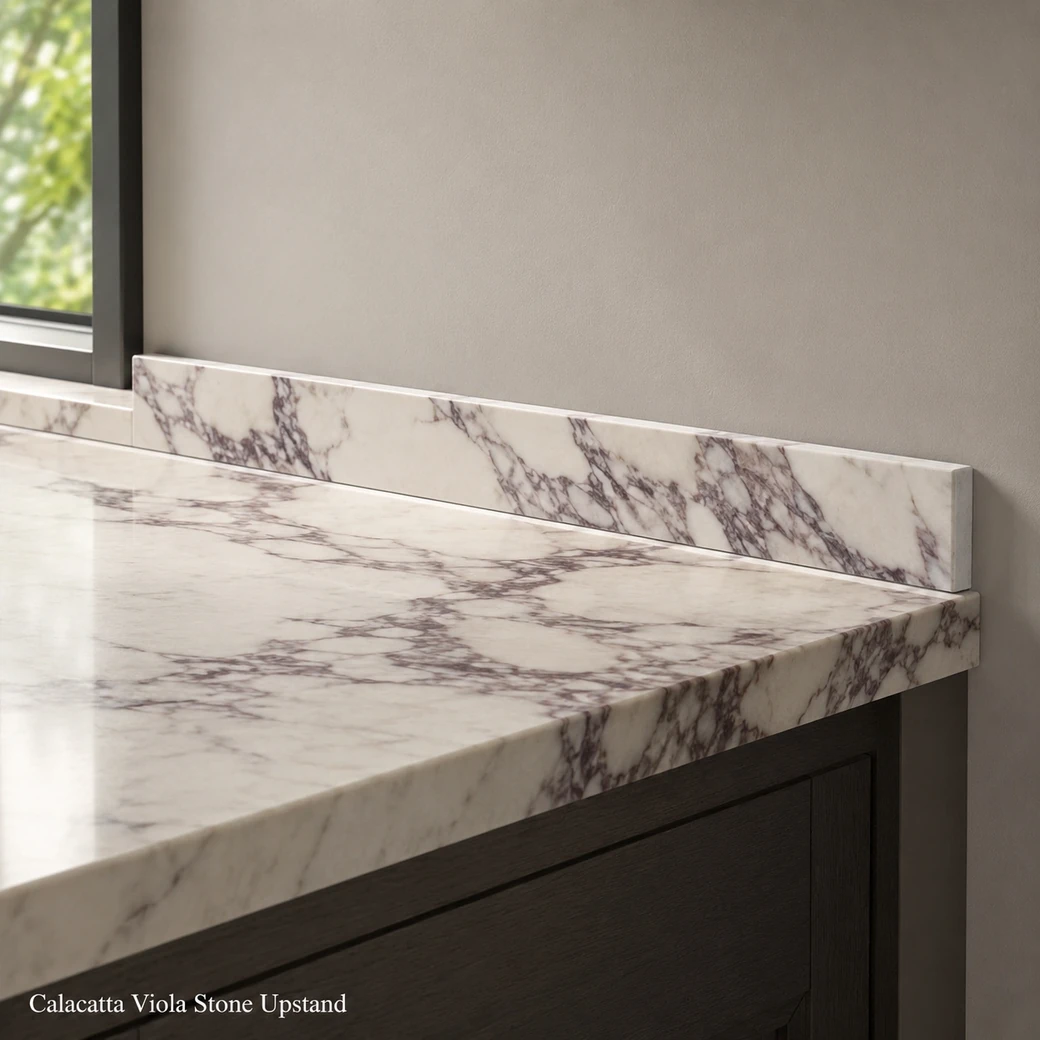
An upstand kerb is a short vertical strip fitted where a worktop meets the wall, mainly to protect the joint and create a finished edge; a splashback covers a much larger wall area. Traditional kitchen upstands are often around 100 mm high, while thickness normally coordinates with the worktop or fabrication design. Installation uses appropriate adhesive and sealed joints, and porous stone may benefit from a suitable impregnating sealer.
Practical Countertop Edge Protection
Stone Upstand Small
Secure product inquiry
Buy now
Cash on delivery available. Product details are pre-filled below. Owner delivery adds AED 5,000.
Worktop-to-Wall Finishing Detail
Choosing the Right Height, Thickness and Sealant
A stone upstand forms a short sealed transition between the worktop and wall, typically around 100 mm high, rather than covering the large area of a full splashback. Premium marble versions are commonly around 18 mm thick, while thinner stone-resin alternatives can be closer to 6 mm. Adhesive fixing holds the strip in place, but the critical detail is the silicone or compatible sealant along joints where water could otherwise penetrate behind the worktop.
Installation Role
Choosing the Right Kitchen Stone Upstand
A kitchen stone upstand creates a short finished transition where the countertop meets the wall, helping protect and visually close that junction without dominating the wall surface. A full-height splashback extends much farther upward behind the work area, so it provides broader wall coverage and should be treated as a separate design decision rather than simply a taller upstand.
Design Formats
Calacatta Marble Upstand Configurations
A matching Calacatta strip creates visual continuity with the worktop and keeps the wall junction understated, while a contrasting stone can deliberately frame the countertop edge. Standard-height upstands suit basic splash protection, whereas taller custom strips are useful behind sinks or preparation areas where the wall needs additional coverage without becoming a full splashback.
Countertop Upstand Height and Thickness
The supplied 60 × 2 × 10 cm piece provides a conventional 10 cm upstand height, while its 20 mm thickness should visually and technically coordinate with the adjoining worktop.
Vanity Upstand Sealed Wall Junction
Bond the Calacatta Viola upstand with a compatible adhesive and seal the worktop-wall junction with flexible silicone to limit water entry at the joint.
Calacatta Backsplash Sealing Needs
Honed Calacatta Viola can contain more absorbent areas, so use a compatible impregnating sealer where required without creating a surface film or artificial gloss.
Product Data
Viola Worktop Upstand Details
This small worktop upstand is fabricated from honed Calacatta Viola marble with a cream-white background and burgundy-violet veining. At 60 × 2 × 10 cm and 3.2 kg, its 10 cm height creates the short vertical stone strip intended to finish and protect the worktop-to-wall junction.
| Edge Profile | 2 mm eased/pencil exposed edge |
|---|---|
| End Return Detail | 20 mm full-depth mitred return at exposed end |
| Corner Joint Type | 45° mitred internal corner joint, resin-bonded and colour-matched |
| Vein-Matching Direction | Continuous vein direction maintained horizontally through mitred corner joints |
| Socket Notch Provision | Site-cut socket notch with minimum 5 mm clearance around the electrical box and colour-matched sealant |
| Wall Tolerance Allowance | 5 mm rear scribe allowance for correcting normal wall irregularities during installation |
| Joint Gap Width | 2 mm nominal joint gap between adjoining upstand sections for colour-matched sealant |
| Back Face Preparation | Rear face mechanically keyed with 3–5 mm-deep grooves for improved adhesive bonding |
| Mitred Corner Option | Optional 45° factory-mitred internal and external corners with colour-matched resin joints |
| Fabrication Tolerance | Finished length and height tolerance of ±1.5 mm, with joint-edge squareness within 1 mm |
Made to Order
Custom Stone Worktop Upstand Options
Custom worktop upstands can be cut to project-specific lengths and taller heights with polished, honed, bevelled or rounded exposed edges. Slab selection should be planned with the worktop so veins continue deliberately across joints and mitred corners.
Key Benefits
Why Choose This Vanity Stone Kerb
A vanity stone kerb creates a short protective barrier where the worktop meets the wall, helping reduce direct splash exposure at the joint while giving the installation a deliberate finished edge. Calacatta Viola can be vein-matched to the main surface so the detail feels integrated, while sealed joints and correctly prepared backing remain essential to actual moisture protection.
- Wall Joint Protection
The Calacatta Viola strip protects the worktop-to-wall joint from routine splashes while creating a clean finished transition along the edge.
- 100 mm Height
The 100 mm-high Calacatta Viola strip protects the worktop-to-wall junction without covering the larger wall area of a full splashback.
- Coordinated Stone Finish
Matching the Calacatta Viola upstand to the worktop finish creates a continuous stone transition while protecting the wall-to-counter joint.
- Cut To Size
Calacatta Viola strips can be precision-cut to the exact worktop length, height and junction requirements for cleaner wall-to-counter alignment and fewer unnecessary joints.
Purchase Guidance
Before Ordering a Marble Upstand
Before ordering a Calacatta Viola upstand, measure the full wall run and mark corners, appliance interruptions and joint positions so each piece can be fabricated to the actual worktop layout. Coordinate the 10 cm height and 2 cm thickness with the worktop depth, then decide whether the upstand alone handles minor splashes or forms part of a larger splashback strategy; dimensional specification is equally important for honed travertine slabs.

Specification Reference
Calacatta Stone Upstand Technical Specifications
Check the specification table for the 60 cm length, 10 cm height, 2 cm thickness and 3.2 kg weight together with honed Calacatta Viola finish, edge treatment, joint allowance, adhesive requirement and sealing details so you can coordinate the upstand precisely with your worktop, wall and splashback layout.
Product details
Specifications, care, delivery and FAQ
Everything is rendered from product JSON fields so the page remains SEO-ready even before JavaScript runs.
Cleaning: Wipe cooking splashes from honed Calacatta Viola promptly with a soft cloth and pH-neutral stone cleaner, clean the worktop joint and sealed corners using a soft brush, dry the surface and inspect sealant for gaps, renew suitable impregnating protection when professionally recommended, avoid vinegar citrus harsh degreasers abrasives and saturated joints
Daily Care: Wipe cooking splashes immediately, clean honed Calacatta Viola with pH-neutral stone cleaner, dry the worktop junction and corners, inspect sealed joints for gaps, avoid vinegar citrus harsh degreasers abrasives and water collecting behind the upstand
- Avoid leaving acidic cooking splashes on Calacatta Viola
- avoid allowing water behind failed sealant joints
- avoid abrasive scrubbers
- avoid unsupported corners or poorly finished returns
- avoid using an incompatible adhesive or surface sealer
Maintenance: Blot cooking splashes immediately, wipe honed Calacatta Viola with pH-neutral cleaner, clean corner joints and end returns using a soft brush, dry the worktop junction, inspect sealant for gaps or mould, renew compatible joint sealant when necessary, assess impregnating protection periodically
Handling: Handle the 60 cm stone strip with full-length support, use two hands to prevent flexing, protect finished edges and mitred returns during transport, dry-fit corners before adhesive installation, use spacers without point loading, never lift the upstand from one end or strike its thin 2 cm edge
When is a standard-height stone upstand sufficient behind a worktop, and when is a full-height splashback the better choice for wall protection?
A standard upstand around 75–150 mm high is sufficient where the wall mainly needs protection from routine wiping and minor splashes. Use a full-height splashback behind sinks, taps and hobs or where grout-free cleaning and stronger water protection are priorities; joints and penetrations still require correctly specified sealing.
When is a standard 20 mm stone upstand profile sufficient, and when should a thicker section be specified for strength, visual proportion or matching the worktop edge?
A 20 mm profile is normally sufficient when the upstand is supported continuously against a straight wall and mainly provides a visual and cleaning transition. Use a thicker or laminated profile where the worktop has a built-up edge, exposed returns require greater strength or the design needs a more substantial architectural proportion.
Which adhesive system is suitable for fixing this stone upstand to the prepared wall substrate while accommodating stone weight, moisture and minor movement at the worktop joint?
Use a stone-compatible flexible polymer-modified tile adhesive or neutral-cure structural silicone approved for the prepared wall substrate and moisture conditions. Maintain a small flexible sealant joint where the 60 × 10 cm upstand meets the worktop so minor movement is not transferred into the stone.
Which flexible, non-staining sealant should be used where the Calacatta Viola upstand meets the worktop so the joint remains watertight without discoloring the stone?
Use a neutral-cure, low-modulus silicone specifically labelled non-staining and compatible with natural marble; avoid acetoxy silicone, ordinary construction sealant and oil-bearing mastics that may discolor Calacatta Viola. Prepare clean, dry joint faces, use a backing rod where the gap is deep and create a continuous flexible bead that accommodates worktop movement; approve the exact sealant on an offcut first.
Should outside corners, inside corners and exposed end returns on this Calacatta Viola upstand be mitred, polished or capped to maintain vein continuity and avoid vulnerable sharp edges?
Use mitred joints where vein continuity and a premium monolithic appearance matter, but reinforce and slightly ease vulnerable outside corners. Inside corners may use a narrow flexible colour-matched sealant joint, while exposed end returns should be polished and eased or finished with a short returned piece; avoid raw sawn edges and rigidly grouted movement joints.
Reviews
Reviews and new review submission
0.0 average rating from 0 reviews. New reviews are saved as pending until approved.
No approved reviews yet for this product. The review form is ready for buyer submissions.