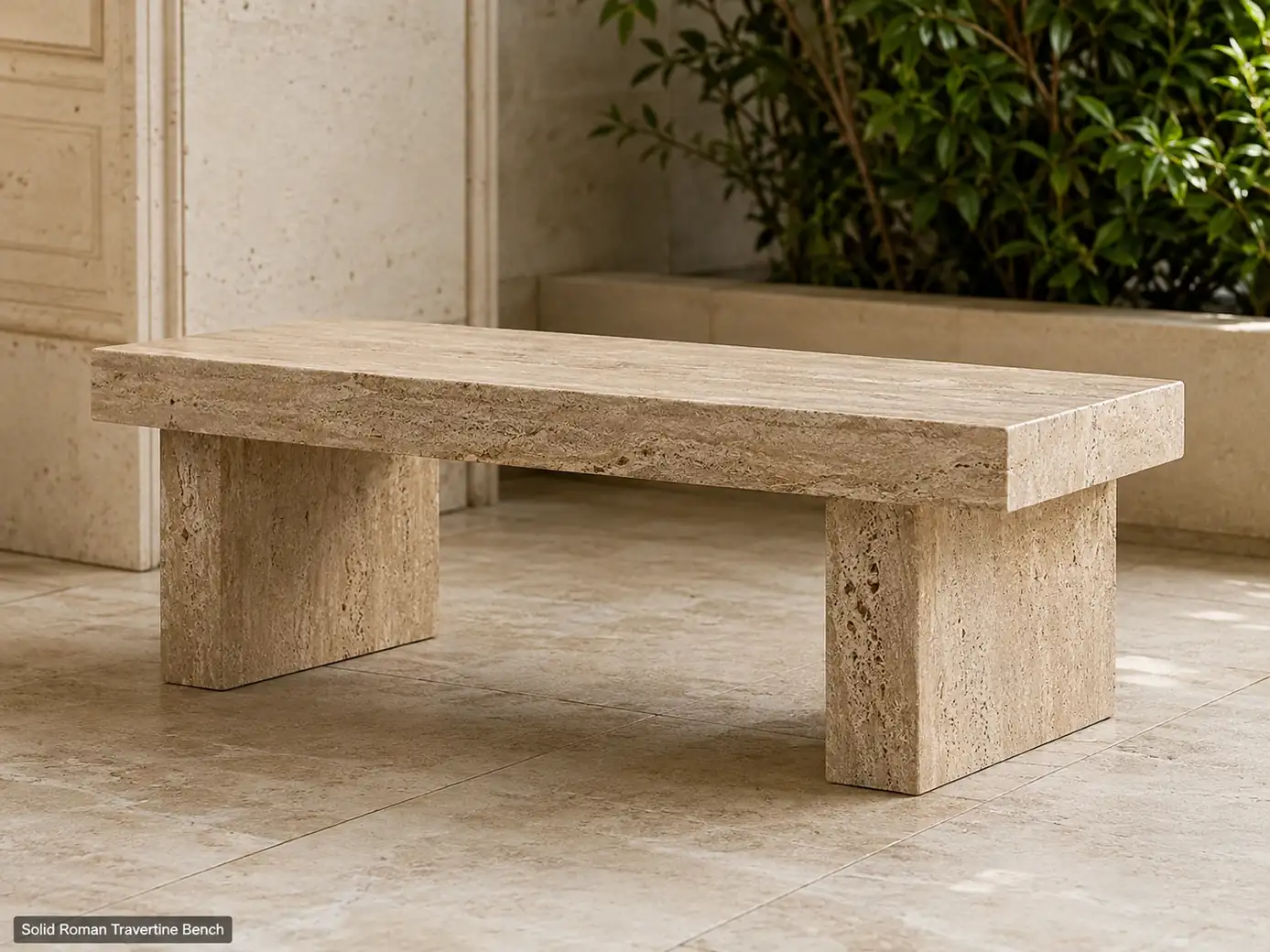
Travertine has enough compressive strength for benches when thickness and support are properly engineered, and it can be used both indoors and outdoors with an appropriate grade. Solid-stone benches are very heavy, so transport, anchoring and substrate capacity should be planned before installation. A low bench can also serve as a coffee table. Where staining is likely, impregnation may help; otherwise maintain it with water or pH-neutral cleaner.
Solid Stone Seating
Travertine Bench Small
Secure product inquiry
Buy now
Cash on delivery available. Product details are pre-filled below. Owner delivery adds AED 5,000.
Indoor-Outdoor Use & Handling
Seating That Doubles as a Surface
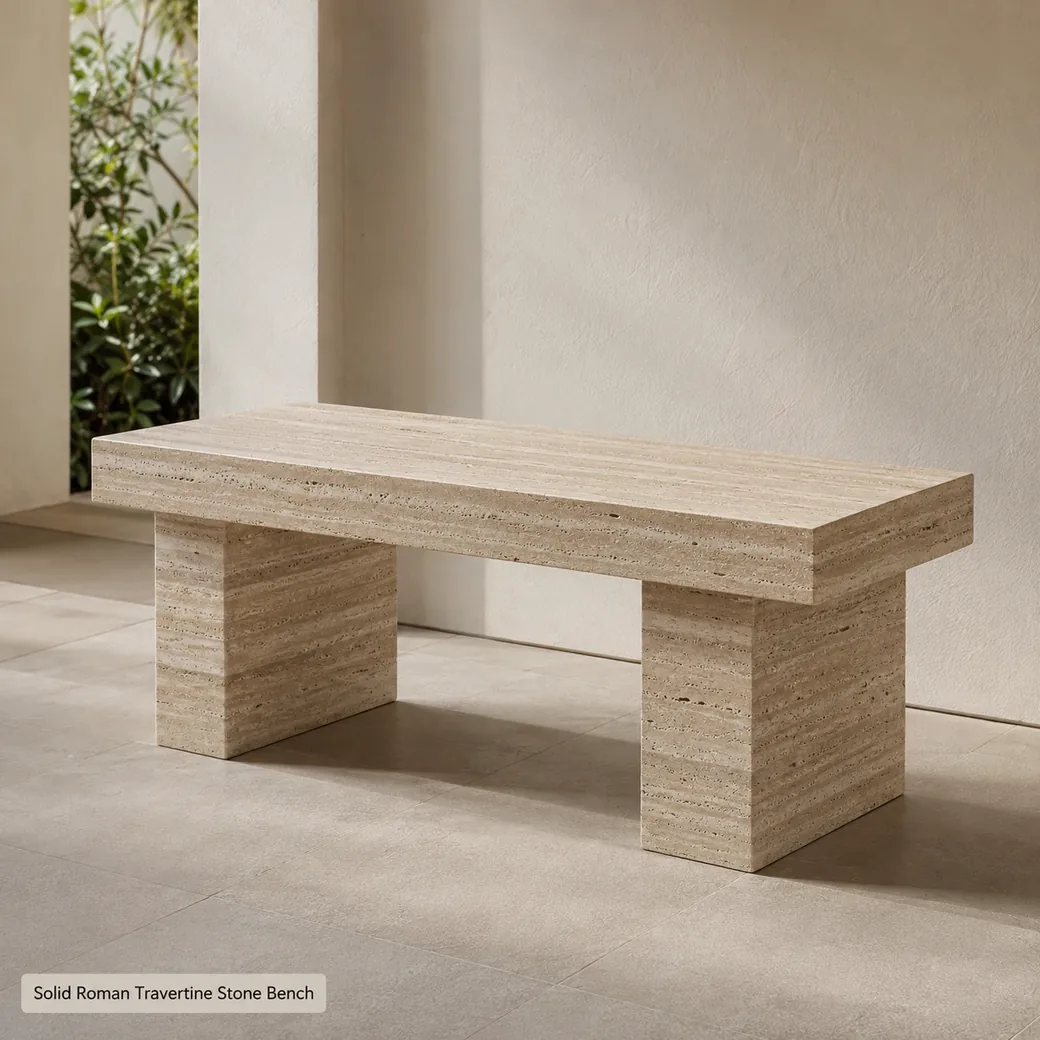
At 95.5 kg, this solid Roman travertine bench provides enough mass for stable seating and can also function as a low display or coffee-table surface. Its 100 × 35 × 45 cm proportions suit entryways, bedrooms and lounge areas, while suitable stone selection can extend use to covered exterior settings. Custom cushion pads may be added without hiding the brushed cream-veined stone structure.
Solid Stone Seating
Roman Travertine Entryway Bench
The Roman Travertine Entryway Bench is a 100 × 35 × 45 cm brushed natural-stone piece designed to function as either substantial seating or a low occasional table. Its warm stone-beige surface is crossed by cream veins, giving the bench a restrained architectural character suited to foyers, hallways, dressing areas and living spaces. At 95.5 kg, it has the grounded presence of solid Roman travertine furniture, making it better suited to a considered permanent position than frequent rearrangement.
Seating Engineering
How to Specify a Solid Travertine Seat
For this 100 × 35 × 45 cm, 95.5 kg solid travertine bench, seat thickness and support position should be engineered together so the 100 cm span is not treated as an unsupported stone bridge. Indoor placement can use a stable finished floor, while covered-outdoor use also requires suitable weather exposure, drainage and substrate conditions; any supports should distribute the stone mass without creating concentrated stress points.
Use a Stone Bench as a Coffee Table
At 45 cm high, the bench can cross over into occasional-table use when seating is not required, provided drinks and decorative objects are placed on protected surfaces.
Add a Cushion to a Travertine Bedroom Bench
A removable upholstered pad can soften the 45 cm-high stone seat while using non-slip, non-staining backing to protect the brushed travertine below.
Plan Access for a 95 kg Stone Seat
Plan rated lifting equipment, confirm the floor or substrate can carry the 95.5 kg bench and establish its final position before installation.
Product Data
Roman Travertine Bench Product Details
This small bench uses solid Roman Travertine with a brushed finish and warm stone-beige colouring crossed by cream veins. At 100 × 35 × 45 cm and 95.5 kg, it is a substantial seating-height stone element whose transport, final positioning and supporting substrate must account for its mass.
| Seat Edge Radius | R5 mm eased seat-front edge |
|---|---|
| Leg Support Spacing | Approx. 600 mm support-center spacing, positioning supports about 200 mm in from each end |
| Base Footprint | Two full-width 300 × 350 mm stone footplates, positioned approximately 200 mm inward from each end |
| Hidden Anchor Point | Two concealed M10 stainless-steel anchor inserts located through the underside of the stone supports |
| Floor Pad Material | 5 mm non-marking EPDM rubber pads beneath each stone support to isolate the bench from the finished floor |
| Underside Reinforcement | Two concealed 6 mm stainless-steel support plates spanning between the stone legs beneath the seat |
| Seat Flatness Tolerance | Maximum 2 mm seat-surface deviation beneath a 1 m straightedge |
| Backrest Compatibility | Optional separate stone backrest mechanically fixed to a concealed stainless-steel frame; do not anchor it solely into the seat slab |
| Levelling Detail | Concealed stainless-steel adjustable feet or non-compressible shims providing approximately 10 mm levelling correction |
| Lifting Point Provision | Two concealed M16 threaded lifting inserts positioned over the calculated centre of gravity and plugged after placement |
Custom Seating
Bespoke Travertine Stone Bench Options
Stone benches can be fabricated in longer project-specific dimensions or shaped as curved, arched, monolithic and other sculptural forms. Removable upholstered seat pads may be added for comfort, while alternative ivory, classic beige, walnut or silver travertine tones can align the piece with indoor or exterior architecture.
Flexible Furniture Use
Why Choose a Travertine Hallway Bench
A travertine hallway bench provides a stable place for short-duration seating, shoe changing or placing bags while adding a substantial natural-stone element to an entrance or corridor. Its solid construction suits high-use transitional areas, the low format can also function as a display or occasional table, and custom sizing allows the bench to fit specific wall lengths and circulation zones.
- Entryway Seating Use
The 95.5 kg travertine bench provides stable short-duration seating for entrance halls, foyers and shoe-changing areas.
- Coffee Table Crossover
The low 45 cm bench height allows the same solid travertine piece to double as a substantial coffee table when needed.
- Heavy Stable Construction
The 95.5 kg solid travertine construction keeps the bench firmly positioned during everyday seating or coffee-table use.
- Custom Upholstery Option
A removable upholstered seat pad can be custom sized to the 100 × 35 cm bench for added comfort without hiding the stone base.
Placement & Care
Maintaining a Natural Travertine Seat
For a natural travertine seat, use the 95.5 kg bench indoors or in a sheltered outdoor setting where the stone grade and exposure are appropriate, and consider an impregnating sealer only when absorption or staining risk justifies it. Routine care should rely on water or a pH-neutral stone cleaner rather than acidic products, following the same material-specific approach expected in professional tiling dubai work.

Technical Specification
Travertine Seating Specifications
Use the seating specification table to confirm how the bench is intended to carry load, whether any upholstered element is included and where the finished piece can be positioned safely. The customization fields also help you compare alternative lengths, support details or placement requirements before installation.
Product details
Specifications, care, delivery and FAQ
Everything is rendered from product JSON fields so the page remains SEO-ready even before JavaScript runs.
Cleaning: Brush away grit before sitting or wiping, wash the brushed surface with pH-neutral stone cleaner and a soft nylon brush, rinse thoroughly and dry, remove organic stains promptly, use breathable covers only when dry, avoid acids wire brushes and close-range pressure washing
Daily Care: Brush away grit before use, wipe food and organic stains promptly, clean brushed travertine with pH-neutral stone cleaner, keep drainage and underside dry, use breathable covers and non-staining seat pads, avoid acids metal brushes and dragging the bench
- Avoid placing the 95.5 kg bench on an unverified substrate
- avoid direct summer-sun use without checking surface temperature
- avoid acidic cleaners
- avoid dragging the bench
- avoid trapping moisture beneath non-breathable covers
Maintenance: Brush away grit, remove organic stains promptly, clean brushed travertine with pH-neutral stone cleaner, keep drainage clear, inspect anchors supports and substrate settlement, use breathable covers only after the bench dries
Handling: Plan the route and substrate capacity for the 95.5 kg bench, use mechanical lifting or several trained handlers, lift from engineered underside points, pad corners, keep the bench level, never drag or tip it onto one leg
How should this 95.5 kg Roman travertine bench be anchored outdoors so it remains stable without cracking the stone or damaging the supporting paving or concrete base?
The 95.5 kg outdoor bench should sit on a level reinforced concrete base or engineered paving foundation with full, even bearing beneath its supports. Concealed stainless-steel dowels or brackets can anchor it against sliding and overturning, but holes must be factory-positioned away from edges, veins and open cavities. Use non-staining bedding material and isolate metal where required. Do not bolt through unsupported paving slabs. A contractor should check drainage, frost or thermal movement conditions, substrate capacity and public-use requirements before selecting anchor diameter and embedment.
Does this 95.5 kg solid travertine bench require a concrete foundation pad, or can it sit safely on existing flooring or paving?
The bench may sit on an existing reinforced concrete slab or structurally sound paving only when the surface is level, stable and capable of carrying its concentrated support loads without settlement. Loose pavers, thin tiles, sand bedding or unknown substrates are unsuitable. A dedicated concrete pad is preferable outdoors or where stability cannot be verified. It should distribute the 95.5 kg weight and include drainage and concealed anchoring where required. A contractor should inspect the base and confirm whether local thickening or a new foundation is necessary.
Which non-staining isolation pads or support details will prevent this 95.5 kg travertine bench from cracking or marking the paving beneath it?
Place the bench on broad, non-staining EPDM, neoprene or high-density isolation pads located beneath its structural bearing points. Pads should distribute the 95.5 kg load, accommodate small paving irregularities and permit drainage without trapping water; verify that their compounds will not migrate into pale stone or porous paving.
Will the brushed Travertine Bench become uncomfortably hot in direct summer sunlight, and would shade, orientation or a removable seat pad make outdoor use safer and more comfortable?
Yes, brushed travertine can become uncomfortably hot in direct UAE summer sun even though pale stone reflects more heat than dark material. Place it in shade, orient it away from prolonged afternoon sun and test the surface before sitting; a breathable removable outdoor cushion improves comfort but should be removed after use so it does not trap moisture, dust or heat against the stone.
How much variation in beige colour, pores and vein movement should be expected when ordering several matching travertine benches, and can they be cut from one batch?
Expect natural variation in beige warmth, vein thickness, pores and filled areas even within one quarry batch. Fabricating all benches from consecutive slabs or one block provides the closest coordination; approve a full dry layout, designate primary faces and retain spare matching material, while accepting that identical duplication is impossible in genuine travertine.
Reviews
Reviews and new review submission
0.0 average rating from 0 reviews. New reviews are saved as pending until approved.
No approved reviews yet for this product. The review form is ready for buyer submissions.