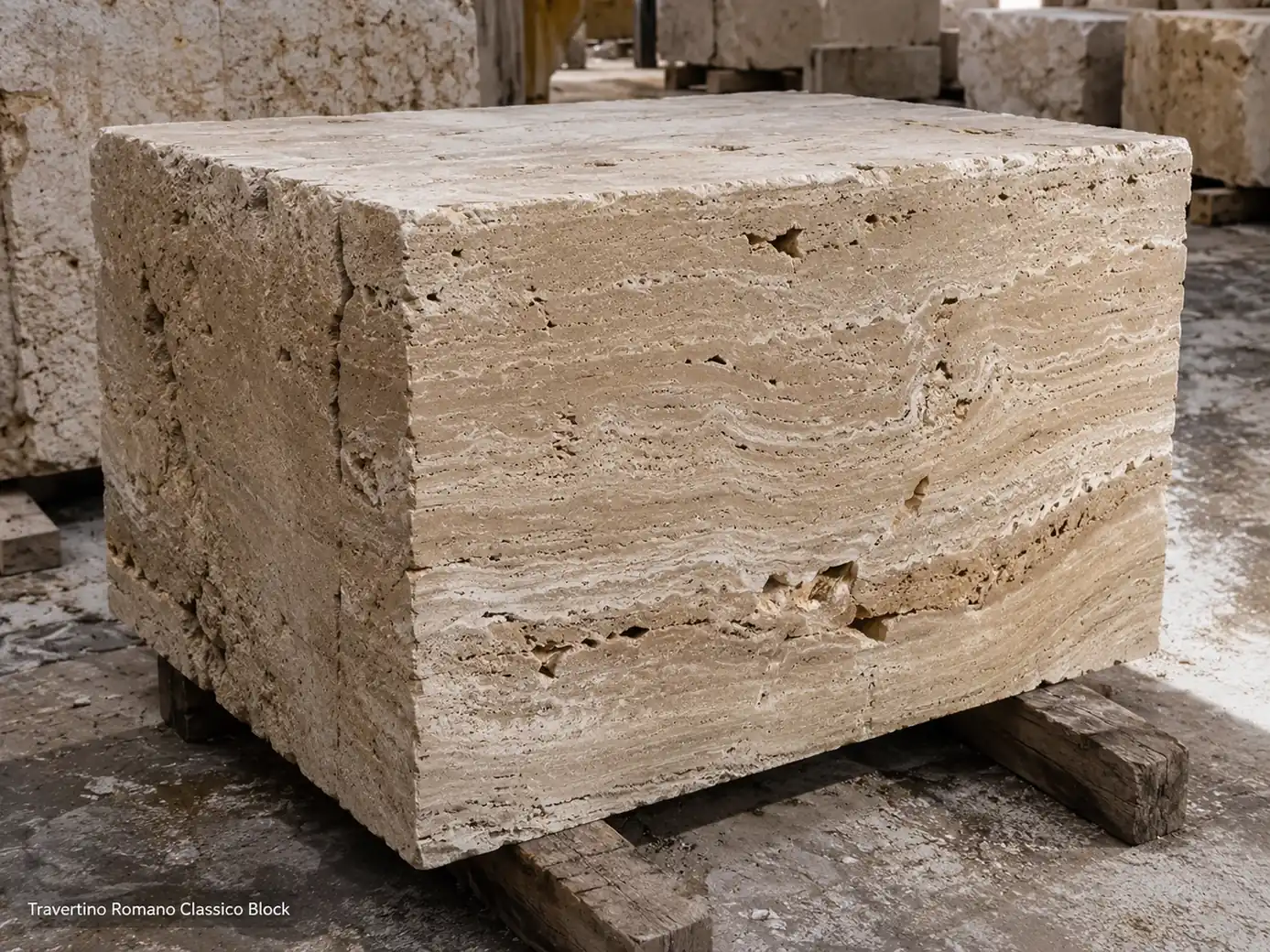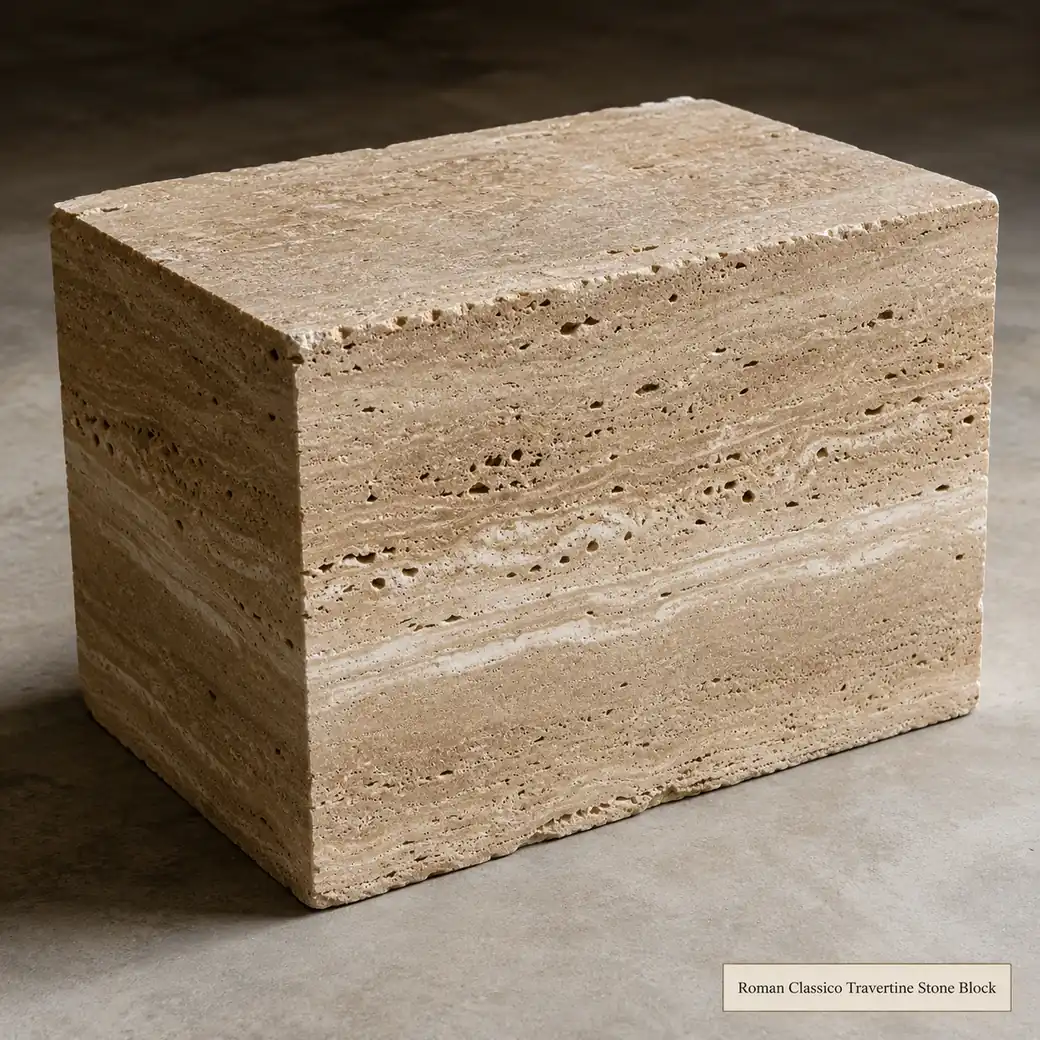
A travertine block is the quarry-sized raw stone from which slabs, architectural pieces, columns, baths and furniture are cut. Block dimensions vary naturally because extraction follows the quarry bed rather than a fixed retail format. Vein cutting slices parallel to the bedding for linear bands, while cross cutting exposes cloud-like pore patterns. Grade is assessed through colour consistency, fissures, voids and usable yield, and commercial projects can purchase blocks in bulk.
From Quarry to Form
Travertine Block Small
Secure product inquiry
Buy now
Cash on delivery available. Product details are pre-filled below. Owner delivery adds AED 5,000.
Grading, Cutting & Bulk Supply
The Starting Point for Bespoke Stonework
This 60 × 40 × 40 cm sawn Roman travertine block represents raw fabrication material rather than a finished decorative product. Blocks are graded by usable dimensions, colour consistency, pore distribution, fissures and expected slab yield before being converted into slabs, stairs, cladding or furniture. Vein-cut and cross-cut appearance ultimately depends on how the block is oriented during primary sawing.
Quarry Material
Roman Travertine Rough Block Selection
Roman Travertine Rough Blocks are raw Travertino Romano Classico quarry material intended to be cut into slabs, columns, furniture and architectural components rather than used as finished decorative pieces. Their sawn surfaces reveal warm taupe-beige stone, ivory veins and the characteristic pore structure of travertine before polishing, honing or filling alters the appearance. Because each block originates directly from a quarry bed, color consistency, vein direction, void distribution and usable yield naturally vary from one extracted section to another, making block selection an important first step in controlling the appearance of the finished fabrication.
Grade & Processing
Beige Travertine Block Grading and Conversion
This 60 × 40 × 40 cm travertine block weighs 240 kg and should be evaluated for colour consistency, fissures, void distribution and the percentage of sound stone that can actually be recovered after cutting. Higher usable yield allows the block to be converted efficiently into slabs, tiles or architectural elements, while major fissures or inconsistent zones may reduce the number and size of finished pieces even when the gross block dimensions appear adequate.
Vein-Cut Roman Travertine Block Processing
Vein cutting the raw block follows its natural bedding for long ivory bands, while cross cutting exposes cloudier pores and less directional movement.
Cross-Cut Natural Stone Block Results
Linear ivory bands appear when the block is vein-cut, while cross-cutting exposes a cloudier field of pores and less directional movement.
Quarry Travertine Block for CNC Fabrication
The raw 240 kg block is intended for industrial sawing and fabrication into slabs, columns, baths, furniture and other dimensional stone components.
Product Overview
Travertine Rough Block Product Details
This raw block uses Travertino Romano Classico Roman Travertine Block Stone with a sawn finish and warm taupe-beige colouring with ivory veins. At 60 × 40 × 40 cm and 240 kg, it is intended for further industrial processing; actual pore distribution, fissure condition and usable yield require block inspection.
| Bed Orientation Marking | Permanent BED/VEIN directional arrow marked on top and side quarry faces |
|---|---|
| Quarry Lot Identification | Quarry lot code identifying quarry/bed, extraction batch and sequential block number, e.g. TRV-RM-L24-B07 |
| Dimensional Squareness Tolerance | Maximum ±2 mm deviation in length, width and height, with adjacent faces maintained within 2 mm of square per metre |
| Face Flatness Tolerance | Maximum 2 mm face-flatness deviation beneath a 1 m straightedge |
| Sawing Allowance | Minimum 20 mm sawing allowance added to every unfinished block face before final sizing |
| Handling Lift Points | Minimum four engineered lifting points or certified clamp zones, positioned symmetrically around the block’s calculated centre of gravity |
| Core Sample Availability | Ø50 mm petrographic or physical-test core samples available from agreed non-critical block locations before primary cutting |
| Moisture Condition | Supply in air-dry condition with no standing water; moisture state must be recorded before weighing, resin treatment or fabrication |
| Crate Support Method | Transport on a reinforced timber cradle with continuous bottom bearers positioned beneath sound stone zones and restrained against movement |
| Soundness Inspection Record | Photographic six-face inspection record with mapped fissures, cavities, resin repairs, weathered zones and impact damage before cutting |
Commercial Evaluation
Assessing a Natural Stone Block Before Cutting
Inspect every block for fractures, cavities, weathered areas and changes in colour before calculating usable yield. Confirm dimensions, cutting allowance, bedding orientation and visual continuity, and compare the purchasing basis—tonnage, cubic metres or gross block size—against the recoverable slabs expected after processing.
Fabricator Value
Why Choose Roman Travertine Quarry Stone
Roman travertine quarry stone gives projects four useful attributes: large blocks provide material for slabs and bespoke architectural pieces, cutting direction can be selected for linear vein-cut or cloudier cross-cut appearance, raw blocks allow better planning of colour and usable yield, and bulk purchasing can support repeated fabrication across larger commercial or hospitality projects.
- Raw Quarry Material
The raw quarry block provides the starting material for cutting slabs, columns, furniture, baths and architectural pieces.
- Multiple Cut Directions
Vein-cut and cross-cut processing reveal different linear or cloud-like patterns from the same raw travertine block.
- Bulk Project Supply
Quarry blocks can be supplied in commercial quantities for projects requiring repeated slabs, furniture or architectural fabrication.
- CNC Ready Stone
The raw travertine block can be CNC cut and shaped into slabs, furniture, baths, columns or detailed architectural components.
Project Supply
Wholesale Travertine Block Options
Wholesale travertine blocks should be selected by usable yield, colour consistency, fissures, voids and the required vein-cut or cross-cut character, with quantities planned around the expected production program rather than individual retail pieces. For bulk orders, confirm container loading, block identification, quarry traceability and continuity of supply so slabs, stairs, cladding, furniture or carved work can remain visually coordinated; this planning is comparable to assessing granite slab dimensions before fabrication.

Technical Reference
Natural Travertine Block Specifications
Use the block specification table to compare quarry grade, cutting orientation and estimated usable yield before purchasing raw material for fabrication. The supply-format field is particularly useful for commercial orders where block consistency, processing direction and logistics affect downstream slab or carved-piece production.
Product details
Specifications, care, delivery and FAQ
Everything is rendered from product JSON fields so the page remains SEO-ready even before JavaScript runs.
Cleaning: Remove quarry dust using a soft brush and vacuum, wash sawn faces with clean water and pH-neutral stone cleaner when required, scrub gently with nylon bristles, allow complete drying before inspection or packing, avoid acids wire brushes salt contamination and sealing damp stone
Daily Care: Keep the sawn block supported on dry load-spreading bearers, brush away dust and grit, prevent oil rust and salt contamination, cover with breathable protection, inspect fissures and voids regularly, avoid acids standing water metal impact and sealed non-ventilated wrapping
- Avoid shipment without fissure and void documentation
- avoid unsupported handling
- avoid rust oil or salt contamination
- avoid trapping moisture inside packaging
- avoid calculating usable yield from gross dimensions alone
Maintenance: Store on dry load-spreading timber bearers, maintain full support and separation, brush off quarry dust, document developing fissures and voids, protect against oil rust and salt contamination, keep breathable packaging secure
Handling: Use a forklift crane or loader rated beyond 240 kg, lift with approved forks clamps or slings positioned around stable mass, keep the block on timber bearers, secure it against rolling or shifting, document fissures, never lift from natural voids
How should I estimate the realistic slab yield from this raw Roman travertine block after allowing for saw cuts, natural voids, fissures, edge trimming and unusable sections?
Begin with the block’s gross volume, then deduct bands containing unacceptable voids, fissures or colour changes, plus saw kerfs, end trimming and surface-finishing allowances. From a 60 × 40 × 40 cm block, theoretical slab count is misleading because orientation and defects control yield. Prepare trial cuts or imaging where available and map the proposed slab direction. Sound, regular blocks may achieve roughly 60–75% saleable yield, while highly porous or selectively matched Travertine can produce considerably less. Include at least 15–25% contingency until the block is opened.
How do natural fissures, open cavities and filled voids affect the commercial grade and usable cutting yield of a travertine block?
Open cavities and fissures reduce usable yield when they intersect thin slabs, narrow furniture components or structural edges, while stable voids intended for filling may be acceptable within a commercial Travertine grade. Grade is influenced by colour consistency, pore size and frequency, fissure stability, repair quality and intended application rather than porosity alone. Map visible defects, select cutting orientation and inspect trial faces before estimating yield. Highly selective work may produce far less saleable material than the block’s gross volume, so include substantial fabrication contingency.
Does vein-cut or cross-cut fabrication provide better colour and pattern consistency across a large architectural project from this travertine block?
Vein-cut fabrication provides stronger linear continuity when sequential pieces must repeat the bedding direction, while cross-cut produces cloudier movement that can appear more uniform across broad areas. Neither automatically guarantees colour consistency; reserve a sufficient quantity from one block, approve control samples and map every fabricated piece before cutting.
How should the Travertine Block be inspected, photographed and documented for fissures, voids, colour consistency and usable yield before it is packed for container shipment?
Before packing, clean and photograph all six faces under consistent light with a scale, block ID and orientation marks, then record dimensions, weight, quarry bed, cutting direction and estimated usable volume. Map visible fissures, voids, colour changes and repaired areas on annotated images, inspect with appropriate non-destructive methods where required and attach the approved inspection report to the crate and shipping documents.
What percentage of this travertine block is likely to become waste after removing fissures, large voids and irregular edges and allowing for saw kerf and vein-matched fabrication?
Waste commonly ranges around 20–35%, but fissured or highly porous blocks and demanding vein matching can push loss beyond 40%. Calculate yield from six-face inspection, cutting direction, required finished sizes, saw kerf and defect mapping rather than applying one universal percentage; purchase approval should be based on estimated usable volume, not gross 240 kg block weight.
Reviews
Reviews and new review submission
0.0 average rating from 0 reviews. New reviews are saved as pending until approved.
No approved reviews yet for this product. The review form is ready for buyer submissions.