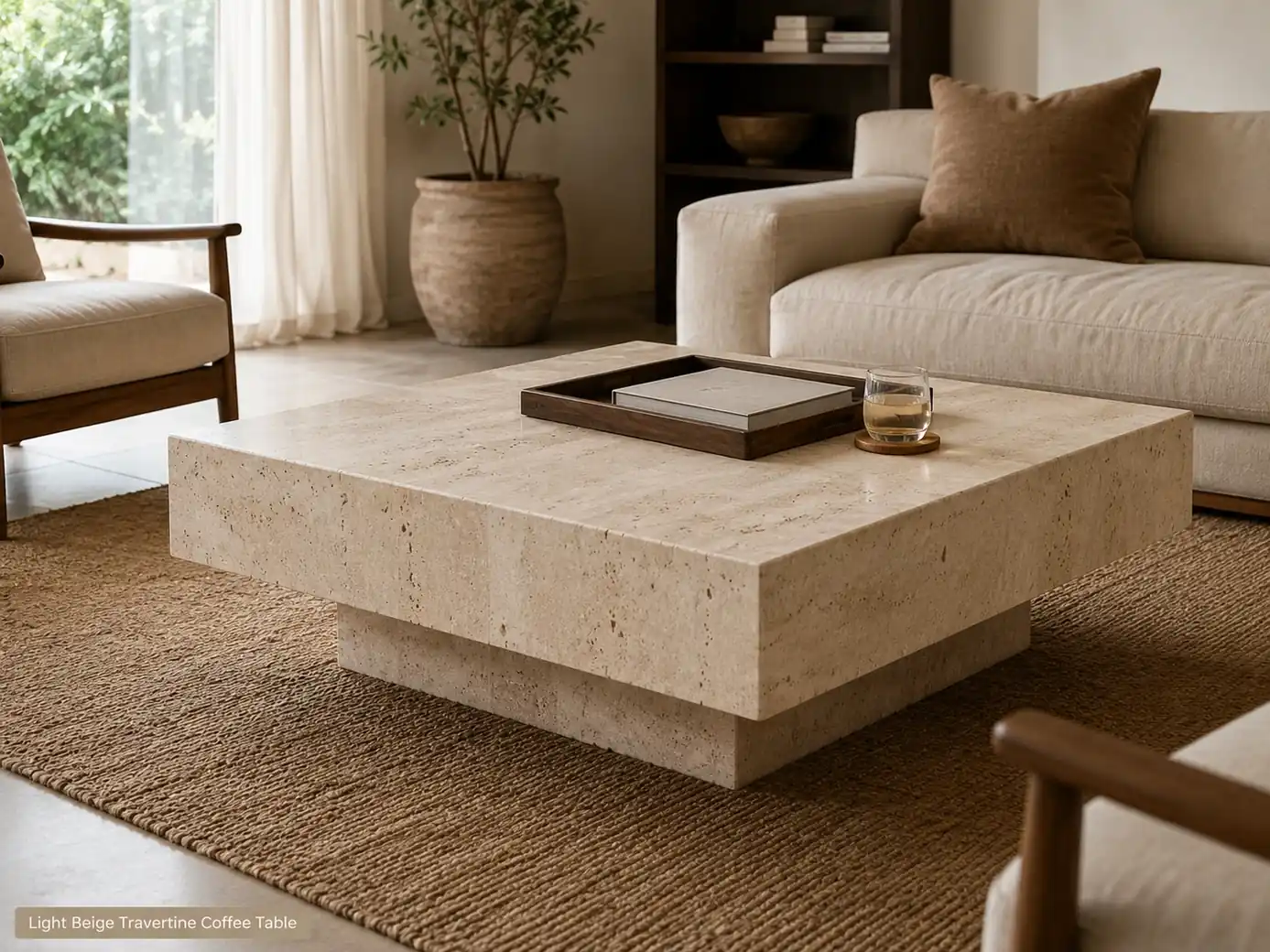
A travertine coffee table Dubai design works well as a round travertine coffee table, oval travertine coffee table or bespoke sculptural form because the stone provides substantial visual and physical weight. Travertine is porous and may need periodic sealing depending on the surface; use coasters, wipe spills quickly and avoid acidic cleaners. Filled or honed surfaces are easier for tabletops, and custom dimensions can be fabricated around the seating layout.
Natural Travertine Living Centerpiece
Travertine Coffee Table Small
Secure product inquiry
Buy now
Cash on delivery available. Product details are pre-filled below. Owner delivery adds AED 5,000.
Made-to-Order Shapes & Delivery
Choosing Shape, Weight and Sealing for Daily Use
Travertine coffee tables range from compact 70 cm rounds to large 120 × 120 cm or 140 × 70 cm statement pieces, with weights often spanning roughly 20–80 kg. This 75 × 75 × 35 cm table sits at the compact end while still weighing 50 kg, giving it a stable solid-stone presence. Because travertine is porous, sealing and pH-neutral cleaning are important, and made-to-order pieces should allow for heavy-item delivery access.
Natural Living Centerpiece
Light Beige Travertine Center Table
The Light Beige Travertine Center Table is a 75 × 75 × 35 cm natural-stone centerpiece designed to sit low within a living-room seating arrangement. Its honed light travertine surface has a pale sand-beige tone that gives the table a calm architectural character while allowing surrounding sofas, rugs and décor to remain visually balanced. At 50 kg, it carries the physical weight expected from solid stone furniture, creating a grounded central surface for books, trays and everyday living-room objects rather than the lightweight feel of a conventional coffee table.
Shape & Scale
How to Configure a Travertine Lounge Table
The 75 × 75 × 35 cm travertine coffee table can be shaped around the seating plan rather than treated as a fixed furniture format. A round form improves movement around sectional or closely grouped sofas, a square top aligns neatly with symmetrical seating, a rectangular version suits longer sofas, and an organic outline works well where circulation is less formal; the chosen shape should fill the center of the lounge without narrowing the routes between seats.
Choose a Pedestal or Sculptural Coffee Base
A cylindrical base gives compact central support, a block base creates stronger visual mass, while four legs open more floor space beneath the 75 cm top.
Compare Italian and Turkish Travertine Tables
Select Light Travertine for its pale sand tone, visible pores and natural piece-to-piece variation rather than assuming any single quarry origin is automatically superior.
Size a Stone Coffee Table Around Seating
Made-to-order sizing can begin around compact 70–75 cm formats and scale to larger statement tables as sofa length and room circulation increase.
Product Data
Light Travertine Coffee Table Details
This small coffee table uses honed Light Beige Travertine in a pale sand-beige tone. Its 75 × 75 × 35 cm format weighs 50 kg, giving the low square table substantial visual and physical mass while keeping the surface close to typical lounge seating height.
| Pedestal Base Type | Central cylindrical/drum travertine pedestal |
|---|---|
| Top Overhang | Approx. 150 mm radial top overhang |
| Underside Reinforcement | Two recessed 40 × 20 × 2 mm powder-coated steel reinforcement rails bonded beneath the tabletop |
| Base Levelling Feet | Four concealed M8 levelling feet with non-marking nylon pads and ±8 mm adjustment |
| Floor Pad Material | 3 mm beige felt or non-marking thermoplastic-rubber pads fitted beneath every floor-contact point |
| Edge Radius | R12 mm continuous rounded tabletop edge |
| Vein Orientation | Vein direction aligned continuously across the tabletop and vertically down the pedestal face |
| Knock-Down Connection | Concealed M10 threaded studs with locating dowels for removable top-to-pedestal assembly |
| Top Flatness Tolerance | Maximum 1.5 mm surface deviation beneath a 1.2 m straightedge |
| Segmented Construction Detail | Hollow segmented pedestal formed from four vein-matched panels with 45° mitred and resin-bonded corners |
Custom Fabrication
Bespoke Travertine Center Table Options
Bespoke travertine centre tables can be fabricated to custom dimensions in round, oval, organic or sculptural shapes. Pedestal style and alternative beige stones can be selected around the seating plan, while the top span, vein layout and finished weight should be approved before fabrication.
Living Room Performance
Why Choose a Natural Travertine Sofa Table
A natural travertine sofa table provides a substantial central surface for drinks, books and decorative objects while visually anchoring the seating arrangement. Its weight improves stability, honed stone gives a practical tabletop finish, and bespoke dimensions allow the table to be proportioned to the sofa and circulation space rather than forcing the room around a fixed furniture size.
- Natural Pore Variation
Natural pores and mineral variation give each honed travertine tabletop an individually formed stone character.
- Stable 50 kg Build
The 50 kg travertine construction gives the coffee table substantial stability within the central seating area.
- Custom Stone Shapes
Travertine can be fabricated into round, oval or bespoke sculptural shapes to suit the seating layout and design concept.
- Honed Everyday Surface
The honed surface provides a smooth low-sheen tabletop suited to regular drinks, books and living-room accessories with proper care.
Stone Care
Protecting a Beige Travertine Coffee Surface
Assess whether the honed light travertine needs an impregnating sealer based on its actual absorption, then use coasters routinely and wipe coloured, oily or acidic spills immediately. Avoid vinegar, citrus-based cleaners and other acids, and maintain the surface with a pH-neutral stone product; understanding construction details such as 2cm vs 3cm countertops similarly helps separate genuine material performance from assumptions.

Technical Specification
Travertine Center Table Specifications
Use the specification table to confirm the finished shape, base construction and available size changes before matching the table to your sofa arrangement. The care and customization fields also help you decide how the piece can be adapted while keeping the natural travertine practical for everyday living-room use.
Product details
Specifications, care, delivery and FAQ
Everything is rendered from product JSON fields so the page remains SEO-ready even before JavaScript runs.
Cleaning: Lift dust and grit with microfiber, blot coffee wine citrus and oil immediately, clean honed travertine with diluted pH-neutral stone cleaner, rinse sparingly and dry, use coasters and trays, avoid vinegar lemon bleach abrasive pads and steam cleaning
Daily Care: Dust porous areas with microfiber or a soft brush, use coasters trays and felt pads, blot coffee wine citrus and oil immediately, wipe honed travertine with pH-neutral stone cleaner, dry fully, avoid acids abrasives and dragging décor
- Avoid acidic drink spills remaining
- avoid wet glasses without coasters
- avoid dragging décor across honed travertine
- avoid abrasive cleaners
- avoid sitting or standing on the tabletop
Maintenance: Dust pores with microfiber or a soft brush, use coasters and felt pads, blot acidic spills immediately, clean honed travertine with pH-neutral stone cleaner, dry fully, reassess impregnation when water begins absorbing rapidly
Handling: Clear the tabletop, use two or more people for the 50 kg table, lift beneath the base with the top evenly supported, pad honed edges, use load-rated dollies on protected flooring, never slide or pivot on one corner
For a living room used every day, is filled travertine more practical than unfilled travertine for preventing crumbs, dust and drink residue from collecting in natural pores?
Filled travertine is more practical for an everyday coffee table because resin or cementitious filler closes the larger natural voids where crumbs, dust and spilled drinks would otherwise collect. It provides a smoother wiping surface while retaining the stone’s characteristic smaller pores and variation. Unfilled travertine offers a more rustic appearance but requires more brushing and careful cleanup. For frequent living-room use, choose properly filled, honed Light Travertine, test whether sealing is needed and remove coffee, wine or citrus spills immediately.
Can small chips along the honed travertine tabletop be repaired with a colour-matched stone filler, and will the repaired area remain noticeable after honing?
Small chips can normally be repaired with colour-matched polyester, epoxy or mineral filler selected for the travertine and location. After curing, the repair is carefully levelled and honed to blend with the tabletop; it may remain slightly visible because natural pores and colour variation cannot be reproduced perfectly.
Does honed travertine temporarily darken when wet, and how long should the surface take to return to its normal colour?
Honed travertine can temporarily darken where water enters its pores, especially if unsealed or unevenly sealed. A small damp area may return to normal within several hours, while deeper saturation can require 24–72 hours in ventilated conditions; persistent darkening may indicate trapped moisture, oil contamination or deteriorated filler.
How far should the 75 × 75 cm Travertine Coffee Table sit from the sofa to provide comfortable reach without restricting legroom or movement around the seating area?
Position the table approximately 40–45 cm from the sofa edge, which keeps the 75 cm-square surface reachable while leaving room for feet and seated movement. Increase the gap to around 50–60 cm where it forms a regular walkway; less than roughly 35 cm will feel restrictive, particularly around the table’s projecting corners.
How can reopened pores in this honed travertine coffee table be cleaned, colour-matched and refilled without leaving raised patches or a noticeably different sheen?
Remove loose filler back to sound material, vacuum the pores and clean and dry them thoroughly before applying a colour-matched stone resin, epoxy or mineral filler chosen for the cavity size. Slightly overfill, allow full curing and have the repair levelled and honed across a blended area; filling only the visible surface can leave weak material underneath and cause reopening.
Reviews
Reviews and new review submission
0.0 average rating from 0 reviews. New reviews are saved as pending until approved.
No approved reviews yet for this product. The review form is ready for buyer submissions.