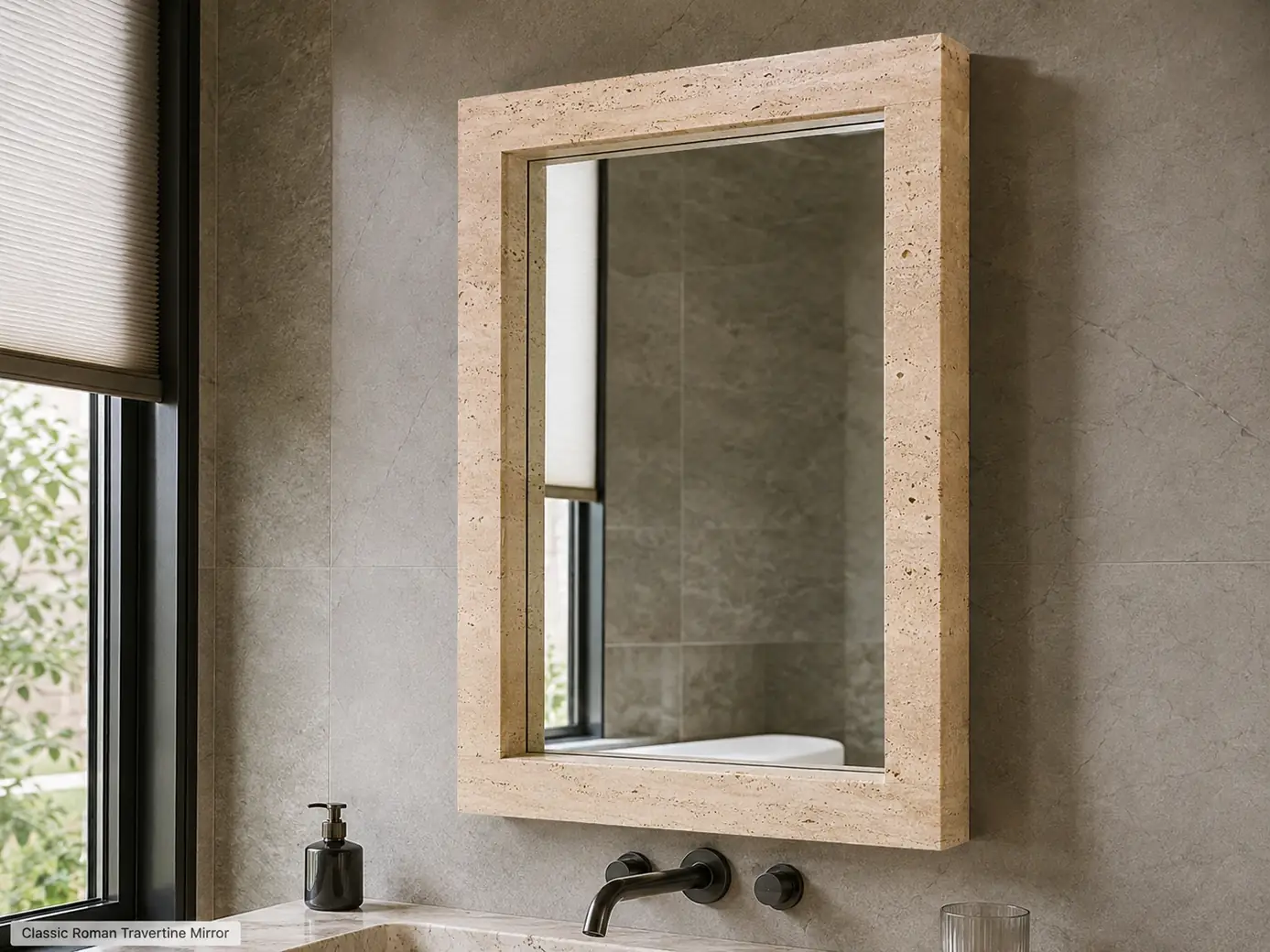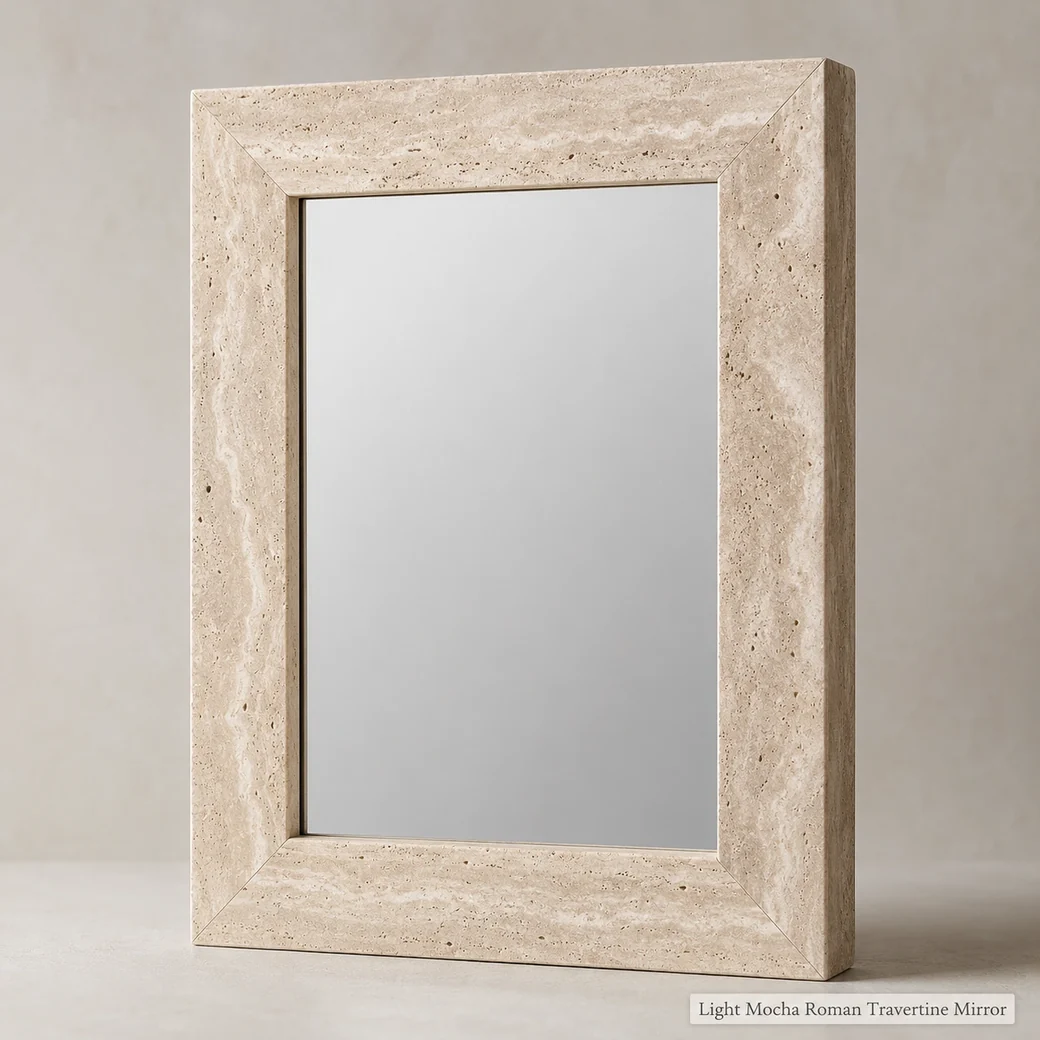
A travertine mirror uses genuine stone around a glass mirror and is therefore considerably heavier than timber- or resin-framed alternatives. It can be used in bathrooms if the wall fixing is rated for the completed weight and the stone is protected from persistent moisture. Round, rectangular and custom dimensions are feasible. Mechanical anchors or properly engineered brackets are preferable for large pieces; clean the stone frame with neutral cleaner.
Stone-Framed Reflections
Travertine Mirror Small
Secure product inquiry
Buy now
Cash on delivery available. Product details are pre-filled below. Owner delivery adds AED 5,000.
Anchoring, Moisture & Frame Care
Crafted Stone Frames for Multiple Interiors
This 50 × 70 cm mirror carries a 16.5 kg travertine frame, so mounting should rely on fixings and wall construction rated for the complete installed weight. Brushed stone frames can be produced in rectangular, round, arched or custom forms. In bathrooms, glass cleaner should be applied to the cloth rather than sprayed across unsealed stone, where repeated chemical contact may mark the frame.
Stone Frame Character
Travertine Wall Mirror Construction and Natural Variation
A Travertine Wall Mirror framed in genuine Classic Roman Travertine has a visibly different character from a mirror assembled with small travertine tiles or mosaic pieces. The brushed Light Mocha Cream stone frame can retain natural pores, tonal variation and irregular veining across larger continuous sections, giving the surround a more monolithic appearance. Tile or mosaic constructions instead introduce repeated joints and smaller pieces, creating a more segmented pattern. With genuine solid-stone framing, the natural variation becomes part of the mirror’s architecture rather than simply a decorative surface treatment.
Shape, Size & Mounting
Travertine Bathroom Mirror Dimensions and Installation Planning
The 50 × 3 × 70 cm travertine mirror weighs 16.5 kg, so installation should be planned from the completed stone-and-glass weight rather than mirror dimensions alone. Rectangular, round, arched and irregular frames can all be produced, but every shape needs wall anchors or brackets rated for the actual load and compatible with the wall construction; heavier custom pieces should not rely on decorative hooks or finish wallboard alone.
White Travertine Vanity Mirror Formats
The 50 × 70 cm rectangular format gives practical vertical viewing, while round or custom shapes can soften the composition or better suit the available wall area.
Natural Stone Mirror Anchoring Requirements
The 16.5 kg mirror should hang from anchors or engineered brackets fixed into suitable wall structure rather than relying on decorative wallboard alone.
Mediterranean Travertine Mirror Placement
The warm brushed travertine frame suits bathrooms, bedrooms and entryways where its soft mocha-cream tone can coordinate with other natural stone or neutral finishes.
Product Overview
Travertine Tile Mirror Product Details
This small mirror uses brushed Classic Roman Travertine in light mocha cream, with overall dimensions of 50 × 3 × 70 cm and a weight of 16.5 kg. It can be installed vertically or as fabrication allows, but exact glass dimensions are not supplied; large stone-framed mirrors require rated anchors or engineered brackets.
| Mirror Glass Thickness | 5 mm mirror glass |
|---|---|
| Glass Safety Type | 5 mm silver mirror with BS EN 12600 Class 2B2 anti-shatter safety backing |
| Visible Glass Area | Approx. 54 × 74 cm visible mirror-glass area within the travertine surround |
| Frame Face Width | Approx. 50 mm visible travertine frame-face width around the mirror glass |
| Bevel Width | 15 mm polished bevel around the exposed mirror-glass perimeter |
| Safety Backing Film | Full-surface anti-shatter safety film applied to the rear of the mirror glass |
| Orientation | Portrait orientation with the longer dimension installed vertically; landscape installation available where the fixing positions are reconfigured |
| Rear Backing Board | 6 mm moisture-resistant cementitious backing board mechanically secured behind the stone frame |
| Mounting Hole Pattern | Four concealed keyhole slots arranged symmetrically near the frame corners for secure portrait or landscape mounting |
| Anti-Fog Compatibility | Compatible with a low-voltage demister pad bonded to the rear of the mirror glass, outside the stone fixing and adhesive zones |
Moisture & Cleaning
Caring for a Stone-Framed Bathroom Mirror
A stone-framed mirror can be used in a bathroom when the wall, fixings and surrounding ventilation manage moisture correctly. Wipe the travertine with a soft damp cloth and dry standing water promptly; apply glass cleaner to the cloth rather than spraying it across porous or unsealed stone.
Designed for Interiors
Why Choose a Natural Travertine Wall Mirror
A natural travertine wall mirror is worth choosing when four factors suit the project: the stone frame provides substantial visual depth, custom shapes and sizes can be fabricated, bathroom use is possible with suitable moisture control, and the wall structure can support the completed weight. Proper mechanical fixing is particularly important because the stone frame is much heavier than timber or resin alternatives.
- Genuine Stone Frame
The genuine Roman travertine frame gives the mirror real stone depth and weight rather than a printed or resin imitation.
- Multiple Shape Options
Travertine frames can be fabricated in round, rectangular or bespoke shapes to suit different wall layouts.
- Secure Wall Mounting
The 16.5 kg stone-framed mirror requires properly rated anchors or engineered brackets for secure wall installation.
- Natural Surface Variation
Natural pores, veins and tonal shifts vary across the brushed stone frame, giving every mirror an individual surface character.
Bespoke Framing
Custom Travertine Vanity Mirror Options
A custom travertine vanity mirror can be produced in rectangular, round or arched formats with frame width and overall dimensions tailored to the wall, vanity and viewing height. Matching slabs can be selected for tone and vein continuity, with brushed or honed treatments chosen to suit the interior, while installation planning must account for the 16.5 kg stone frame and suitable anchors; similar load coordination is familiar to any raised floor supplier.

Technical Reference
Roman Travertine Mirror Specifications
Review the mirror specifications for orientation, fixing requirements and bathroom suitability before preparing the wall. These fields help you determine whether the selected mounting surface and hardware can safely support the complete stone-framed mirror in your intended location.
Product details
Specifications, care, delivery and FAQ
Everything is rendered from product JSON fields so the page remains SEO-ready even before JavaScript runs.
Cleaning: Dust the brushed frame with a soft brush, apply glass cleaner to the cloth rather than spraying the mirror, keep overspray off travertine, wipe the frame with pH-neutral stone cleaner and dry, avoid acidic or ammonia-heavy runoff abrasives and moisture behind the frame
Daily Care: Dust the brushed frame with a soft brush, apply glass cleaner to the cloth instead of spraying, wipe stone with pH-neutral cleaner, dry the lower edge and mounting points, monitor moisture in bathrooms, avoid acidic overspray abrasives and saturated joints
- Avoid mounting with unrated anchors
- avoid acidic glass-cleaner overspray
- avoid persistent bathroom moisture behind the frame
- avoid abrasive cleaning
- avoid positioning the mirror too close to obstruct the vanity tap
Maintenance: Apply glass cleaner to the cloth rather than spraying, dust the brushed stone frame separately, clean it with pH-neutral stone cleaner, dry the lower edge, inspect anchors and moisture seals, maintain clearance around taps and fittings
Handling: Use two people for the 16.5 kg mirror, remove it from rated brackets while supporting both lower corners, carry vertically, use glass suction cups only on the mirror pane where appropriate, pad the travertine frame, never lift by the top edge
What type of wall anchors or concealed brackets are suitable for safely supporting this 16.5 kg travertine-framed mirror on masonry, tiled walls or reinforced drywall?
The 16.5 kg mirror needs brackets rated above its total weight and fixed into structure. On masonry, use suitably sized expansion or chemical anchors; on tiled masonry, drill through the tile without loading it and anchor into the wall behind. On reinforced drywall, fix a French cleat or concealed metal brackets into studs or installed plywood blocking rather than relying on standard plasterboard plugs. Use at least two load-bearing points plus anti-lift restraint, isolate metal from the Travertine and have the fixing layout approved before drilling the stone frame.
Can this 16.5 kg stone-framed mirror be mounted safely over bathroom tiles without cracking them or relying only on adhesive?
The mirror can be mounted over tiles, but its 16.5 kg load must pass through the tiled finish into masonry, studs or installed structural blocking. Drill through the tile using appropriate tooling without hammer action, then install rated anchors or a concealed French cleat in the supporting wall. Do not rely only on adhesive or ordinary tile plugs. Use at least two load-bearing fixings plus anti-lift restraint, isolate brackets from the stone and seal penetrations appropriately in wet areas. Installation should be completed by an experienced professional.
Does this 16.5 kg travertine mirror require different bracket positions or hardware when hung horizontally instead of vertically?
Yes, horizontal orientation changes the load direction, centre of gravity and required spacing between attachment points. Use brackets or a continuous cleat rated for the 16.5 kg mirror in the selected orientation, fixed into structural substrate; hardware intended only for the original vertical mounting positions may not be suitable when rotated.
How much clearance should remain between the bottom of the 70 cm-high Travertine Mirror and the vanity tap to allow comfortable use, cleaning and unobstructed faucet operation?
Maintain at least approximately 10–15 cm between the mirror’s bottom edge and the highest point of the faucet, increasing this where a tall mixer tilts backward or needs top access for cleaning and servicing. Check the tap’s full handle movement and reflected sightline before drilling; the mirror should not obstruct operation or sit where repeated splash constantly wets the travertine frame.
Can bathroom moisture weaken an adhesive-only installation of this 16.5 kg travertine mirror, and should mechanical brackets or anchors carry its permanent load?
Yes, humidity can degrade unsuitable adhesive and moisture can enter the stone or backing, so adhesive should position and cushion rather than solely support this 16.5 kg mirror. Use corrosion-resistant mechanical brackets, a continuous cleat or anchors fixed into structural substrate, plus neutral-cure non-staining adhesive where specified and ventilation behind the frame.
Reviews
Reviews and new review submission
0.0 average rating from 0 reviews. New reviews are saved as pending until approved.
No approved reviews yet for this product. The review form is ready for buyer submissions.