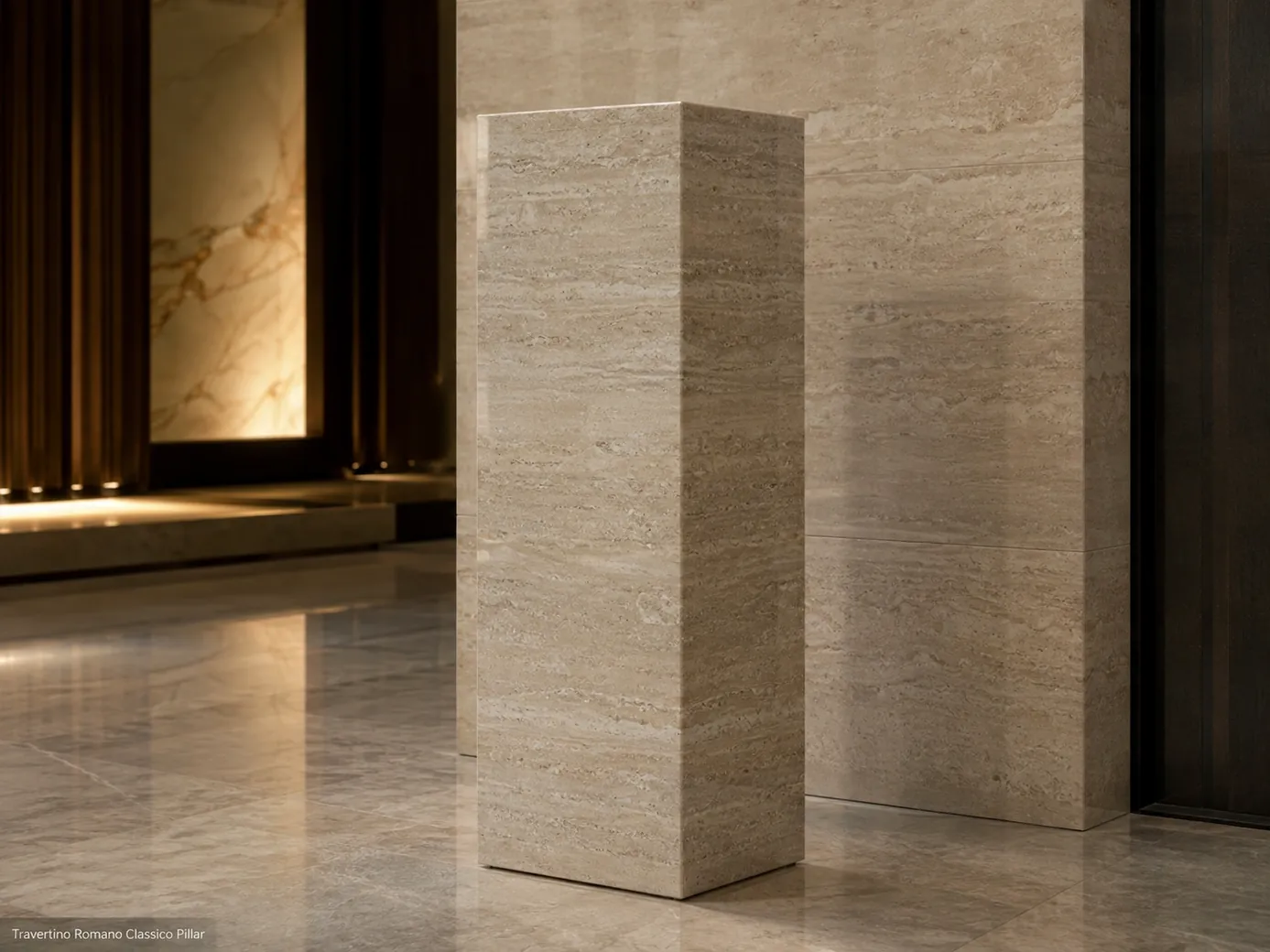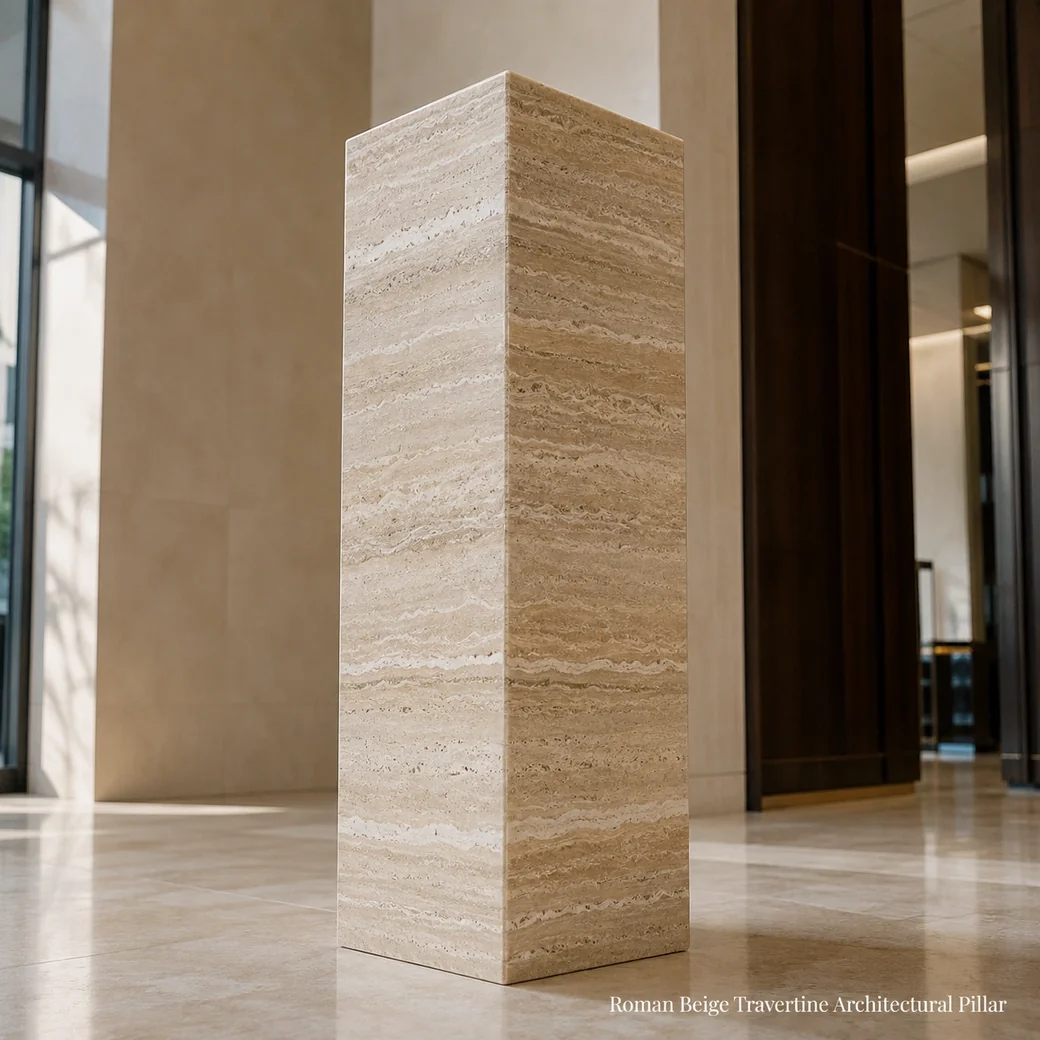
A travertine pillar may serve as architectural cladding, a decorative column, display pedestal or sculptural side-table form. Structural columns require engineering, while decorative pillars can be solid, hollow or stone-clad. Diameter, height and profile can be custom fabricated, with polished surfaces giving a formal appearance and honed or brushed finishes producing a softer look. Routine care requires neutral stone cleaner and protection from acidic chemicals.
Architectural Travertine Forms
Travertine Pillar Small
Secure product inquiry
Buy now
Cash on delivery available. Product details are pre-filled below. Owner delivery adds AED 5,000.
Structural vs Decorative Use
Custom-Carved Forms for Every Setting
This 30 × 30 × 120 cm Travertino Classico pillar can be fabricated as a solid architectural element, a hollow or veneer-clad decorative column, or adapted into pedestal-style display furniture. Round, fluted and rectangular profiles can be produced to project dimensions, while its 270 kg mass gives excellent stability for sculpture, lighting or architectural applications. Natural pores and white veining remain part of the individual stone character.
Architectural Stone Column
Roman Travertine Decorative Pillar
The Roman Travertine Decorative Pillar is a 30 × 30 × 120 cm polished stone element with considerably more physical mass than a typical decorative pedestal. Weighing approximately 270 kg, it must be planned as a substantial architectural or fixed decorative feature rather than an easily repositioned accessory. Its Roman-beige stone and soft white veining give the column a formal natural-stone appearance suited to architectural compositions, statement interiors, display applications or custom decorative installations where weight and support have been properly considered.
Column Design
How to Specify a Travertine Architectural Column
Before specifying load for the 30 × 30 × 120 cm, 270 kg travertine pillar, establish whether it is a decorative solid piece, stone cladding around another core, or an actual structural column. A decorative pillar only needs support for its own weight and displayed objects, a clad column transfers structural load through its concealed core, and a genuinely load-bearing stone column requires project-specific structural engineering rather than assumptions based on size.
Choose Solid, Hollow or Stone-Clad Pillars
A solid pillar carries far more weight and installation demand, while hollow or stone-clad forms are lighter decorative solutions; structural load-bearing use requires engineering.
Select Round, Fluted or Rectangular Columns
The 120 cm pillar can use restrained straight profiles or carved architectural detailing, with the profile chosen to match the surrounding interior rather than decoration alone.
Use a Travertine Pedestal Column for Art
The polished pillar can function decoratively beneath a lamp or sculpture or cross over into a sculptural side-table role when the top load remains appropriate.
Product Data
Roman Travertine Column Product Details
This small-category column uses polished Travertino Romano Classico in Roman beige with soft white veining. Its 30 × 30 × 120 cm dimensions and 270 kg weight describe an exceptionally substantial stone element, so installation, handling and any structural role must be planned around the actual construction.
| Internal Core Diameter | Approx. Ø150 mm internal service/core cavity |
|---|---|
| Base Plate Detail | Approx. 220 × 220 × 10 mm concealed AISI 304 stainless-steel base plate with four M12 anchoring points |
| Top Connection Detail | Concealed 10 mm AISI 304 stainless-steel top plate with four M12 threaded connection points |
| Segment Joint Position | Horizontal segment joints positioned at approximately 600 mm intervals and aligned with changes in the internal support frame |
| Lifting Point Provision | Two concealed M12 stainless-steel lifting inserts per prefabricated segment, removed or plugged after installation |
| Plumb Tolerance | Maximum 3 mm deviation from vertical over each 3 m installed pillar height |
| Floor Anchor Pattern | Four M12 stainless-steel anchors arranged on an approximately 200 × 200 mm square pattern around the pillar centreline |
| Capital Connection Type | Concealed stainless-steel dowel-and-plate connection between the pillar shaft and capital, bonded with non-staining structural epoxy |
| Base Levelling Detail | Non-shrink levelling grout beneath the full base plate with stainless-steel shims for initial alignment |
| Protective Crating Method | Fully enclosed reinforced timber crate with padded vertical bearers, corner protectors, moisture barrier and clearly marked upright lifting points |
Custom Stonework
Bespoke Travertine Pillar Options
Bespoke pillars can be adjusted in height, diameter or square section and supplied with smooth, fluted or carved shaft profiles. Bases and capitals may be simplified or made more decorative, while polished, honed, brushed and sanded finishes allow the same travertine to suit formal entrances, classical interiors or contemporary architectural schemes.
Architectural Presence
Why Choose a Natural Stone Display Column
A natural stone display column can serve as a pedestal for sculpture, retail products or decorative objects, or as a non-structural architectural feature within entrances and interiors. Custom height, section and profile allow the travertine column to be proportioned to the display or surrounding architecture rather than treated as a fixed-format element.
- Architectural Column Use
The 120 cm travertine column can function as decorative architectural cladding, a pedestal or a sculptural interior feature.
- Sculptural Display Support
The stone pillar can elevate sculpture, art or retail objects while functioning as a substantial architectural display support.
- Custom Carved Profiles
Custom carving can shape the pillar into fluted, stepped, rounded or other architectural profiles for project-specific interiors.
- Heavy Stable Construction
The 270 kg travertine construction gives the pillar substantial stability as a decorative column, pedestal or architectural feature.
Installation & Care
Handling a Heavy Travertine Pedestal Pillar
Before moving the 270 kg travertine pillar, verify structural floor capacity and the stability of the intended location, then use suitable lifting equipment rather than manual handling. The pillar should be anchored or restrained where engineering requires it and maintained with pH-neutral stone cleaner after installation; understanding heavy stone dimensions, such as the standard size of granite slab in cm, is similarly important when planning access and load handling.

Technical Specification
Travertine Column Specifications
Check the column specifications carefully for construction type and structural status before using the piece as anything more than a decorative element. The customization fields can guide changes to profile or size, but any load-bearing use should be determined from the documented construction and project engineering.
Product details
Specifications, care, delivery and FAQ
Everything is rendered from product JSON fields so the page remains SEO-ready even before JavaScript runs.
Cleaning: Dust polished surfaces from top to bottom with microfiber, wipe using diluted pH-neutral stone cleaner, rinse lightly and buff dry to prevent streaks, clean seams with a soft brush, avoid acidic sprays abrasives wax buildup and excessive moisture at joints
Daily Care: Dust polished faces from top to bottom with microfiber, wipe fingerprints using pH-neutral stone cleaner, buff dry, protect lower corners from impact, inspect seams and joints regularly, avoid acids abrasive pads and leaning wet objects against the pillar
- Avoid treating decorative cladding as a structural column
- avoid poorly positioned visible seams
- avoid unsupported heavy stone sections
- avoid acidic cleaners
- avoid moving the 270 kg pillar without engineered handling
Maintenance: Dust polished faces from top to bottom, clean with pH-neutral stone cleaner, buff dry, inspect cladding seams and anchors, repair failed joint sealant, protect lower corners from carts and furniture impact
Handling: Use an engineered lifting and rigging plan for the 270 kg pillar, confirm whether it is solid or clad, protect all edges with padded guards, keep it vertical in a rated cradle, control rotation with tag lines, never rely on decorative seams as lifting points
How should this heavy decorative travertine pillar be anchored at the floor and ceiling so it remains stable without visible fixings or damage to the stone?
A 270 kg decorative Travertine pillar requires an engineered concealed connection, typically a stainless-steel central rod or internal frame fixed into structural floor and ceiling elements with base and head plates. Resilient isolation pads and non-staining grout can distribute bearing pressure without loading fragile stone edges. Do not anchor only into finishes, suspended ceilings or tiles. The pillar should be fabricated around the support system, with access for tightening and movement allowance where required. A structural engineer must design the anchors for dead load, impact, overturning and substrate conditions.
Can the hollow interior of this decorative travertine column safely conceal electrical wiring or other services while preserving ventilation, inspection access and required separation?
Services can pass through a hollow decorative column only when the internal frame and structural connections leave a dedicated route and local regulations permit it. Electrical wiring should run in suitable conduit, remain separated from plumbing or heat-producing services and avoid sharp stone or metal edges. Provide discreet removable access panels for junctions and inspection; concealed electrical connections must not become permanently inaccessible. The column’s structural engineer and licensed electrician should coordinate the route before fabrication so drilling does not compromise anchors, reinforcement or ventilation.
How should four travertine faces be cut and sequenced so the veins continue convincingly around every corner of the pillar?
Cut the four faces consecutively from adjacent slab areas, preserving their orientation and marking every edge before fabrication. Mitre corresponding edges so each vein wraps from one face onto the next, then dry-assemble the complete pillar and adjust the sequence before bonding; random slab selection will not create convincing continuity.
Where should vertical and horizontal seams be positioned on a stone-clad Travertine Pillar so they align with the vein pattern and remain discreet from primary viewing angles?
Place vertical seams on secondary sides or precisely at mitred corners, where consecutive stone faces can wrap the veins around the pillar. Align any horizontal seam with a natural vein band, architectural datum or shadow line rather than through a visually quiet field; photograph and dry-assemble all four faces from the primary viewpoints before bonding and numbering them.
What lifting equipment, route protection and temporary support are required to move this 270 kg travertine pillar safely through a completed interior without damaging floors, walls or stone edges?
Use specialist stone riggers with a surveyed route and lifting equipment rated beyond the 270 kg load, such as a gantry, compact crane, powered trolley or machinery skates selected for the site. Hold the pillar in an engineered padded cradle, protect floors with load-spreading sheets and walls with barriers and use temporary bracing so it cannot rotate or topple during transitions.
Reviews
Reviews and new review submission
0.0 average rating from 0 reviews. New reviews are saved as pending until approved.
No approved reviews yet for this product. The review form is ready for buyer submissions.