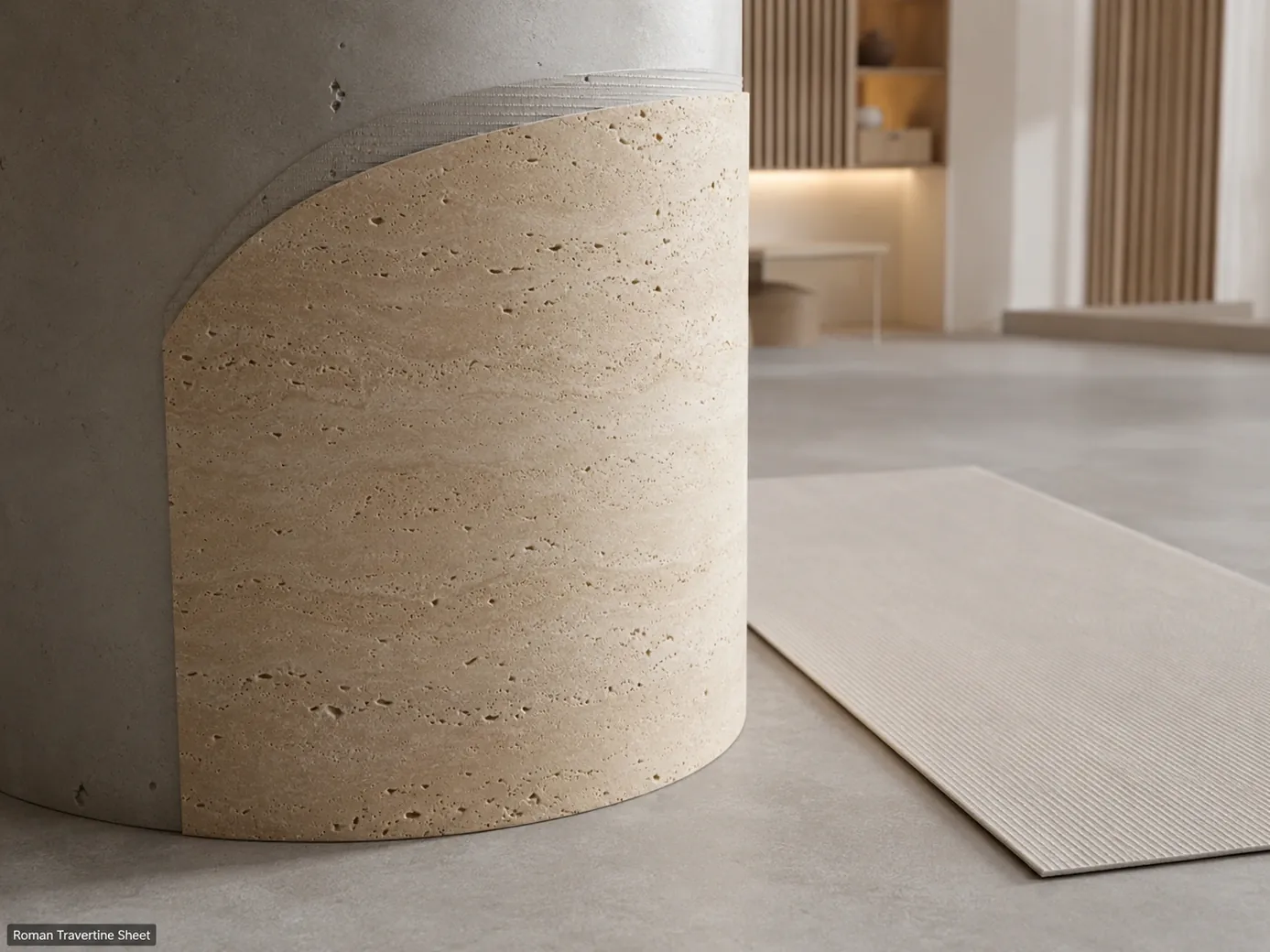
A flexible travertine sheet should not be confused with a conventional solid slab: flexible stone veneer is a thin stone layer bonded to a backing, with products commonly around 1.5–2 mm thick. This construction can follow columns and gentle curves and may be installed with suitable adhesive on prepared walls. Exterior or shower use depends entirely on the backing, adhesive, joints and waterproofing system; thin veneer itself should not be assumed waterproof.
Lightweight Flexible Stone Cladding
Travertine Sheet Small
Secure product inquiry
Buy now
Cash on delivery available. Product details are pre-filled below. Owner delivery adds AED 5,000.
Bend Radius & Wet-Area Limits
Renovate Large Surfaces Without Heavy Slabs
Flexible travertine sheets are designed for locations where full slabs would be too heavy or too rigid, including columns, furniture, ceilings, reception desks and curved wall surfaces. Stone veneer and composite products commonly measure about 3–5 mm thick and reach formats up to roughly 1200 × 2400–2900 mm; this 2 mm sheet is even slimmer. Installation is typically adhesive-based, but exterior exposure, bend radius and shower suitability depend on the backing and coating system and should be confirmed before specification.
Lightweight Stone Skin
Flexible Roman Travertine Sheet
The Flexible Roman Travertine Sheet is a 120 × 60 × 0.2 cm thin decorative facing that should be understood differently from a conventional solid travertine slab. At only 3.6 kg, its construction is intended for lightweight surface application rather than use as a structural stone component or freestanding worktop. The sanded cream-beige travertine appearance allows walls and selected architectural details to receive the visual character of Roman stone in situations where the thickness and mass of traditional slab material would be impractical.
Flexible Cladding Planning
How to Specify Thin Travertine Veneer Sheets
The 120 × 60 × 0.2 cm travertine sheet should be specified as a thin veneer system in conjunction with its backing, adhesive and receiving substrate. A stable interior wall may require a different installation build-up from an exterior surface exposed to heat, moisture and weather, so the intended location must be confirmed before selecting backing type or adhesive; the thin stone face itself should not be treated as a structural or waterproof layer.
Wrap Flexible Stone Around Columns
The 2 mm backed travertine sheet can follow gentle curves, but the minimum bend radius must be confirmed for the specific backing before wrapping tighter forms.
Bond a Travertine Wall Sheet Correctly
Use an adhesive approved for the veneer backing and substrate, applied only over a clean, flat and properly prepared installation surface.
Check Flexible Travertine for Shower Use
Shower or wet-area suitability depends on the backing, joint treatment and waterproofing system, not on the thin travertine face alone.
Product Data
Flexible Travertine Cladding Product Details
This small-category flexible cladding uses sanded Roman Travertine Stone over a backing, measuring 120 × 60 × 0.2 cm and weighing 3.6 kg. The 2 mm construction is a flexible veneer rather than a solid slab; the specific backing material is not identified in the supplied product data.
| Backing Material Type | Fiberglass-reinforced polymer/resin backing |
|---|---|
| Backing Thickness | Approx. 0.5–1.0 mm fiberglass/resin backing within the 2 mm overall flexible-stone sheet build |
| Minimum Bend Radius | Minimum 200 mm bend radius when curved parallel to the recommended flex direction |
| Sheet Tensile Strength | Minimum 3 MPa tensile-strength benchmark for the complete stone-veneer and backing composite; verify using the supplier’s tested system |
| Peel-Bond Strength | Minimum 1.0 N/mm peel-bond strength between the stone veneer and backing; verify using the complete supplier system |
| Edge Trimming Method | Trim from the backing side using a sharp carbide knife for straight cuts or a fine-tooth carbide/diamond tool for precise openings |
| Seam Joint Width | 1–2 mm nominal seam width, filled with flexible colour-matched stone sealant where movement accommodation is required |
| Primer Requirement | Apply the veneer manufacturer’s compatible low-VOC primer on porous, dusty or high-absorption substrates; omit only where the approved adhesive system specifically permits |
| Corner-Wrap Method | Heat and wrap one continuous sheet around corners with a minimum 100 mm radius; use a colour-matched butt joint for sharp 90° corners |
| UV-Stability Rating | UV-stable backing and adhesive suitable for sheltered exterior exposure, with no visible colour change greater than Grey Scale Grade 4 after the supplier’s accelerated-weathering test |
Surface Applications
Custom Thin Stone Sheet Options
Thin travertine sheets can wrap furniture, reception desks, columns and joinery or cover ceilings, walls and feature panels with much less weight than solid stone. Façade suitability depends on specifying a UV-stable exterior backing, compatible adhesive, sealed joints and an approved substrate system rather than treating every flexible sheet as interchangeable.
Lightweight Renovation
Why Choose Flexible Travertine Wall Skin
Flexible travertine wall skin gives designers the appearance of genuine stone in areas where a conventional slab would be unnecessarily heavy or difficult to bend. Its thin backed construction makes it useful for columns, curved walls and lightweight decorative surfaces while reducing material thickness and making adhesive installation more practical on prepared substrates.
- Ultra Thin Stone
At only 2 mm thick, the stone veneer can clad prepared walls and gentle curves without the mass of a conventional slab.
- Lightweight Wall Coverage
The 2 mm stone veneer provides broad wall coverage with far less weight than a conventional solid travertine slab.
- Curved Surface Installation
The 2 mm flexible stone veneer can follow columns and gentle curves that conventional solid travertine slabs cannot wrap.
- Reduced Joint Lines
The 120 × 60 cm veneer format covers broad areas with fewer visible joints than smaller decorative stone pieces.
Installation Guidance
Installing a Flexible Travertine Surface
Bond the flexible travertine sheet with an adhesive compatible with both its backing and the prepared substrate, trim it carefully with the appropriate tools and plan joints so edges remain secure and visually controlled. Exterior installations may require compatible protective coatings, while showers and other wet areas still depend on the complete waterproofing system rather than the veneer itself; edge coordination can be planned alongside details such as skirting profiles.

Technical Specification
Thin Travertine Sheet Specifications
Review the thin-sheet specifications for backing construction, bendability and approved applications before treating this material as a conventional stone panel. These fields tell you where the flexible veneer can realistically be installed and what substrate or environmental limitations must be considered.
Product details
Specifications, care, delivery and FAQ
Everything is rendered from product JSON fields so the page remains SEO-ready even before JavaScript runs.
Cleaning: Dust sanded veneer gently with microfiber, spot-clean using a barely damp cloth and pH-neutral stone cleaner, support flexible areas while wiping, dry edges and seams immediately, avoid soaking vigorous scrubbing acids steam and solvents that could affect the backing
Daily Care: Dust gently with microfiber, wipe marks using a barely damp pH-neutral cleaner cloth, dry seams and exposed edges immediately, protect the veneer from impact and substrate movement, inspect lifting corners regularly, avoid soaking acids abrasives steam and flexing beyond specification
- Avoid bending below the backing’s minimum radius
- avoid applying over unstable substrates
- avoid soaking or steam cleaning
- avoid acidic solvents
- avoid leaving exposed edges where the backing can lift
Maintenance: Dust flexible veneer gently, spot-clean with a barely damp pH-neutral cleaner cloth, dry cut edges and seams, inspect corners for lifting, maintain compatible joint sealant, repair substrate movement before it telegraphs through the sheet
Handling: Keep the flexible sheet supported on a large roll or flat board, respect the specified minimum bend radius, carry with two people, protect backing and cut edges,, acclimatize before installation, never crease or fold sharply
What is the minimum safe bend radius for this flexible travertine sheet before the natural stone face starts cracking or separating from its backing?
A universal bend radius cannot be assigned to a 2 mm Travertine sheet because flexibility depends on its backing, resin system, vein direction, panel dimensions and manufacturer. Forcing an untested sheet around a tight curve can crack the stone face or delaminate it even when it initially appears flexible. Obtain the supplier’s tested minimum radius, bend only in the approved direction and create a full-size sample on the actual substrate. Use narrower segmented strips or factory-curved components when the required radius is tighter than the documented limit.
Can this 2 mm flexible travertine veneer wrap an outside corner without cracking, and what minimum bend radius or corner-detailing method does the manufacturer require?
A 2 mm flexible Travertine veneer should not be folded sharply around a 90-degree outside corner. Its safe bend radius depends on the backing, resin, vein direction and manufacturer, so obtain the tested minimum for the exact product and make a full-size sample. If the required corner is tighter, terminate two sheets at the edge and use a mitred, overlapped or separate solid-stone corner trim. Forcing the veneer beyond its documented radius can crack the stone face or cause delayed delamination.
How should exposed flexible-travertine veneer edges be trimmed, sealed or returned so the backing remains concealed and protected?
Trim veneer with the manufacturer’s recommended tools, seal the exposed backing and finish edges with a matching return, purpose-made trim or carefully fabricated mitred detail. Outside edges should not expose mesh or resin to moisture and impact; use compatible flexible sealant at transitions rather than a brittle filler that may crack as the veneer moves.
Which flexible backing—fiberglass, resin composite or another system—best allows the 2 mm Travertine Sheet to follow curved joinery without cracking, lifting or showing substrate movement?
A fiberglass-backed resin-composite system is generally the most practical because it combines tensile reinforcement with enough flexibility for gentle curves. The minimum bend radius depends on the specific product, stone grain and backing thickness, so use one manufacturer’s sheet, primer and flexible adhesive system, test a full-size curved sample and avoid expecting 2 mm veneer to follow tight radii or substrate movement without cracking.
Can this 2 mm flexible travertine sheet be bonded over sound existing tile, and what cleaning, abrasion, priming and flatness preparation does the tiled substrate require?
It can be installed over tile only when the existing finish is firmly bonded, dry, flat and free of cracks or contamination. Degrease it, remove gloss mechanically, repair joints and uneven areas, apply the veneer manufacturer’s compatible primer and flexible full-coverage adhesive and create a mock-up; loose tile or active substrate movement must be removed or corrected first.
Reviews
Reviews and new review submission
0.0 average rating from 0 reviews. New reviews are saved as pending until approved.
No approved reviews yet for this product. The review form is ready for buyer submissions.