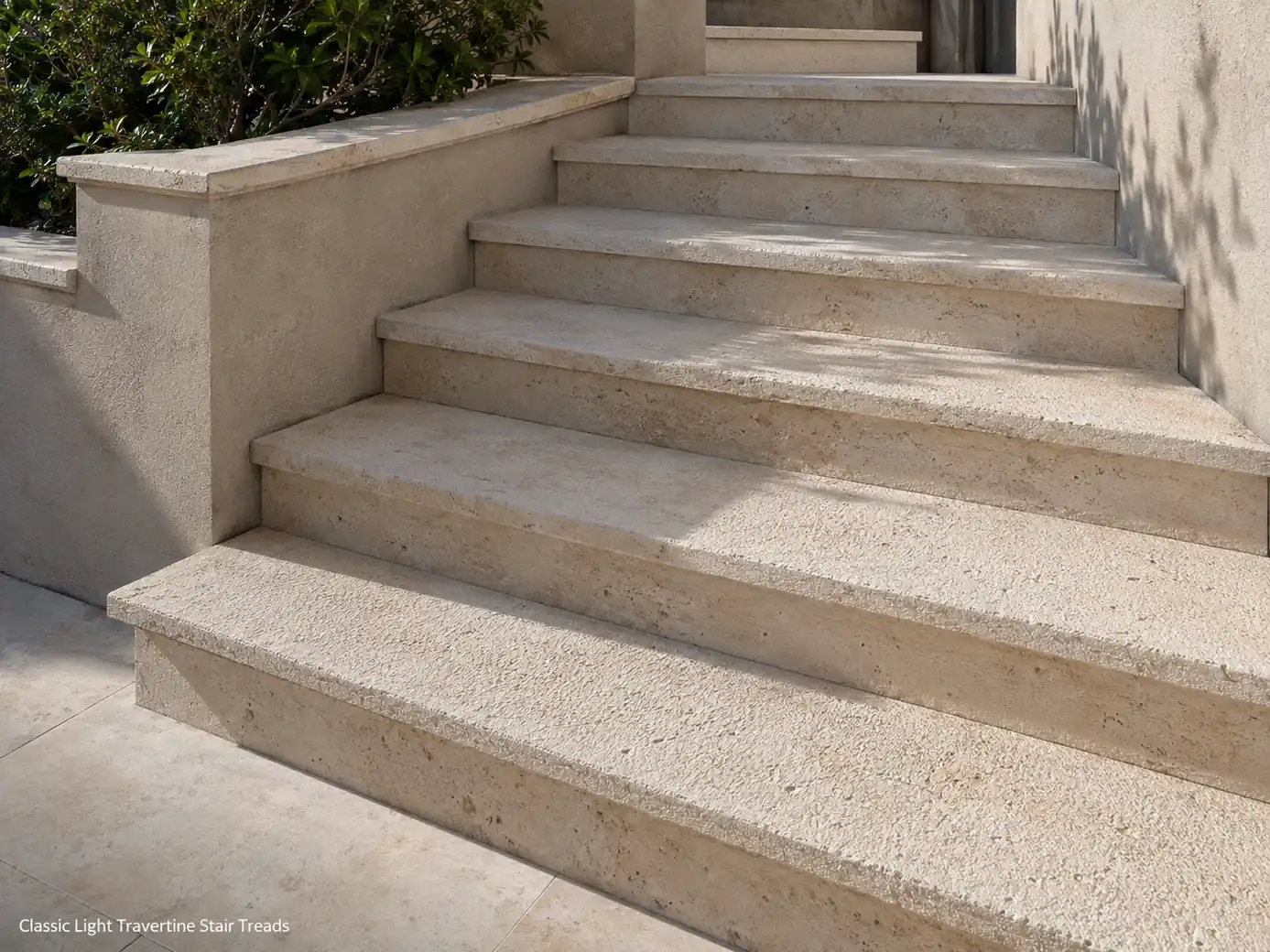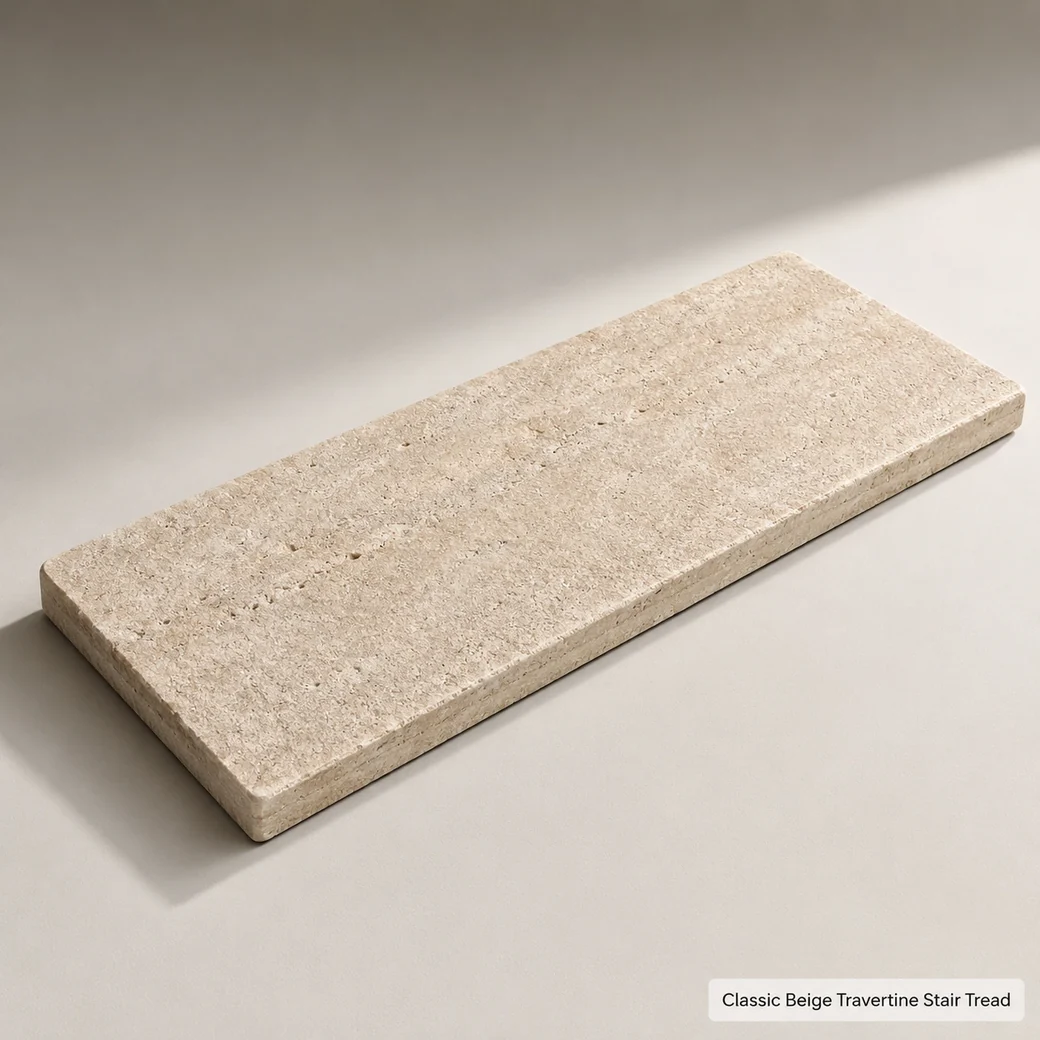
Travertine works well for stair treads when the stone thickness, substrate and edge detail are engineered correctly. Highly polished stone can become slippery, whereas bush-hammered, sandblasted, brushed or other textured surfaces improve traction. Treads are commonly fabricated thicker than wall tile, often around 30 mm where structurally appropriate. Sealing may reduce staining, and every riser, tread and landing can be custom cut to the staircase drawings.
Travertine Stair Solutions
Travertine Stairs Small
Secure product inquiry
Buy now
Cash on delivery available. Product details are pre-filled below. Owner delivery adds AED 5,000.
Nosing, Grip & Custom Cutting
Coordinated Treads, Risers and Landings
This 100 × 30 × 3 cm travertine tread uses a bush-hammered finish specifically suited to applications where added surface grip matters. Treads can be fabricated with straight, eased, bullnose or project-specific nosing and coordinated with matching risers, landings and skirting. Exterior stair design should also account for drainage, substrate support and the increased slip risk created by standing water.
Architectural Stone Steps
Travertine Stair Tread Construction and Finish Selection
Travertine stair systems use different stone components for distinct parts of the staircase rather than treating every piece as the same tile. Classic Light Travertine with a pale beige color and bush-hammered texture works particularly well for treads because the textured surface adds grip where feet make direct contact. Risers form the vertical faces beneath each tread, landings require larger horizontal sections, and full stair cladding can wrap several visible surfaces to create a more continuous stone composition. Matching these components carefully allows the staircase to read as an integrated architectural feature rather than a collection of separate cut pieces.
Safety & Fabrication
Travertine Steps for Interior and Exterior Staircases
Each 100 × 30 × 3 cm travertine tread weighs 22.5 kg and uses the 30 mm thickness appropriate to a substantial supported stair component rather than thin wall tile. Width, risers and edge details can be fabricated to the staircase drawing, while interior and exterior projects should select surface texture according to slip exposure; the bush-hammered finish is particularly relevant where improved traction is needed.
Travertine Stair Nosing Profiles
The exposed nosing should be accurately fabricated from the stair drawings, with a softened durable edge and the traction finish continued toward the front of each tread.
Textured Beige Travertine Stair Treads
The bush-hammered surface adds useful texture underfoot, but final stair grip should still be assessed for the actual interior or exterior exposure.
Natural Stone Staircase Risers and Landings
Complete stairwork can coordinate treads, risers and landings from the same stone batch so thickness, texture and colour remain consistent through the staircase.
Product Overview
Travertine Outdoor Step Product Details
This tread uses bush-hammered Light Travertine Stone in pale classic beige, measuring 100 × 30 × 3 cm and weighing 22.5 kg. The 30 mm textured tread can suit indoor or appropriate outdoor stairwork, while exact nosing profile and cut direction are not specified in the supplied data.
| Riser Compatibility | Compatible with approximately 150–180 mm finished riser heights |
|---|---|
| Landing Piece Availability | Matching custom-cut landing slabs available from the same stone lot with coordinated vein direction |
| Step Shade-Matching Sequence | Dry-lay and number sequential pieces from bottom to top, maintaining continuous vein direction and distributing tonal variation evenly across the complete flight |
| Anti-Slip Groove Option | Optional three parallel anti-slip grooves, each approximately 5 mm wide × 3 mm deep, positioned 25–30 mm behind the tread edge |
| Tread Support Length | Minimum 100 mm continuous bearing at both ends of each tread, unless an engineered full-width support frame is provided |
| Kerf Detail | Two underside kerfs, approximately 5 mm wide × 8 mm deep, positioned for stainless-steel support or anchoring channels without weakening the tread edge |
| Adhesive Bed Thickness | Approx. 6–10 mm finished full-coverage adhesive-bed thickness over a prepared substrate |
| Recommended Joint Width | 3 mm nominal joints between calibrated interior treads and risers, with movement joints maintained at structural transitions |
| Template Reference | Final tread, riser, kerf and fixing dimensions taken from an approved full-size site template referenced to each numbered stair position |
| Bullnose Return Length | Minimum 50 mm bullnose return along each exposed tread end, mitred and vein-matched to the front nosing |
Performance & Care
Maintaining a Travertine Staircase
Choose a textured finish and suitable nosing for dependable traction, particularly where stairs may become wet, and provide drainage and continuous substrate support where required. Seal according to absorption, clean with pH-neutral products and exercise extra caution with polished travertine because its wet slip resistance is lower.
Project Performance
Why Choose Travertine Stair Treads
Travertine stair treads offer four technical benefits: textured finishes such as bush-hammering improve traction, tread thickness can be engineered for the support condition, each tread and riser can be cut accurately to staircase drawings, and sealing can be specified where stain exposure is high. This makes the material suitable for coordinated stairs, landings and entrance transitions rather than only decorative cladding.
- Custom Cut Treads
Each travertine tread can be cut to the staircase drawings for consistent dimensions, riser alignment and edge detailing.
- Textured Grip Finish
The bush-hammered surface adds tactile grip to stair treads compared with highly polished stone.
- Matching Riser Options
Matching travertine risers can be custom cut with the treads to create a coordinated stone staircase installation.
- Indoor Outdoor Application
Properly specified travertine treads can be used indoors or outdoors, with textured finishes preferred where added traction is required.
Cut to Drawing
Custom Beige Travertine Steps
Custom beige travertine stairs should be fabricated directly from staircase drawings, with tread depth, riser height and overall width coordinated before cutting and either straight or bullnose nosing selected according to the design. Vein-cut pieces create more linear movement while cross-cut stone appears cloudier, and matching skirting can be produced from the same selection before professional installation; this level of coordination is also familiar to a raised floor supplier in dubai.

Technical Reference
Natural Travertine Stair Specifications
Review the stair specifications for nosing profile, cut direction, slip-related surface treatment and substrate requirements before fabrication. These details help your installer coordinate each tread with the actual staircase geometry while maintaining the intended traction and support conditions.
Product details
Specifications, care, delivery and FAQ
Everything is rendered from product JSON fields so the page remains SEO-ready even before JavaScript runs.
Cleaning: Sweep grit frequently with a soft broom, wash bush-hammered treads using pH-neutral stone cleaner and a nylon brush, rinse without leaving standing water, keep drainage and nosing grooves clear, dry indoor steps promptly, avoid acids metal brushes wax and slippery coatings
Daily Care: Sweep grit daily, wipe spills immediately, clean bush-hammered treads with pH-neutral stone cleaner, keep nosings joints and drainage clear, dry standing water and inspect loose pieces, avoid acids metal brushes wax and slippery coatings
- Avoid flat exterior treads that retain water
- avoid missing movement or drainage joints
- avoid acidic cleaners
- avoid slippery film-forming sealers
- avoid installing cracked or inadequately supported treads
Maintenance: Sweep grit frequently, clean textured treads with pH-neutral stone cleaner, keep drainage movement joints and drip edges clear, repair loose filler promptly, inspect nosings and substrate adhesion, maintain slip resistance without waxy coatings
Handling: Carry each 22.5 kg tread vertically with two trained handlers, support both ends, protect nosing and corners, use suction lifters compatible with the texture, store flat on full-length bearers, never lift by projecting edges
Which stair-nosing profile provides the best grip with this bush-hammered travertine while still giving the tread edge enough stone thickness to resist chipping?
A slightly rounded or small bevelled nosing combined with the bush-hammered surface gives practical grip while preserving edge strength. Avoid a thin projecting bullnose or deeply grooved edge, which can chip under impact and become difficult to clean. Retain substantial stone beneath the nosing—particularly with a 30 mm tread—and use one or two shallow antislip grooves set back from the edge if additional traction is required. The profile, support and permissible projection should comply with local stair and accessibility requirements.
Are bush-hammered travertine stair treads comfortable for barefoot use while still providing adequate wet-area traction?
A moderate bush-hammered texture provides strong wet traction but may feel coarse under bare feet if the treatment is aggressive. For pool, spa or residential barefoot stairs, specify a fine or medium bush-hammered finish and approve a full-size sample under wet conditions. Sharp peaks should be lightly brushed without polishing away the grip. Comfort and safety also depend on rounded nosings, consistent risers, drainage and documented wet-slip performance; visual texture alone does not establish whether a stair is suitably slip-resistant.
How should travertine tread, riser and landing veins be sequenced to create continuous movement without mismatched bands?
Photograph and number consecutive slabs, then map treads, risers and landings on a full stair elevation before cutting. Continue major vein bands from each riser into the next tread where possible, reserve longer sequential sections for landings and dry-lay the entire visible sequence so abrupt direction or colour changes can be corrected.
Do exterior Travertine Stairs require sloped treads, drip edges, movement joints or additional drainage detailing to prevent standing water and moisture-related damage?
Yes, exterior treads should fall slightly toward the drainage edge—commonly around 1–2%—so water cannot pond, with drip grooves beneath projecting nosings where appropriate. Provide movement joints at structural transitions and suitable intervals, continuous waterproofing and drainage beneath bonded stone and correctly detailed landings; the exact system must reflect climate, substrate and local exterior-stair requirements.
Can a chipped travertine stair edge be rebuilt and refinished in place without replacing the complete tread, and what determines whether the repair will remain durable?
A small stable chip can often be rebuilt in place using a pinned insert for larger losses or colour-matched structural stone resin for minor damage, followed by shaping and texture matching. Durability depends on sound surrounding stone, tread support and impact location; recurring or load-bearing nosing damage may require a professionally fabricated replacement section or full tread.
Reviews
Reviews and new review submission
0.0 average rating from 0 reviews. New reviews are saved as pending until approved.
No approved reviews yet for this product. The review form is ready for buyer submissions.