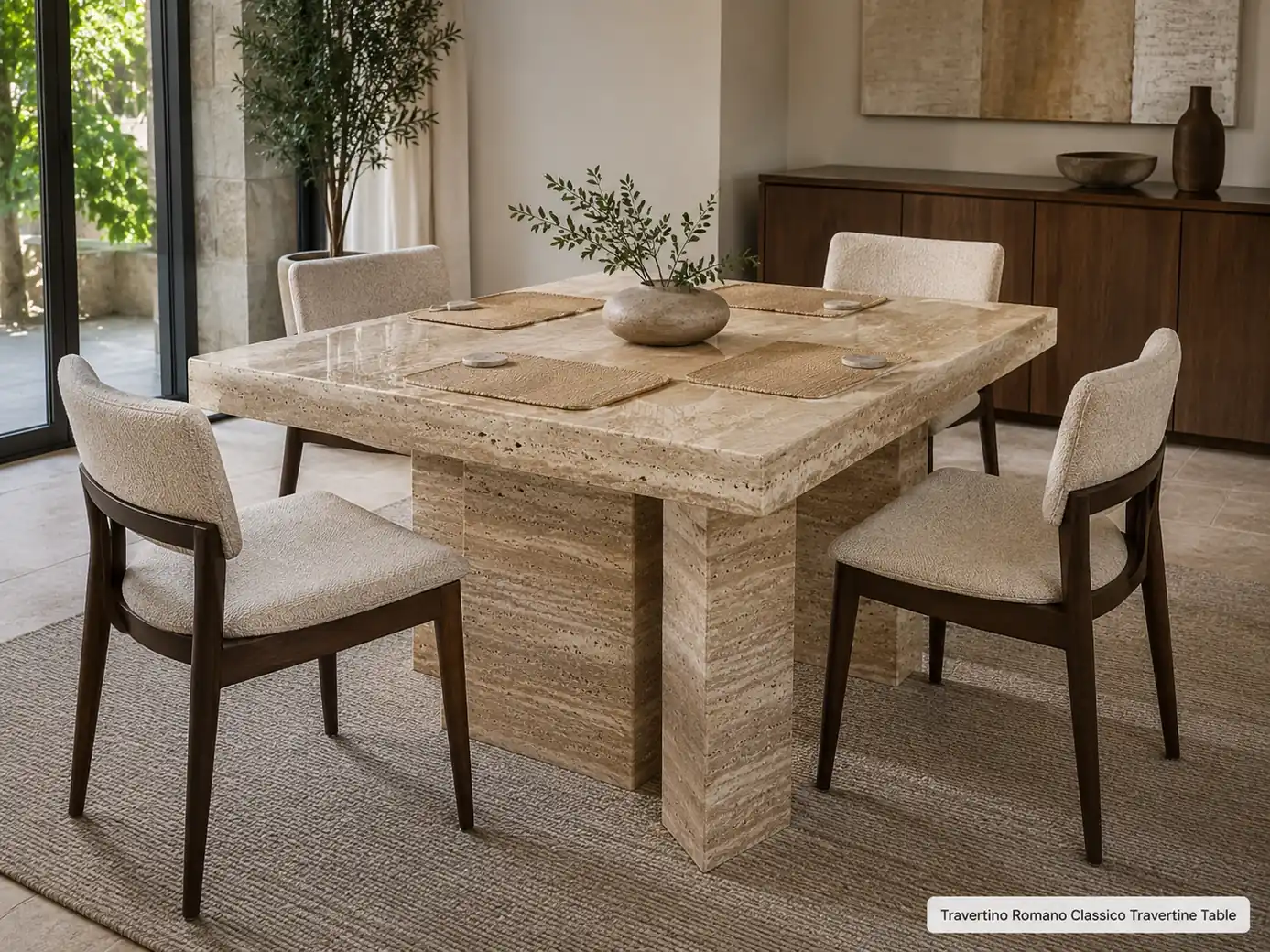
A travertine dining table is suitable for everyday dining when spills are wiped promptly and acidic foods are kept from sitting on the surface. Most dining tables are about 71–76 cm high, while length and width depend on seating capacity; custom dimensions are practical. Because natural stone is heavy, confirm the finished weight and floor access before delivery. Use pH-neutral stone cleaner, and apply an impregnating treatment only when the specific stone’s absorption calls for it.
Solid Travertine Dining Statement
Travertine Table Small
Secure product inquiry
Buy now
Cash on delivery available. Product details are pre-filled below. Owner delivery adds AED 5,000.
Size, Weight & Custom Fabrication
Choosing Dining Size, Weight and Custom Dimensions
Travertine tables span everything from compact side tables to dining formats over two metres long, including roughly 213 × 102 cm six-seaters and 244 × 102 cm tables for eight to ten people. This 120 × 75 × 75 cm piece is a smaller dining format but still weighs 95 kg. Custom fabrication can adjust top size and base form, while sealing and pH-neutral maintenance help manage the natural pores and variation of the stone.
Solid Stone Dining
Roman Classico Travertine Dining Table
The Roman Classico Travertine Dining Table is a substantial 120 × 75 × 75 cm natural-stone table designed to give everyday dining a strong architectural centerpiece. Its polished Travertino Romano Classico surface combines light mocha-beige coloring with visible white banding, creating the linear variation associated with Roman travertine. At 95 kg, the table has considerable physical presence, making it particularly suited to dining spaces where the furniture is intended to remain visually and structurally grounded rather than frequently repositioned.
Dining Scale
How to Size a Travertine Dining Table
The 120 × 75 × 75 cm travertine dining table should be sized from the intended chair count and the space available after those chairs are occupied, not from tabletop dimensions alone. Its 120 cm length suits compact dining, but each diner still needs usable elbow space and every chair needs room to pull back; if the room cannot maintain comfortable circulation around the 95 kg table, a smaller top or different shape is more practical.
Compare Compact and Large Stone Dining Tables
The 120 × 75 cm format suits a smaller dining arrangement, while longer custom tops can extend the same concept into six-, eight- or ten-seat layouts.
Choose a Pedestal or Solid-Block Table Base
The base should distribute the 95 kg load evenly while preserving knee clearance, with heavier monolithic forms creating more visual mass than open supports.
Order a Travertine Table to Exact Dimensions
The table can be fabricated to custom length, width, round or rectangular shape and selected finish so its proportions follow the dining layout.
Product Data
Roman Travertine Dining Table Details
This small dining table is made from polished Travertino Romano Classico with light mocha-beige colouring and white bands. Its 120 × 75 × 75 cm dimensions and 95 kg weight create a substantial dining-height format whose delivery and floor support should account for the natural-stone mass.
| Leg Clearance | Approx. 90 cm clear leg width × 68 cm clear height |
|---|---|
| Top Overhang | Approx. 150 mm tabletop overhang beyond supporting base |
| Base Type | Twin solid travertine slab-end bases joined by a concealed steel stretcher |
| Levelling Feet | Four concealed M8 stainless-steel levelling feet with non-marking nylon pads and approximately 10 mm height adjustment |
| Floor Pads | Replaceable 3 mm non-marking thermoplastic-rubber floor pads beneath each support |
| Top-to-Base Fixing | Concealed M10 stainless-steel studs fixed into bonded threaded inserts with slotted base plates |
| Edge Radius | R10 mm continuous radius on exposed tabletop edges |
| Vein Orientation | Linear veins oriented along the 120 cm tabletop length and matched across the supporting bases |
| Knock-Down Assembly | Demountable M10 stainless-steel stud-and-insert assembly with locating dowels |
| Apron Clearance | Minimum 680 mm vertical clearance beneath the apron |
Bespoke Dining
Custom Natural Stone Table Options
This natural-stone table can be fabricated with a round, oval, square or rectangular top sized to the required seating plan. Pedestal choices include solid sculptural, twin-column, fluted or internally reinforced hollow forms, while the dimensions and finish can be changed from polished to honed, brushed or sanded according to the intended setting.
Dining Performance
Why Choose a Solid Travertine Dining Surface
A solid travertine dining surface gives the table substantial weight, natural variation and a durable base for everyday meals while still allowing the piece to be tailored to the room. Length, width, edge treatment and base configuration can be fabricated around seating requirements, making the finished table more closely matched to the dining layout.
- 95 kg Stone Build
The 95 kg stone build gives the dining table substantial stability and a firmly anchored presence during everyday use.
- Custom Dining Sizes
Length and width can be fabricated around the required seating capacity and available dining-room circulation.
- Natural White Banding
Natural white banding runs through the light mocha travertine, giving the tabletop distinct linear mineral character.
- Polished Table Surface
The polished finish creates a smooth reflective dining surface that highlights the stone’s light mocha tone and natural white bands.
Delivery & Care
Protecting and Installing a Heavy Stone Dining Table
Plan delivery access for the 95 kg table before arrival, checking doors, stairs, lifts and the final assembly area so the stone can be positioned without unsafe lifting or edge impacts. Seal only where the travertine requires it, clean with pH-neutral products and remove citrus, wine and other acidic foods promptly; these material differences can be considered alongside options such as greynight stone when selecting natural stone furniture.

Technical Specification
Travertine Dining Furniture Specifications
Review the specification table for seating capacity, base construction and available customization before planning this dining table into your room. It will also help you confirm delivery and support requirements for the finished stone piece while keeping the appropriate maintenance information in one place.
Product details
Specifications, care, delivery and FAQ
Everything is rendered from product JSON fields so the page remains SEO-ready even before JavaScript runs.
Cleaning: Remove crumbs and grit before wiping, blot acidic food wine and oil immediately, clean polished travertine using pH-neutral stone cleaner and microfiber, rinse lightly and buff dry, use placemats coasters and trivets, avoid acids abrasives and waxy polish
Daily Care: Use placemats coasters trivets and padded décor, remove crumbs before wiping, blot acidic food wine and oil immediately, clean polished travertine with pH-neutral stone cleaner, buff dry, avoid acids abrasives and direct hot cookware
- Avoid acidic food and wine remaining on polished travertine
- avoid direct hot cookware
- avoid dragging crockery
- avoid abrasive cleaners
- avoid moving the 95 kg table without load-spreading equipment
Maintenance: Use placemats coasters and trivets, remove crumbs before wiping, blot acidic spills promptly, clean polished travertine with pH-neutral stone cleaner, buff dry, inspect supports and load-spreading floor pads regularly
Handling: Empty and clear the dining area, use professional movers for the 95 kg table, detach the top only if designed for it, lift from engineered support points, pad polished edges, distribute weight through suitable floor protectors
Can the heavy travertine tabletop and base be separated for delivery through narrow doors, lifts or staircases and then safely reassembled inside the room?
The 95 kg Travertino Romano Classico table can be designed with a detachable top and base, which is usually the safest way to move it through narrow doors, lifts or stairs. The connection should use engineered concealed plates, threaded inserts or mechanical fasteners rather than site-applied adhesive alone, with locating pins preventing lateral movement. Obtain the weight and dimensions of each separated component before delivery, confirm lift and doorway clearances, and use professional stone handlers. Reassembly must follow the fabricator’s fixing and levelling instructions.
Which doorways, lift interiors, corridors, turns and stair landings must be measured to confirm that this 120 × 75 cm, 95 kg travertine table can reach its intended room?
Measure every doorway’s clear opening with doors, handles and frames included, plus lift door width, internal dimensions, weight limit and diagonal turning space. Record corridors, corners, ceiling height, stairs and landings, then compare them with the table or separately packed components in their delivery orientation, including protective packaging and handling equipment.
Can a small chip on the polished travertine tabletop edge be repaired on site without leaving a visible colour or gloss difference?
A small edge chip can usually be repaired on site with colour-matched stone resin or mineral filler, followed by careful shaping and polishing. A skilled restorer can make it discreet, but exact colour, pore pattern and gloss matching cannot be guaranteed, particularly on a highly reflective polished edge.
What type and size of load-distributing floor protectors should be fitted beneath the 95 kg Travertine Dining Table to prevent dents, scratches or concentrated pressure on timber and delicate flooring?
Use broad, non-staining load-distribution pads beneath every leg or pedestal contact point—typically at least 50–75 mm wide for individual legs, or a continuous dense felt and elastomer layer beneath a full base. Pads should be firm enough not to collapse under 95 kg, colourfast and free of plasticizers; calculate pad size from the flooring manufacturer’s allowable point load.
How closely can two polished Travertino Romano Classico tables be matched for beige colour, white bands and vein movement when fabricated from the same slab batch?
Two tables can be closely coordinated when cut from adjacent areas of the same consecutively numbered slab batch, but exact matching is impossible. Photograph and dry-lay both tables simultaneously, align or mirror major white bands and distribute pores and beige tones deliberately; reserve extra matching material for fabrication damage or later repair.
Reviews
Reviews and new review submission
0.0 average rating from 0 reviews. New reviews are saved as pending until approved.
No approved reviews yet for this product. The review form is ready for buyer submissions.