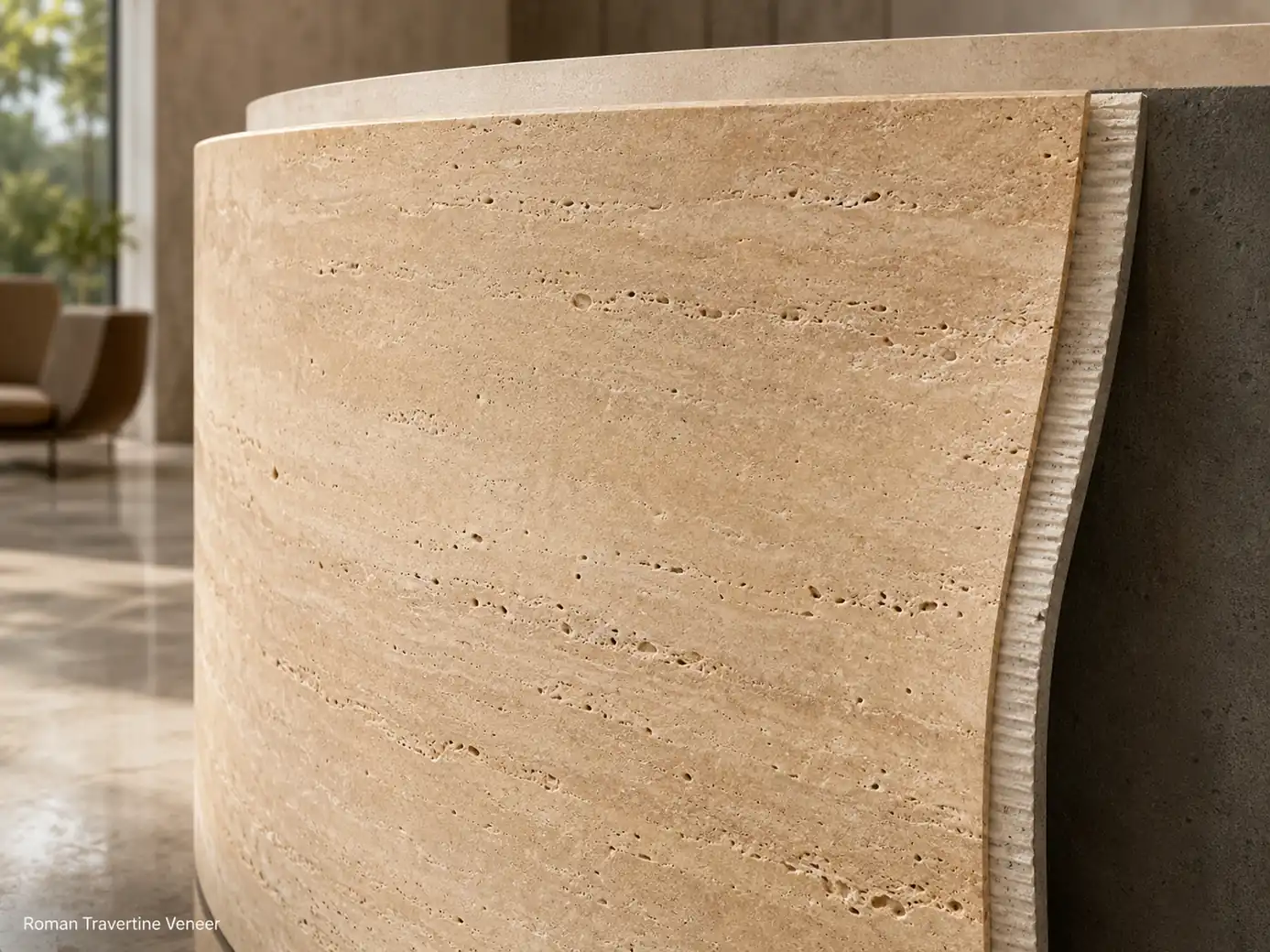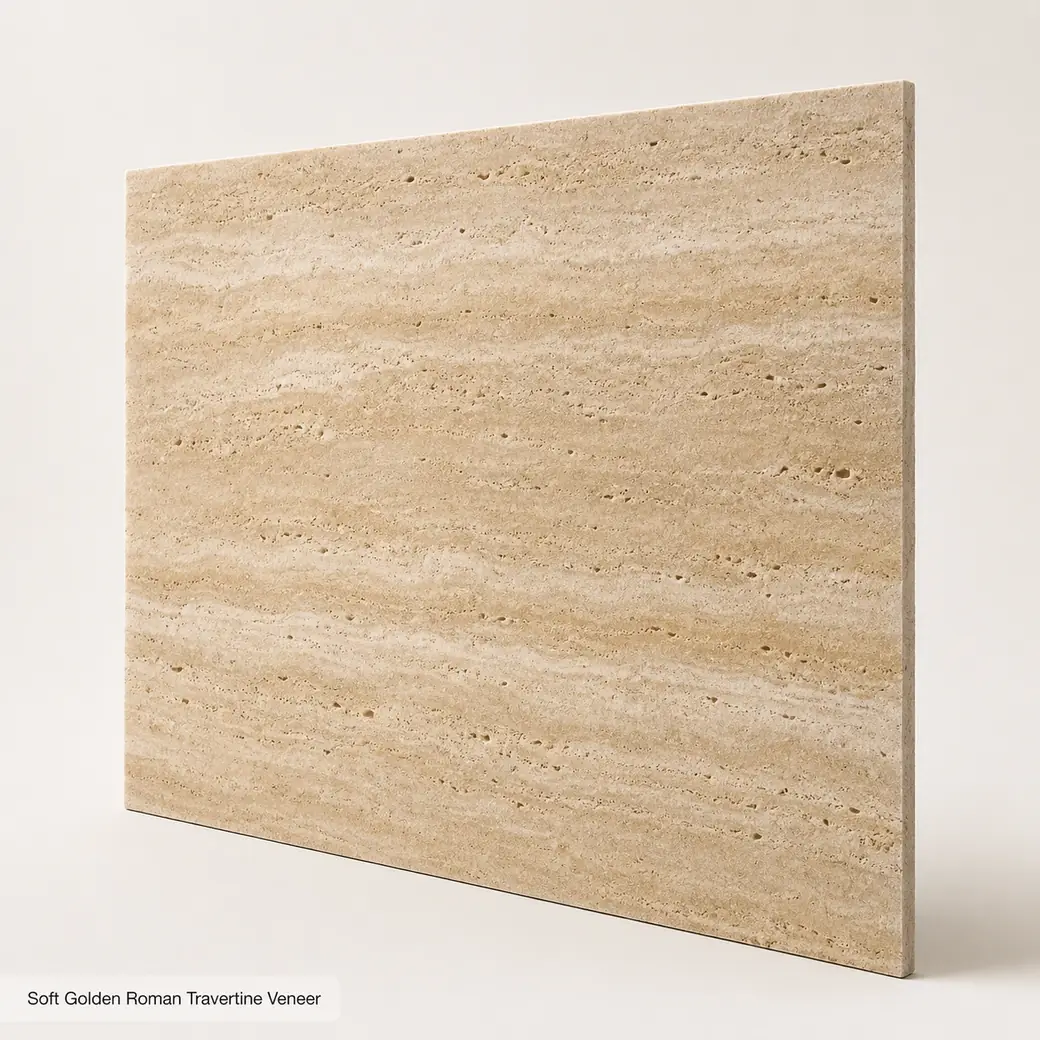
Travertine veneer is a thin decorative facing that reproduces natural stone appearance without the mass of a full slab. True flexible stone veneers may be only about 1.5–2 mm thick and can follow gentle column curves. They are installed with compatible adhesives over a stable substrate. Exterior suitability depends on the backing and adhesive system, and buyers should distinguish genuine thin stone veneer from manufactured flexible travertine-look composites.
Lightweight Stone Cladding
Travertine Veneer Small
Secure product inquiry
Buy now
Cash on delivery available. Product details are pre-filled below. Owner delivery adds AED 5,000.
Thin Stone, Backing & Curves
Natural Stone Character with Less Weight
At only 2 mm thick, this 120 × 60 cm travertine veneer provides natural stone character without the mass of conventional slab cladding. Genuine flexible veneer uses a thin stone face bonded to a backing, allowing installation over columns, furniture and gently curved surfaces. Exterior or wet-area suitability depends on the backing, adhesive and protective coating rather than the travertine face alone.
Thin Natural Stone Facing
Flexible Roman Travertine Veneer
The Flexible Roman Travertine Veneer is a 120 × 60 × 0.2 cm lightweight stone facing designed for applications where the appearance of natural Roman travertine is wanted without the mass of a conventional slab. Its brushed golden-beige surface gives walls, furniture fronts and architectural details genuine stone character, while the 3.5 kg format is far easier to integrate into lightweight assemblies. Its thin construction also makes it suitable for selected curved or shaped surfaces that would be impractical to clad with rigid full-thickness travertine.
Veneer System
How to Specify Thin Travertine Cladding
Genuine thin travertine cladding uses a real stone face bonded to a backing, preserving natural mineral variation while dramatically reducing the mass of a full slab. It should be distinguished from manufactured travertine-look sheets that reproduce the appearance through printed or composite surfaces; material specification should therefore identify whether the visible face is actual stone and what backing system is used.
Wrap Stone Veneer Around Columns
Flexible travertine veneer can follow gentle curved walls or columns, but its minimum safe radius must be checked against the actual backing system before installation.
Bond Travertine Facing to Prepared Substrates
Bond the veneer with a backing-compatible adhesive over a clean substrate and detail sheet joints carefully so edges remain secure and visually controlled.
Check Flexible Stone Cladding for Outdoor Use
Exterior performance depends on the veneer backing, protective coating and adhesive system being specified for weather exposure, not on the stone face alone.
Product Data
Roman Travertine Veneer Product Details
This veneer uses a brushed Roman Travertine face in soft golden beige, measuring 120 × 60 × 0.2 cm and weighing 3.5 kg. It is a thin backed stone product rather than full-thickness slab material; the exact backing composition is not specified and should be matched with a compatible adhesive system.
| Minimum Bend Radius | Minimum bend radius: ≥100 mm |
|---|---|
| Edge Treatment | Factory square-trimmed edge for close butt-joint installation, with clean knife/CNC trimming permitted at site |
| Corner-Wrap Method | Form external corners by heating and wrapping one continuous veneer sheet around a minimum 100 mm radius; use a colour-matched butt joint where a sharp corner is required |
| Panel Joint Gap | 2 mm nominal butt-joint gap, filled with flexible colour-matched stone sealant where movement accommodation is required |
| Cutout Capability | Can be cut for sockets, switches and penetrations using carbide or diamond tools; maintain minimum 20 mm material around openings and round internal corners |
| Sheet Orientation | Install sheets with the natural sedimentary vein direction kept consistent across adjacent pieces; confirm horizontal or vertical orientation before cutting |
| Surface Flatness Tolerance | Maximum 2 mm substrate deviation beneath a 1 m straightedge before veneer bonding |
| Fire Classification | Minimum Euroclass B-s1,d0 for the complete stone-veneer, backing, adhesive and substrate assembly where fire performance is required |
| UV Exposure Rating | Suitable for interior and sheltered exterior use when supplied with UV-stable backing, adhesive and sealer; prolonged direct UAE exposure requires system-specific approval |
| Factory Cutting Method | CNC or guided diamond cutting for accurate factory shapes, socket openings and repeated panels; waterjet cutting may be used for complex profiles |
Design Applications
Custom Thin Travertine Facing Options
Thin travertine facing can be cut for feature walls, fireplace surrounds, furniture, joinery panels, reception counters and decorative columns. Backing type, bend radius, adhesive, joint treatment and exposure rating should be specified for each application, particularly around heat, moisture or exterior conditions.
Lightweight Stone Finish
Why Choose Travertine Veneer Panels
Travertine veneer panels provide genuine stone character with far less weight than conventional slabs, making them useful where full-thickness stone would be impractical. Their thin construction can follow gentle curves, reduces loading on substrates, and allows larger decorative surfaces to be clad with natural travertine while using compatible adhesive systems instead of heavy mechanical stone support.
- Real Stone Surface
The veneer uses a genuine travertine surface to deliver real mineral texture without the weight of a full stone slab.
- Lightweight Wall Cladding
The 2 mm travertine veneer covers walls with genuine stone while adding far less weight than conventional slabs.
- Bendable Column Coverage
The thin flexible travertine veneer can wrap gentle column curves that conventional rigid stone slabs cannot follow.
- Easier Site Cutting
The 2 mm flexible veneer can be trimmed more easily on site than full-thickness stone when fitting walls, columns and detail areas.
Installation Care
Installing and Maintaining Thin Stone Veneer
Install thin travertine veneer with an adhesive compatible with both the backing and prepared substrate, finish exposed edges carefully and plan joints so movement or lifting is minimized. Exterior work may need a compatible protective coating depending on the veneer system, while routine cleaning should remain non-acidic; experienced marble suppliers in uae can also help distinguish genuine stone veneer requirements from full-thickness slab installation.

Technical Specification
Travertine Veneer Specifications
Use the veneer specification table to verify the actual stone face, backing construction and permitted bending before selecting it for curved or lightweight applications. The approved-application field should guide where the system can realistically be installed rather than assuming every thin stone product suits the same environment.
Product details
Specifications, care, delivery and FAQ
Everything is rendered from product JSON fields so the page remains SEO-ready even before JavaScript runs.
Cleaning: Dust brushed veneer gently with a soft brush, spot-clean using pH-neutral stone cleaner on a barely damp cloth, wipe with light pressure along the surface, dry exposed edges and joints, avoid soaking steam acids abrasives and solvents that may weaken the adhesive or backing
Daily Care: Dust brushed veneer gently, spot-clean using a barely damp pH-neutral cleaner cloth, dry joints and exposed edges promptly, protect corners from impact, monitor adhesive stability, avoid soaking acids abrasives steam and pressing heavily on flexible sections
- Avoid installing over moving or damp substrates
- avoid sharp bends beyond the backing limit
- avoid leaving exposed backing at corners
- avoid acidic or solvent-heavy cleaners
- avoid saturating joints and cut edges
Maintenance: Dust with a soft brush, spot-clean using pH-neutral stone cleaner, keep exposed edges and joints dry, inspect lifting corners and substrate cracks, maintain compatible flexible sealant, repair loose areas before moisture reaches the backing
Handling: Support the veneer on a flat board or large-diameter roll, observe the backing’s bend limit, carry with two people, protect exposed corners, keep adhesive faces clean and dry, never fold sharply or pull from one corner
What minimum curve radius can this thin travertine veneer follow around a column before the natural stone face risks cracking or separating from its backing?
Thin Travertine veneer has no universal minimum curve radius because performance depends on backing type, resin, vein direction, sheet size and manufacturer. Obtain a documented tested radius for the exact 2 mm product and make a full-height mock-up around the intended column. The substrate must be smooth, stable and compatible with the specified adhesive. If the required radius is too tight, divide the veneer into narrow vertical strips with controlled joints rather than forcing it; excessive bending can cause delayed cracking or stone-to-backing separation.
Can this 2 mm travertine veneer wrap an external corner without cracking, and what minimum bend radius should be maintained?
Do not bend 2 mm Travertine veneer sharply around an external corner. The safe radius varies with its fibreglass or composite backing, resin, grain direction and manufacturing system, so the supplier must provide a tested minimum. Make a full-height mock-up because small samples may not reveal delayed cracking. When the corner is tighter than the approved radius, use two separately cut sheets meeting at a controlled mitre, butt joint or solid Travertine trim instead of forcing one sheet around the edge.
Which flexible, non-staining adhesive is suitable for bonding this travertine veneer to a prepared curved substrate?
Use the veneer manufacturer’s approved flexible, non-staining polymer-modified or MS-polymer adhesive for both its backing and the prepared curved substrate. The product must support the veneer’s weight, remain compatible with moisture exposure and accommodate the stated bend radius; prepare a bonded mock-up because generic stone adhesive may telegraph or stain through thin material.
How should exposed corners and cut edges of the 2 mm Travertine Veneer be finished so the backing remains concealed and the thin stone does not chip or lift?
Finish outside corners with factory-cut returns, a compatible profile trim or carefully formed mitred veneer pieces that conceal the backing without forcing an excessively tight bend. Seal exposed backing and cut edges with the manufacturer’s compatible system, use flexible non-staining adhesive across full contact and terminate vulnerable edges beneath a shadow gap or protective trim so impact and moisture cannot initiate lifting.
Can this flexible travertine veneer be installed directly over sound existing tiles, and which surface preparation, primer and compatible adhesive system are required?
Yes, provided the tiles are stable, dry, flat and firmly bonded. Clean and degrease them, abrade the glaze, repair cracks and joints and apply the veneer supplier’s approved primer and flexible non-staining adhesive with full coverage; create a sample first, because unstable tile or moisture behind the existing finish will also compromise the veneer.
Reviews
Reviews and new review submission
0.0 average rating from 0 reviews. New reviews are saved as pending until approved.
No approved reviews yet for this product. The review form is ready for buyer submissions.